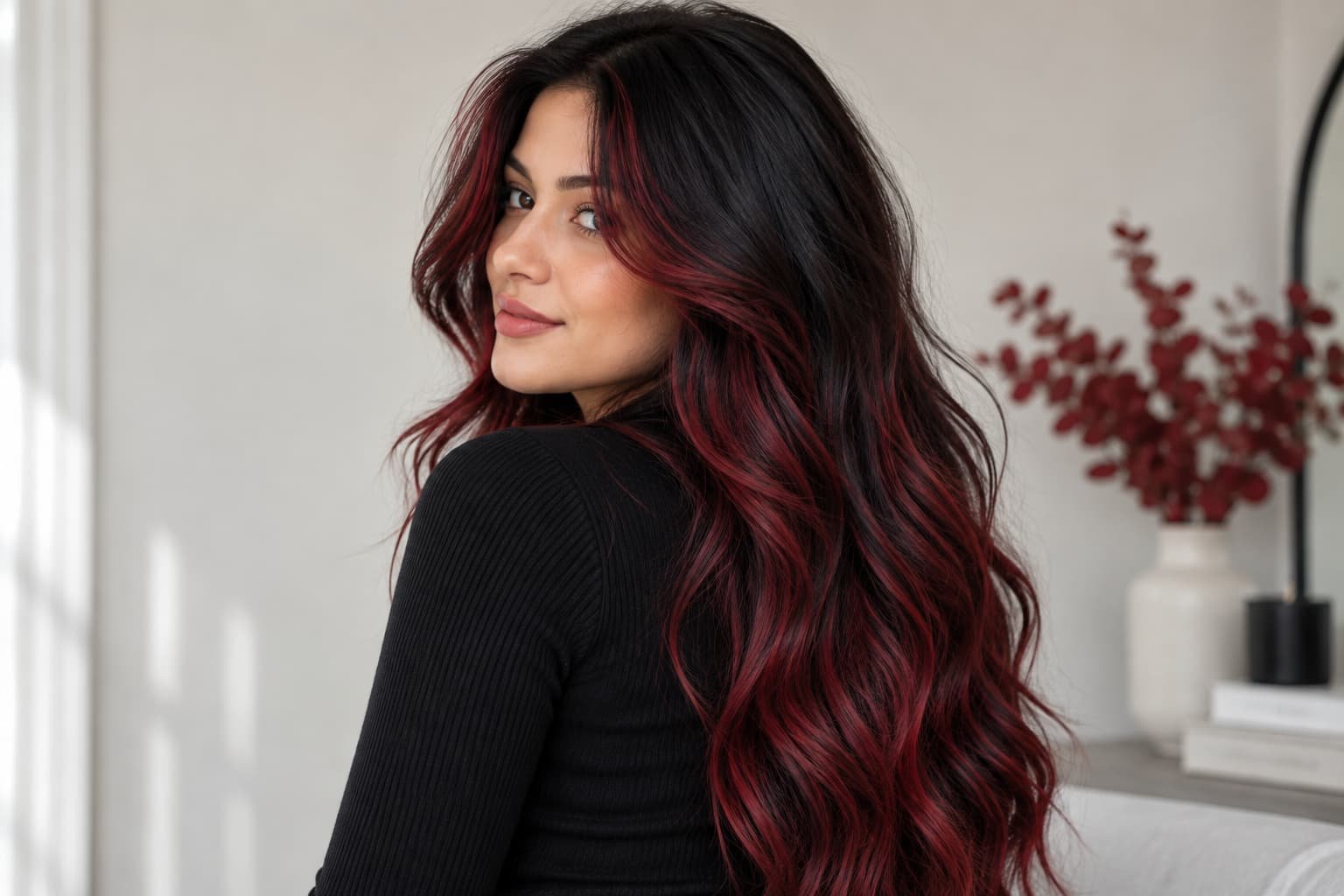
Black and red hair combines dark hair with selected red sections. The result can range from a subtle accent to a clearly defined two-tone look depending on the red shade, colour placement, and amount of contrast.
Deep shades such as burgundy, wine red, or dark cherry can sit closer to black visually. Brighter reds such as cherry, crimson, or vivid red can create a stronger contrast.
There are several ways to combine the two colours. Red may appear as highlights, balayage, ombre, an underlayer, peekaboo sections, face-framing pieces, coloured ends, or larger colour blocks. Each placement gives the hairstyle a different visual effect.
What Does Black and Red Hair Look Like?
Black and red hair usually uses black as the main base or as one of two dominant colours. Red is then placed through selected areas to add visible contrast.
The amount of red can vary considerably. Narrow sections may appear as small flashes of colour, while wider panels can make red a major part of the hairstyle.
Hair texture can also change how the placement is seen. Straight hair may show the separation between colours more clearly, while waves and curls can make black and red sections appear at different points throughout the hairstyle.
How Contrast Changes the Overall Appearance
The difference between the black base and the chosen red shade has a strong effect on the overall look.
Deep reds can create a more restrained colour combination because both shades remain relatively dark. Burgundy, wine red, and dark cherry are possible options when someone wants the black base to stay visually dominant.
Brighter reds usually create more obvious separation from black. This effect can become stronger when the red is used in wider sections or placed prominently around the front of the hair.
Placement also changes the contrast. Fine highlights can distribute red more softly, while thick streaks, panels, or split colour create clearer boundaries between the two shades.
Choosing Between Deep Red and Brighter Red Tones
The choice between deep and bright red mainly depends on how noticeable the colour contrast should be.
Burgundy and wine-red shades can add visible red tones while keeping the overall palette dark. Dark cherry can provide a richer red appearance without creating the same level of contrast as a vivid shade.
Crimson, ruby, cherry red, and other brighter reds can stand out more clearly against black. They may be especially noticeable when used around the face, through the ends, or in larger colour sections.
Lighting, starting hair colour, texture, and placement can all affect how the shades appear. A red that looks very dark in one setting may appear more noticeable in brighter light.
Black and Red Hair Colour Ideas by Placement
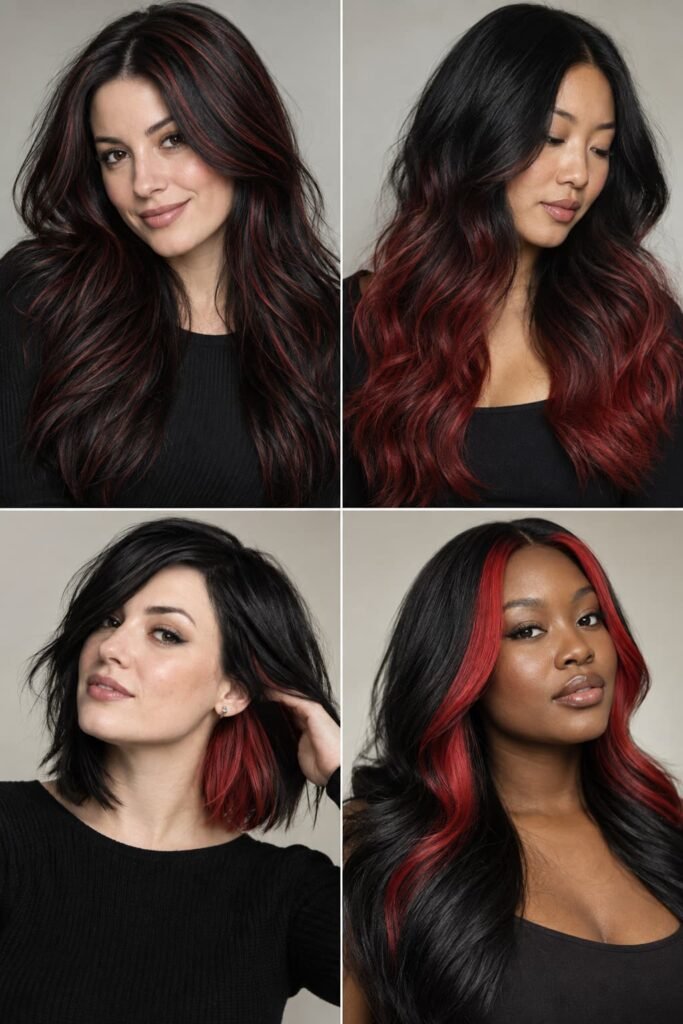
Placement determines where the eye notices the red and how much black remains visible.
Someone looking for a smaller colour accent may prefer fine highlights or hidden sections. Wider panels, split colour, or brighter face-framing pieces can create a more defined two-tone appearance.
Black Hair With Red Highlights
Red highlights place smaller sections of colour throughout a black base.
Fine highlights may create subtle flashes of red between darker strands. Wider or chunky highlights make the red easier to see and create more separation between the colours.
Highlights can also be concentrated in specific areas. Front sections make the colour more noticeable around the face, while highlights through the mid-lengths and ends spread the red across more of the hairstyle.
On layered hair, coloured sections may appear at several levels because shorter pieces reveal different parts of the overall placement.
Black and Red Balayage
Black and red balayage places red through selected sections rather than applying it evenly from the roots downward.
The black base can remain more visible near the top, while red becomes more noticeable through parts of the mid-lengths and ends.
Deep red balayage may create a softer transition against black. Brighter red can create a more visible contrast while still keeping the placement less uniform than traditional full-length sections.
Waves can reveal different coloured pieces as the hair bends, while straight styling may make the direction of the colour placement easier to see.
Black and Red Ombre Hair
Black and red ombre changes from a darker upper section into red toward the lower lengths.
The transition may begin closer to the ends when someone wants black to remain dominant, or higher through the lengths when more red is wanted.
Deep burgundy can create a lower-contrast transition, while bright red can produce a clearer difference between the upper and lower parts of the hair.
This placement differs visually from highlights because the colour change follows the length of the hair rather than appearing as separate narrow sections throughout it.
Black Hair With a Red Underlayer
A red underlayer places colour beneath darker outer sections of hair.
When the hair is worn down, the black upper layer may cover some of the red. The colour can become more visible when the hair moves or when the upper sections are lifted.
The amount of red can also vary. A narrow underneath section creates a smaller accent, while a larger coloured layer can make the two-tone effect more noticeable.
Half-up styles, ponytails, braids, and buns may reveal more of an underlayer because they move the darker surface sections away from it.
Black and Red Peekaboo Hair
Peekaboo colour uses selected hidden sections of red beneath black hair.
These sections may sit near the sides, behind the ears, underneath the back, or between layers. Only part of the colour may be visible when the hair is worn naturally.
Movement and styling can expose different pieces, which makes peekaboo placement useful for someone who prefers red to appear selectively rather than remain equally visible from every angle.
The colour itself can be subtle or bright. The main feature is where it is placed.
Black Hair With Red Face-Framing Pieces
Face-framing colour places red near the front hairline and beside the face.
Because these sections remain highly visible from the front, a relatively small amount of red can still create noticeable contrast.
Thin sections can provide a smaller accent, while wider pieces create a stronger colour feature. Deep red may keep the contrast more restrained, while brighter red can create a clearer separation from the black base.
The front colour can also connect with additional highlights or balayage through the lengths for a more continuous pattern.
Black Hair With Red Ends
Red ends keep most of the roots and lengths black while concentrating colour near the tips.
A small coloured area creates a limited accent, while extending the red farther upward makes it a larger part of the hairstyle.
Dark red may blend more gradually with the black lengths. Bright red can create a sharper visual difference.
On layered hair, the red may appear at several heights because the ends do not all fall at the same level.
Half Black and Half Red Hair
Half black and half red hair divides the hairstyle into two large colour areas.
One option is a centre division with one side black and the other red. Another is an uneven split where one shade covers more hair than the other.
This approach creates stronger separation than highlights or peekaboo colour because both shades remain major parts of the overall look.
Straight hair may show the division more clearly. Waves and curls can allow strands from the two sides to overlap, which can make the boundary appear less rigid.
Black Hair With Red Colour-Block Sections
Colour blocking uses larger, defined sections of red within black hair.
Instead of blending through many fine pieces, the red remains concentrated in visible panels. These sections may appear near the front, through the sides, underneath certain layers, or in another selected part of the haircut.
A single red panel can act as a focused accent. Several panels can give red a larger role in the overall colour design.
Layered and shorter cuts may show these sections at different heights, while longer hair provides more space for extended blocks of colour.
Which Red Shades Can Be Combined With Black Hair?
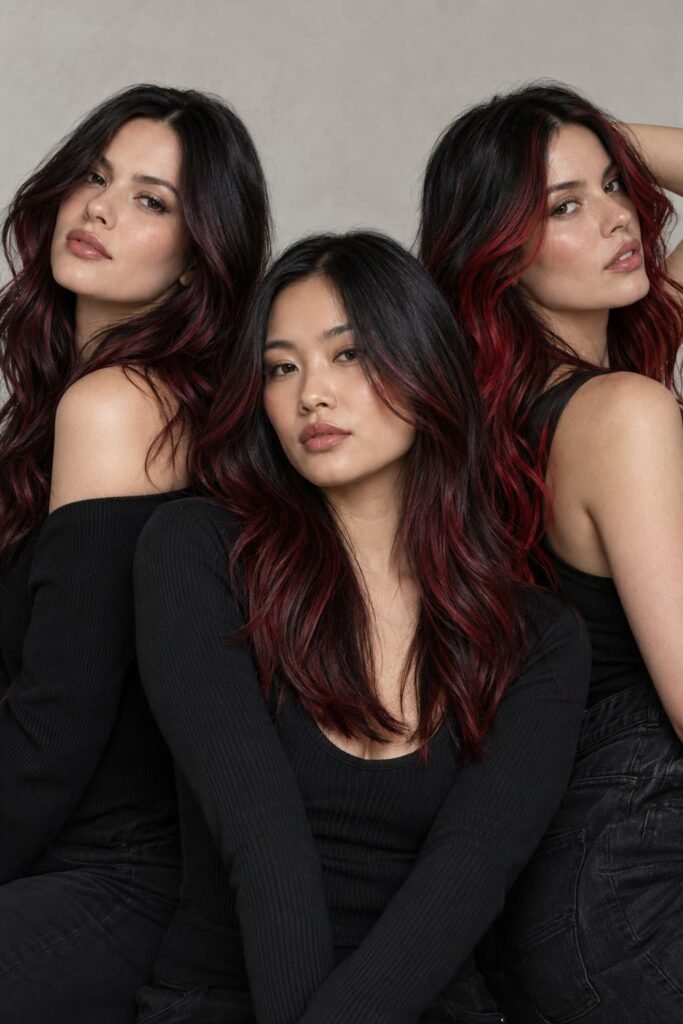
Different red shades can create different levels of contrast against black hair. Deeper reds tend to keep the overall colour palette darker, while brighter reds create a clearer visual separation.
The choice is mainly a style preference. Someone who wants a softer contrast may prefer a deeper red, while someone who wants the red to stand out more may choose a brighter shade.
Burgundy and Black Hair
Burgundy is a deep red shade that often includes wine or violet undertones. When paired with black hair, it can create a rich, dark colour combination.
It can be used in highlights, balayage, underlayers, or larger sections. Someone who wants the black base to remain dominant may prefer smaller burgundy accents rather than wide colour panels.
Cherry Red and Black Hair
Cherry red can appear brighter and more noticeable against black hair than deeper red shades.
It may be used in highlights, face-framing pieces, underlayers, or coloured ends. A darker cherry tone can create a more restrained look, while a brighter version can produce stronger contrast.
Wine Red and Black Hair
Wine red is a deep, muted red that can sit visually close to black.
This shade may appeal to someone who wants visible red tones without using a highly vivid colour. It can be added through fine highlights, balayage, or hidden sections underneath the hair.
Crimson and Black Hair
Crimson is a stronger red shade that can create noticeable contrast with a black base.
Narrow crimson streaks may work as small accents, while wider panels or face-framing sections can make the red a larger part of the hairstyle.
How bold it appears depends on the amount of red used, the placement, and the surrounding black sections.
Vivid Red and Black Hair
Vivid red creates a high-contrast look when placed next to black hair.
It may be used in split colour, chunky highlights, face-framing sections, an underlayer, or colour-blocked panels.
Someone looking for a clearly defined two-tone appearance may prefer this type of red. Those wanting a quieter effect may prefer darker shades such as burgundy or wine red.
Black and Red Hair Ideas for Different Hair Lengths
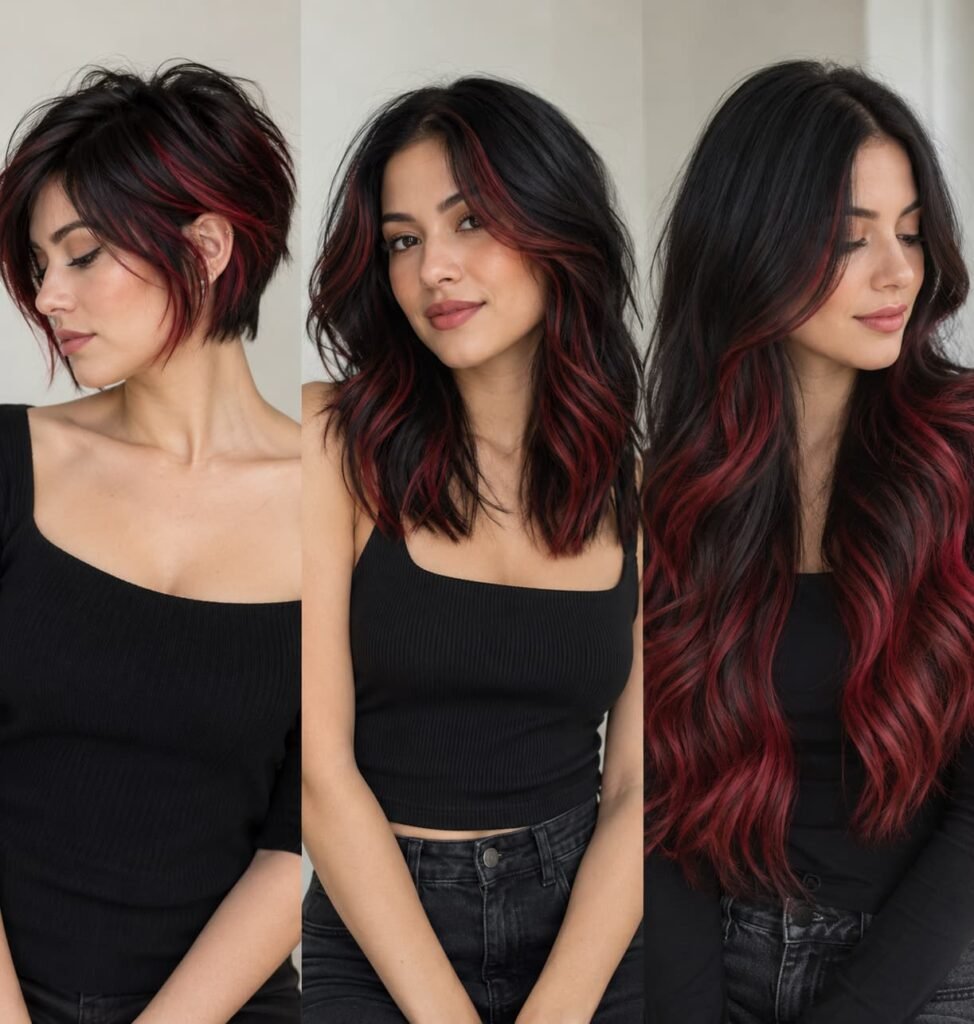
Hair length changes the amount of space available for colour placement and transitions.
Short hair may show individual colour sections more directly. Medium-length hair allows several placement options without requiring a long transition. Long hair provides more room for ombre, balayage, extended highlights, and larger colour sections.
The final appearance can still vary depending on the haircut, layers, texture, and where the red is placed.
Short Black and Red Hair
Short hair can work with focused areas of red rather than long colour transitions.
A pixie cut may feature red through longer top sections while keeping shorter areas black. A bob can include red face-framing pieces, chunky highlights, an underlayer, or coloured ends.
Colour-blocked sections are another option when a more defined contrast is wanted.
On layered short cuts, red placed between or underneath layers may appear in different areas as the hair moves.
Medium-Length Black and Red Hair
Medium-length hair offers enough space for both small accents and more visible colour sections.
Red highlights can be distributed through the length, while balayage can place more colour through selected mid-lengths and ends.
A shoulder-length cut or lob may also be paired with red face-framing pieces, peekaboo sections, an underlayer, or red ends.
Layers can change where the colour becomes visible because shorter pieces may expose sections underneath longer hair.
Long Black and Red Hair
Long hair provides more space for gradual colour changes and extended placement.
A black base can transition into red through ombre, while balayage can introduce selected red sections through the mid-lengths and ends.
Long hair can also combine more than one placement idea. For example, face-framing red sections can be paired with additional colour through the lower lengths.
Braids, ponytails, half-up styles, waves, and curls can change which coloured sections are visible because the hair is rearranged in different ways.
The overall look may range from mostly black with a few red accents to a more balanced two-colour design, depending on how much red is used and where it is placed.
How Hair Texture Changes the Look of Black and Red Colour
Hair texture can change how black and red sections appear across the hairstyle.
Straight hair often shows colour placement in more continuous lines. Wavy and curly textures can break those lines into smaller visible areas because the strands bend, twist, and overlap.
The final appearance can vary with the haircut, colour placement, and the way the hair is styled.
Black and Red Colour on Straight Hair
Straight hair can make colour sections easier to follow from root to end.
Highlights may appear as cleaner vertical pieces, while ombre can show a more obvious transition from darker roots into red through the lower lengths. Larger colour-block sections can also look more defined when the hair lies smoothly.
This may suit someone who wants the placement itself to be a clear part of the overall look.
Black and Red Colour on Wavy Hair
Wavy hair can make black and red sections appear more mixed through the lengths.
As the hair bends, different parts of the colour may become visible at different points. This can work well with balayage, highlights, underlayers, and red ends.
Loose waves may also reveal colour that sits beneath darker outer sections, especially when the red is placed in hidden or lower layers.
Black and Red Colour on Curly Hair
Curly hair can show black and red in separate sections throughout the curl pattern.
A red highlight may appear across part of one curl and disappear behind another. Underlayers and peekaboo sections can also become visible in different areas depending on how the curls fall.
The effect can vary with curl pattern, length, layers, and the amount of red used.
Black and Red Hair With Layers and Bangs
Layers and bangs can influence where red appears and how easily it is seen.
Shorter layers may expose colour placed underneath longer sections, while bangs can bring black and red placement closer to the front of the hairstyle.
How Layers Can Reveal Different Colour Sections
Layers create several lengths within the haircut, which can make colour appear at different heights.
Red placed beneath black hair may become visible around shorter layers, especially as the hair moves. Highlights can also appear more scattered instead of following one continuous length.
Smaller red sections can create a more blended appearance, while wider panels may produce stronger separation between the two colours.
Black and Red Hair With Curtain Bangs
Curtain bangs can be paired with black and red in several ways.
One option is to keep the fringe mostly black and place red through the longer face-framing pieces. Another is to add narrow red sections through the bangs so they connect with colour along the sides.
Because curtain bangs separate around the face, the amount of visible red can change depending on the parting and styling.
Black and Red Hair With Full or Wispy Bangs
Full bangs create a wider front section for colour placement.
They may remain black while red appears through the rest of the hair, or selected red pieces can be added through the fringe for a stronger two-tone effect.
Wispy bangs are more separated, so small red sections may appear as individual accents rather than one solid block. The overall look can vary with fringe density, length, and placement.
How Can You Style Black and Red Hair?
Styling can change which parts of the colour pattern are most visible.
Some styles make the separation between black and red clearer, while others mix the colours together through movement, twisting, or overlapping sections.
Straight Styles for Clear Colour Placement
Straight styling can make highlights, colour blocks, and split sections easier to see.
Ombre may show a clearer transition through the lengths, while face-framing pieces can appear more defined against the darker base.
This is one possible option when the goal is to make the colour placement easy to identify.
Waves and Curls for More Visible Dimension
Waves and curls can separate black and red sections as the hair bends.
Highlights and balayage may appear at several points through the hairstyle instead of following straight lines. Red sections placed underneath may also become more noticeable as the hair moves.
The final effect can vary depending on texture, curl size, and where the colour is placed.
Braids and Half-Up Styles for Underlayers and Peekaboo Colour
Braids can combine black and red strands within the same style, which may create an alternating colour pattern.
Half-up styles can lift darker outer sections and reveal red underneath. This can be especially useful when the colour is placed as an underlayer or peekaboo section.
The amount of visible red depends on the original placement and how much hair is pulled back.
Ponytails and Buns for Showing Hidden Red Sections
Ponytails can expose colour placed near the nape or underneath longer black sections.
Buns can bring several coloured pieces together as the hair is twisted, which may reveal red sections that are less visible when the hair is worn down.
Depending on the placement, these styles may show a few small red accents or much larger areas of colour.
Subtle vs Bold Black and Red Hair
Black and red hair can look soft or high-contrast depending on the shade of red, the size of the coloured sections, and where the colour is placed.
A softer version usually keeps black as the dominant shade and uses smaller or deeper red accents. A bolder version may use brighter red, wider sections, or a stronger division between the two colours.
Ideas for a Softer Black and Red Look
For a more understated look, deeper shades such as burgundy, wine red, or dark cherry are possible options.
Fine highlights, a narrow underlayer, small peekaboo sections, or red through the lower ends can add colour without making it the main focus.
Red can also be placed away from the most visible front sections. Colour underneath the hair or through selected lower layers may appear more gradually as the hair moves.
Ideas for Stronger Colour Contrast
Brighter reds and larger sections can create a more noticeable difference against black hair.
Chunky highlights, vivid face-framing pieces, split colour, red ends, or larger colour-blocked panels are options for a more defined two-tone look.
Placement also affects visibility. Red around the face or through broad outer sections is usually easier to see than colour hidden beneath darker layers.
What Should You Consider Before Choosing Black and Red Hair?
Before choosing a black and red combination, it can help to think about the starting hair colour, how much red you want to show, and whether you prefer blended or clearly separated colour placement.
It is also useful to consider how much colour upkeep you are comfortable with, especially when choosing brighter red tones.
Your Starting Hair Colour
Starting hair colour can affect how a red shade appears.
On very dark hair, deeper red tones may look more restrained, while creating a noticeably brighter red result can involve a different colouring process.
The final appearance can vary depending on the starting shade, previous colour, the red tone chosen, and the type of colour product used.
How Much Red You Want to Show
Decide whether black or red should be the main colour.
If you want black to remain dominant, smaller highlights, peekaboo pieces, an underlayer, or red ends may be suitable options.
If you want the red to play a larger role, wider panels, face-framing sections, ombre, or split colour can make it more visible.
Placement and Contrast
Placement affects where the red appears most clearly.
Face-framing colour is more visible from the front, while underlayers and hidden sections may show mainly when the hair moves or is restyled.
Fine highlights can create a more blended effect. Wider panels, chunky sections, and split colour create stronger separation between black and red.
The red shade matters too. A dark red may sit closer to black visually, while a brighter red can create clearer contrast.
Colour Maintenance and Fading
Red hair colour can lose vibrancy over time, so the appearance may gradually change between colour applications.
How quickly this happens can vary with the colour product, washing habits, styling routine, sun exposure, and other factors.
There is no single maintenance schedule that applies to every person or every product. Care directions provided with the specific colour product should be followed rather than relying on a fixed timetable.
Hair Dye Safety and Product Instructions
Hair dye products should be used according to the directions and warnings provided by the manufacturer.
Preparation, application, processing time, and safety instructions can differ between products, so these details should not be guessed or transferred from one product to another.
Any test or precaution specifically required in the product instructions should be followed as directed.
For this type of inspiration article, it is more useful to focus on colour choice and placement than on chemical formulas or technical colouring procedures.
Frequently Asked Questions
Can Red Highlights Show Clearly on Black Hair?
Red highlights can be visible on black hair, but the final result can vary with the starting colour, the shade of red, the width of the highlights, and the colouring method.
Deeper reds may create a softer contrast, while brighter reds can appear more noticeable. Wider sections may also stand out more clearly than very fine highlights.
What Is the Difference Between Black and Red Balayage and Ombre?
Balayage and ombre differ mainly in how the colour is placed.
With balayage, red is usually added through selected sections of the mid-lengths and ends. This can create a more scattered or blended effect.
Ombre creates a more gradual change along the length, with black remaining stronger near the roots and red becoming more visible toward the ends.
What Is Black Hair With Red Underneath Called?
Black hair with red underneath may be described as a red underlayer, hidden colour, or peekaboo colour.
An underlayer usually covers a broader section beneath the darker hair. Peekaboo colour is often placed in smaller hidden sections that become visible when the hair moves or is styled differently.
The exact term can vary depending on the placement.
Which Red Shades Create a More Subtle Look With Black Hair?
Deeper shades such as burgundy, wine red, and dark cherry may create a softer visual contrast with black.
Colour placement matters too. Fine highlights, a narrow underlayer, or small hidden sections can keep black as the dominant shade while adding visible red accents.
Someone wanting stronger contrast may prefer a brighter red or wider colour sections instead.
How Does Black and Red Hair Look on Curly Hair?
On curly hair, black and red sections can appear at different points throughout the curl pattern.
Highlights may be visible across individual curls, while underlayers and hidden sections may appear as the curls move and overlap.
The final effect can vary with curl pattern, length, layers, and colour placement.
Can Black and Red Hair Work on Short Hair?
Black and red colour can be used on short hair in several ways.
A bob may include red face-framing pieces, an underlayer, chunky highlights, or coloured ends. A pixie cut may use red through longer top sections while keeping other areas black.
Shorter hair provides less space for long colour transitions, so concentrated sections or colour blocking may be easier to see.
Does Red Hair Colour Fade?
Red hair colour can lose vibrancy over time.
The rate and way the colour changes can vary depending on the product used, washing habits, styling routine, sun exposure, and other factors.
There is no single fading pattern or maintenance schedule that applies to every person or every type of red colour.
How Can Red Be Placed Around the Face Without Colouring All the Hair?
Face-framing pieces are one option for adding red near the front while leaving most of the hair black.
Thin sections can create a smaller accent, while wider pieces can produce stronger contrast.
Another option is to place red only through the longer sections around the face rather than colouring the full head.
Final Thoughts on Black and Red Hair Colour Ideas
Black and red hair can be adapted in many ways, from small red accents to a clearly divided two-tone look.
Highlights, balayage, ombre, underlayers, peekaboo sections, face-framing pieces, red ends, and colour blocks all change where the red appears and how noticeable it becomes.
The shade of red also affects the overall appearance. Deeper tones can keep the colour palette darker, while brighter reds can create stronger contrast against black.
Hair length, texture, layers, bangs, and styling can further change how the colour is displayed.
A useful starting point is to decide how much red you want to show and whether you prefer a softer blend or a more defined contrast. From there, the shade and placement can be chosen to match the look you have in mind.