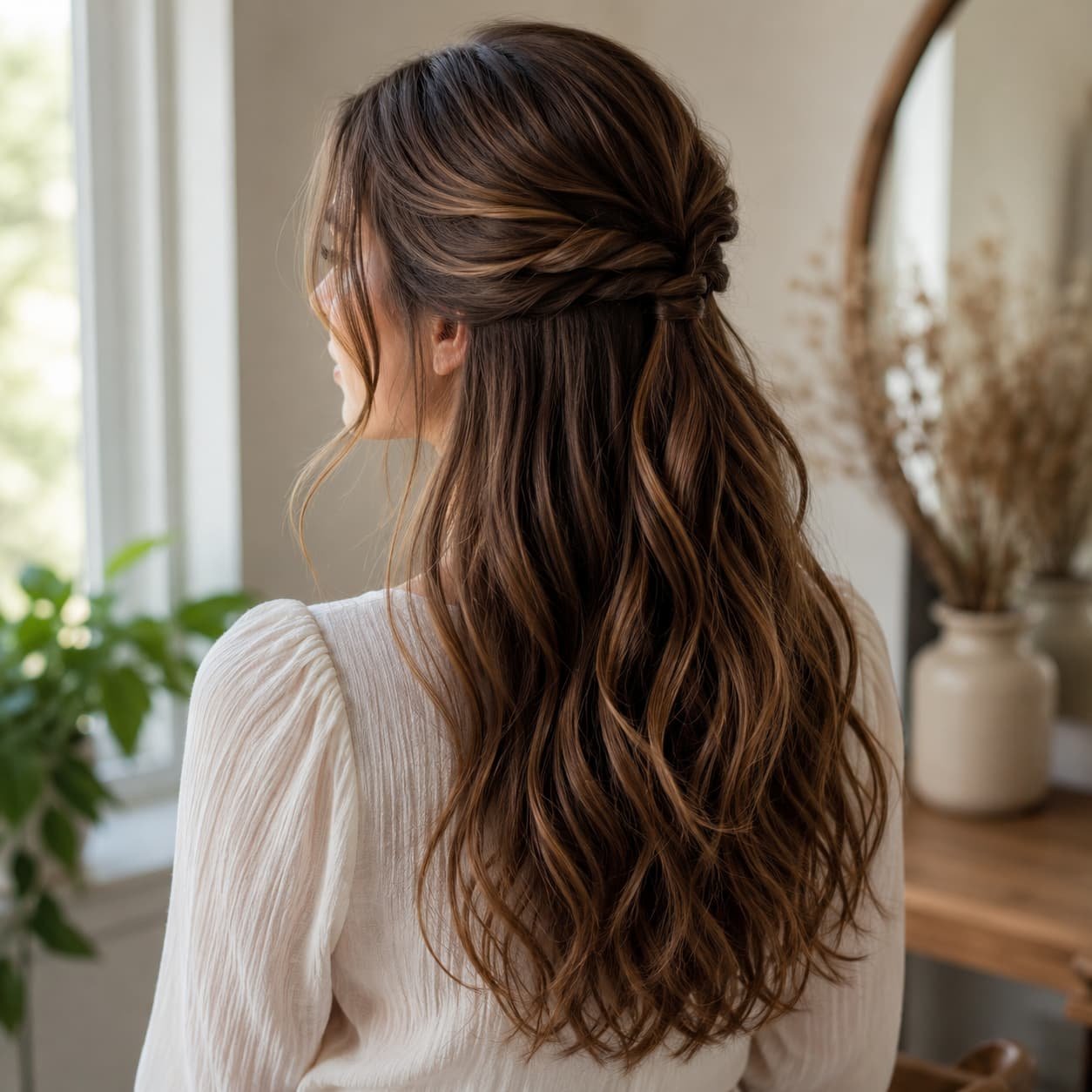
Half up half down hairstyles combine a secured upper section with loose lengths below. Part of the hair is gathered at the crown or sides, while the remaining hair stays down.
The upper section can be styled into a ponytail, bun, braid, twist, or clipped arrangement. The loose hair may remain straight, wavy, curly, coily, or naturally textured. Hair length, density, layering, and placement can all influence the final appearance.
What Is a Half Up Half Down Hairstyle?
A half up half down hairstyle is created by securing part of the hair while leaving the rest loose.
The gathered section commonly comes from the crown, temples, or upper sides of the head. It can be tied into a ponytail, braided, twisted, clipped, or shaped into a small bun.
The name does not mean that exactly half of the hair must be secured. Some versions use a small crown section, while others gather more hair from the sides and top.
Because the amount of hair gathered and the securing method can vary, half-up hairstyles can range from simple to more detailed.
Main Types of Half Up Half Down Hairstyles
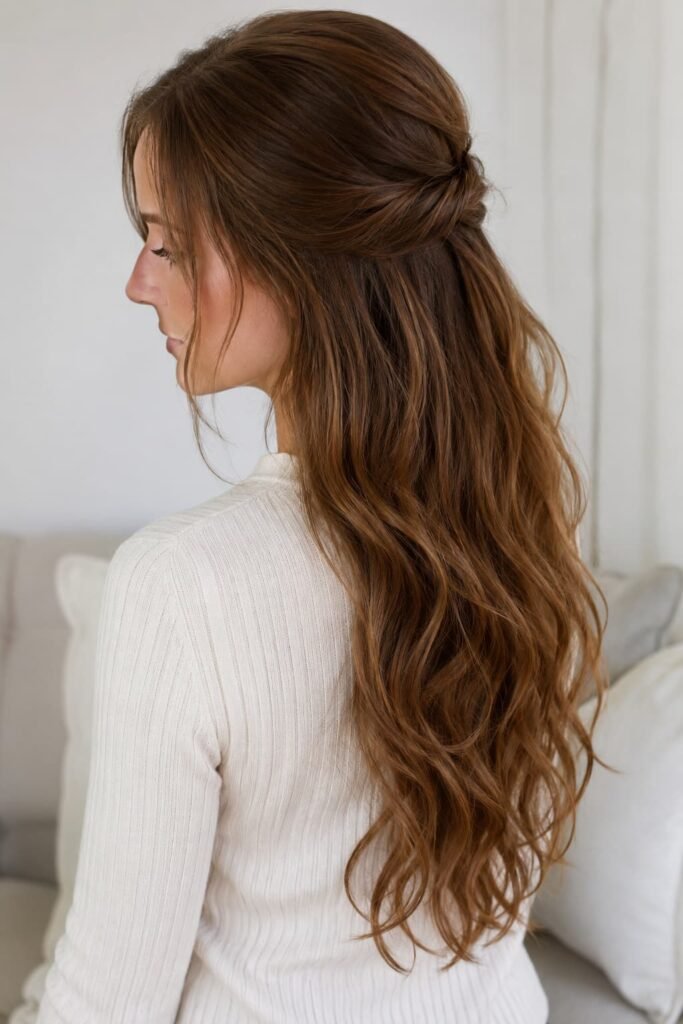
The main variations differ in how the upper section is gathered, positioned, and secured.
Classic Half Up Half Down Style
A classic half-up style gathers sections from both sides of the head and secures them toward the back.
The upper section can be kept smooth or slightly relaxed, while the remaining hair stays loose. This basic arrangement can also serve as the foundation for braids, twists, clips, and other variations.
Straight hair may create a more defined outline, while waves or curls can add visible texture and movement. The final look can vary depending on hair density, layers, texture, and placement.
Half Up Ponytail
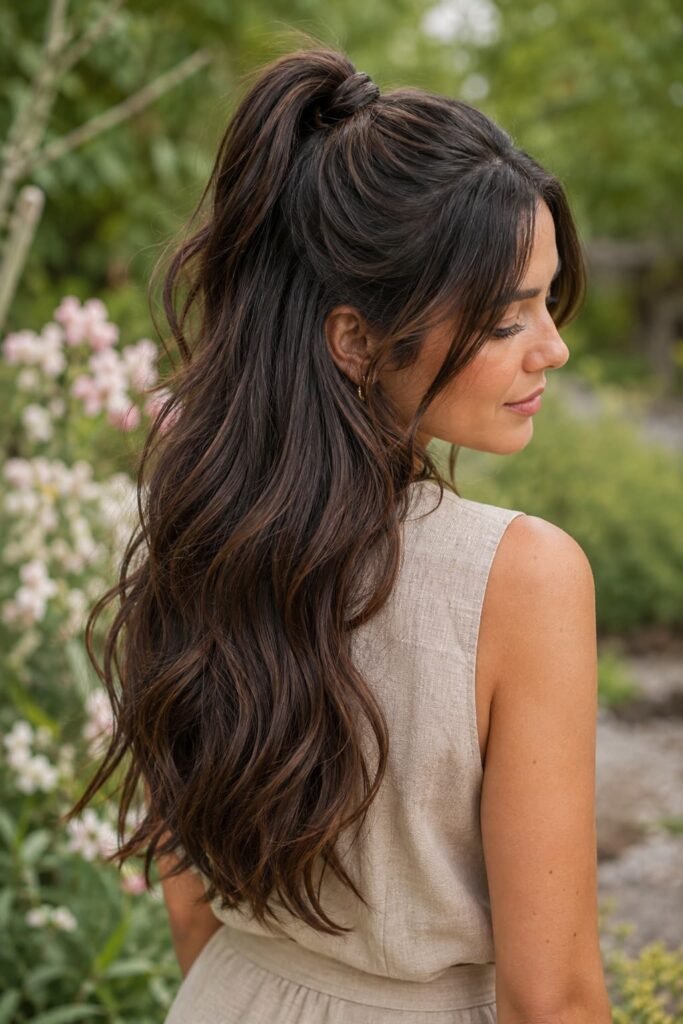
A half up ponytail gathers the upper portion of the hair into a ponytail while leaving the lower section loose.
The ponytail can sit higher near the crown or lower toward the back of the head. A higher position creates a more noticeable separation between the secured and loose sections, while a lower placement can create a softer transition.
The ponytail can remain straight or follow the natural or styled texture of the rest of the hair. Another possible detail is wrapping a small section of hair around the elastic to conceal it.
The amount of hair gathered can also be adjusted depending on the desired shape.
Half Up Bun
A half up bun uses the gathered upper section to form a small bun while the remaining hair stays loose.
The bun can sit near the crown or farther toward the back of the head. A compact bun creates a more defined shape, while a loosely arranged bun may show more texture.
The size of the bun can vary depending on hair length, density, and how much hair is included in the upper section.
This variation can be worn with straight, wavy, curly, or coily textures, although the finished shape will differ from one hair type to another.
Braided Half Up Half Down Hairstyle
A braided half up half down hairstyle incorporates one or more braids into the secured upper section.
Two side braids can meet at the back, a single braid can become the central detail, or smaller accent braids can be added around the crown or sides.
Braid width and placement affect how noticeable the detail becomes. Narrow braids may provide a subtle accent, while wider braids can become a stronger visual feature.
The loose section can remain in its existing texture or be styled separately.
Twisted Half Up Half Down Hairstyle
A twisted half-up style uses sections of hair that are rolled or twisted toward the back instead of braided.
Sections from the sides can be secured with pins, an elastic, or a decorative clip. The twists can be kept more defined or gently loosened depending on the preferred finish.
This is one possible alternative for someone who wants added detail without using a braid.
Twists can be paired with straight lengths, waves, curls, or a small ponytail.
Half Up Half Down Claw Clip Style
A claw clip can secure the upper section without forming a traditional ponytail or bun.
The hair may be gathered directly into the clip or twisted before being secured. Clip size should generally correspond to the amount of hair being held.
Because the clip remains visible, it also becomes part of the hairstyle’s overall appearance.
Placement can change the silhouette. A higher clip may create more visible height around the crown, while a lower position can produce a flatter, more relaxed shape.
Half Up Half Down Hairstyles by Hair Length
Hair length affects how much hair can be gathered and how much loose length remains visible.
Short, medium, and long hair can all support some form of half-up styling when enough hair reaches the intended securing point. Layers also influence the result because shorter pieces may remain loose around the face or sides.
Half Up Half Down Hairstyles for Short Hair
Some short haircuts can be styled half up when there is enough length around the crown and sides.
Bobs, longer short cuts, and other styles with usable crown length may allow a mini ponytail, small bun, twist, braid, barrette, or claw clip.
Using a smaller upper section can be a practical option when the shorter pieces do not reach the back.
Possible ideas include:
- Mini half ponytail
- Small top knot
- Side twists
- Narrow braids
- Small claw clip
- Decorative barrette
Shorter layers or face-framing pieces may remain loose rather than being incorporated into the secured section. The exact result depends on the haircut, layer placement, texture, and available length.
Half Up Half Down Hairstyles for Medium Hair
Medium-length hair can accommodate a wide range of half-up variations.
Possible options include:
- Half ponytails
- Mini buns
- Braided sections
- Side twists
- Claw clips
- Barrettes
- Bows or ribbons
Shoulder-length and collarbone-length hair may show a clear contrast between the gathered upper section and the loose hair below.
If the haircut includes layers, shorter pieces may remain around the face while longer sections are secured at the back. Some people may prefer to leave these pieces loose, while others may use pins or clips to incorporate more of the front section.
Both higher and lower placement are possible when the available length allows the hair to reach the chosen securing point.
Half Up Half Down Hairstyles for Long Hair
Long hair provides additional length for braids, ponytails, twists, buns, and other detailed half-up arrangements.
Possible variations include:
- High half ponytails
- Low half ponytails
- Half-up buns
- Crown-inspired braids
- Side braids
- Twisted sections
- Bubble-style ponytails
- Bows and ribbons
- Decorative clips or pins
Longer braids, twists, and ponytails may be more visible because they extend farther from the secured section.
Layers can also change how the loose lengths fall. Short face-framing layers may remain outside the upper section, while longer layers may be easier to gather.
Waves or curls can make the movement between layers more noticeable, while straight hair may show the shape and length more clearly. The final appearance can vary according to the haircut, texture, density, and styling method.
A simple half-up ponytail is also an option when a more minimal style is preferred.
How Hair Texture Changes the Look
Hair texture can influence the shape, movement, and overall appearance of a half-up hairstyle. Straight, wavy, curly, and coily hair can all be styled this way, but the result can vary depending on length, density, layering, and how much hair is gathered.
Straight Half Up Half Down Hair
Straight hair can create a more defined outline in a half-up style.
The upper section may be secured in a ponytail, bun, braid, twist, or clip while the loose lengths remain straight below. This can make the separation between the gathered and loose sections easier to see.
A simple half ponytail is one option for keeping the overall look minimal. Braids, twists, or decorative clips can add more detail if preferred.
Layers may also remain visible through the loose section, although the effect depends on the haircut and how the hair falls.
Wavy Half Up Half Down Hair
Wavy hair can add visible movement through the loose section of a half-up hairstyle.
A ponytail, bun, braid, twist, or clip can be used to secure the upper portion while the waves remain visible below.
Some people may prefer a more relaxed upper section that blends with the waves, while others may choose a smoother and more defined crown.
The final appearance can vary depending on wave pattern, density, length, and placement.
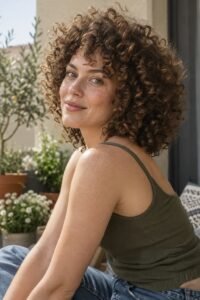
Curly Half Up Half Down Hair
Curly hair can create a textured half-up shape while keeping the curl pattern visible through the loose lengths.
The upper section may be gathered into a ponytail, bun, braid, twist, puff, or clip.
Using a smaller upper section leaves more curls loose below, while gathering a larger section changes the balance between the secured and loose portions.
The final shape can vary according to curl pattern, hair length, density, and section size.
Coily Half Up Half Down Hair
Coily hair can also be arranged in a half-up style while keeping much of the natural texture visible.
The upper section may be styled into a puff, ponytail, bun, braids, twists, or a clipped arrangement. The lower portion can remain loose or continue an existing braided or twisted style.
Changing the amount of hair gathered can alter how defined the division between the upper and lower sections appears.
The final look can vary depending on coil pattern, density, length, haircut, and sectioning.
Half Up Half Down Hairstyles With Bangs and Face-Framing Pieces
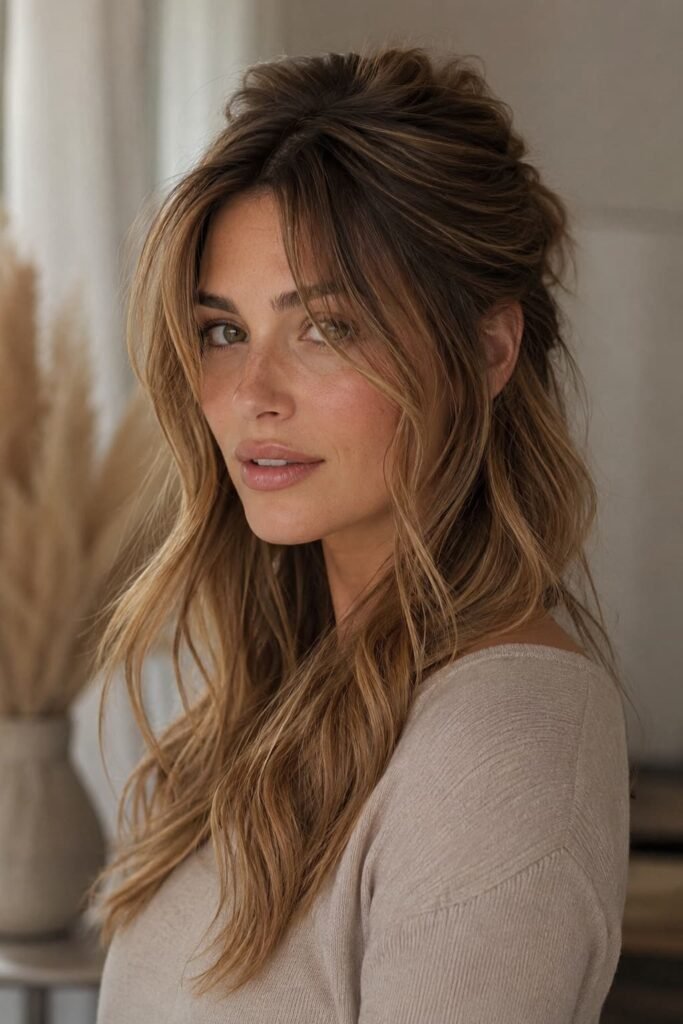
Bangs and shorter front sections do not always need to be included in the gathered part of the hairstyle.
They can remain loose while hair from the crown and sides is secured at the back. This is one way to keep visible detail around the front while maintaining the half-up structure.
How these sections fall depends on their length, the haircut, texture, and personal styling preference.
With Curtain Bangs
Curtain bangs can remain loose while the upper section of the hair is secured behind them.
Because curtain bangs generally separate around the center or slightly off-center, they can remain visible on both sides of the face.
They can be paired with a half ponytail, bun, braid, twist, or clip.
Longer curtain bangs may blend into surrounding face-framing layers, while shorter sections can remain more distinct.
With Wispy or Full Bangs
Wispy or full bangs can stay at the front while hair from the crown and sides is gathered.
This keeps the fringe visually separate from the secured section.
A half ponytail, mini bun, braid, or clip can all be combined with bangs. The final balance can vary depending on fringe length, density, texture, and how much surrounding hair is pulled back.
Some people may prefer to leave additional side pieces loose, while others may choose a more defined separation between the fringe and the rest of the hairstyle.
With Loose Face-Framing Layers
Face-framing layers can remain outside the secured section.
Depending on the haircut, these pieces may fall around the cheekbones, jawline, shoulders, or farther down the length.
They may remain straight, wavy, curly, or coily depending on the existing texture and styling choice.
Leaving shorter layers loose is also a practical option when they do not comfortably reach the securing point.
High vs. Low Half Up Half Down Placement
The position of the secured section can change the overall silhouette of a half-up hairstyle.
A high half-up style is secured closer to the crown. This makes the ponytail, bun, braid, or clip more visible toward the upper part of the head and can create the appearance of additional height.
A low half-up style is secured farther toward the back of the head. This can create a more gradual transition between the gathered section and the loose lengths.
Some people may prefer higher placement when they want the secured section to stand out more. Others may prefer a lower position for a softer or less prominent effect.
Neither placement is universally better. Hair length, layers, density, texture, and the desired appearance can all influence the choice.
Half Up Half Down Hairstyles With Braids, Twists, and Accessories
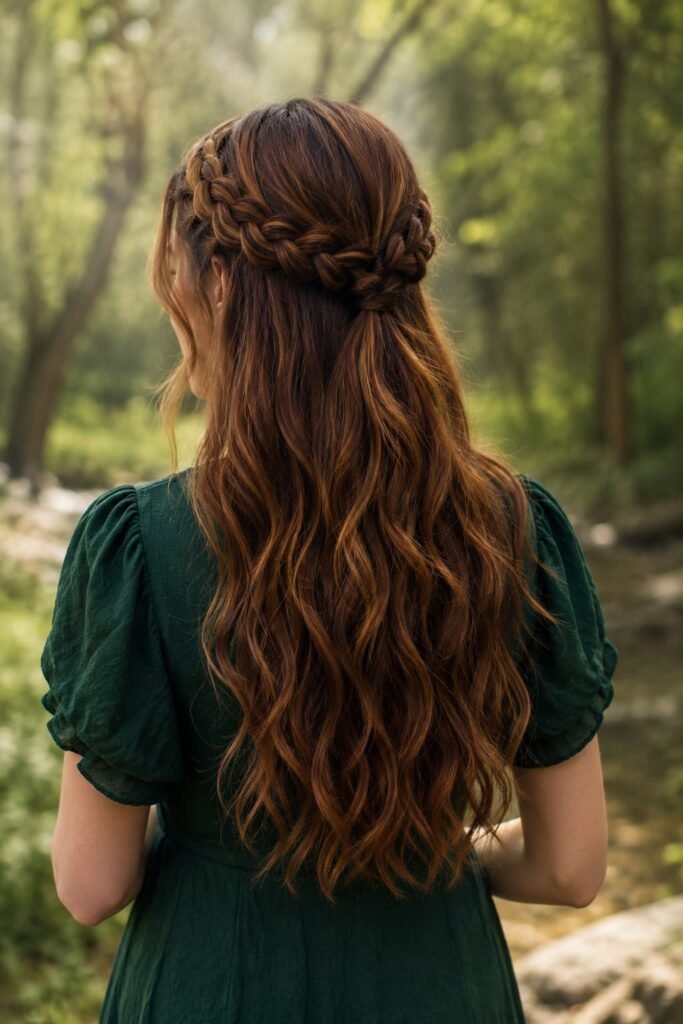
Braids, twists, and accessories can add detail to a half-up hairstyle without changing its basic structure.
These elements may be subtle or more noticeable depending on their size, placement, and how much hair is involved.
Crown and Side Braids
Braids can be placed around the crown, along the sides, or where the upper sections meet at the back.
Two side braids may be joined behind the head, while a wider braid can create a more prominent crown-inspired detail.
Smaller accent braids are another option when a more understated effect is preferred.
Braid type, width, placement, hair length, and texture can all influence how visible the detail appears.
Rope or Side Twists
Twists provide another way to add structure without using a braid.
Sections from the sides can be twisted toward the back and secured with pins, an elastic, a barrette, or a clip.
A tighter rope twist may appear more defined, while a looser twist can create a softer shape.
Twists can be combined with straight, wavy, curly, or coily hair, and the final appearance can vary with texture and section size.
Bows, Barrettes, and Decorative Clips
Accessories can serve both a practical and decorative role in a half-up hairstyle.
A bow or ribbon may be added around a ponytail, a barrette can hold side sections together, and decorative clips can be placed around braids, twists, or the crown.
Smaller accessories may provide a subtle accent, while larger pieces can become a more noticeable part of the hairstyle.
The accessory also needs to be suitable for the amount of hair being secured. Hair density, section size, and the accessory’s holding capacity can affect whether it works comfortably for a particular style.
What to Consider Before Choosing a Half Up Half Down Style
A half-up hairstyle can be adjusted in many ways, so the most suitable version depends on the hair itself and the appearance you want to create.
Hair length, layering, density, texture, placement, and the way the upper section is secured can all affect the finished look.
Hair Length and Layering
Hair length determines how much of the upper section can comfortably reach the point where it will be secured.
Longer hair usually provides more options for ponytails, buns, braids, and twists. Medium-length hair can also support many variations, while shorter hair may work better with smaller gathered sections, mini buns, clips, or side twists.
Layers can influence which pieces stay in the hairstyle. Short face-framing layers may remain loose, while longer layers may be easier to gather into the upper section.
If several shorter pieces fall out naturally, leaving them loose can be one styling option rather than trying to pull every section back.
Hair Density and Texture
Hair density and texture can affect the size and shape of the gathered section.
A larger section of dense hair may create a fuller ponytail or bun, while a smaller section can produce a lighter appearance. With finer or lower-density hair, gathering less hair may help keep more of the loose section visible.
Straight, wavy, curly, and coily textures can also change how braids, twists, buns, and ponytails appear.
There is no single version that works the same way for every texture or density. The final look can vary depending on how the hair naturally falls and how much is included in the upper section.
Securing Method and Placement
The upper section can be secured with an elastic, pins, a claw clip, barrette, ribbon, or another suitable hair accessory.
The choice depends partly on the style being created and the amount of hair that needs to be held.
Placement also changes the silhouette. A higher ponytail, bun, or clip can make the upper section more noticeable, while lower placement can create a softer transition into the loose hair.
The securing point should also work with the available length. Short layers may not comfortably reach a position that works well for longer hair.
Desired Finish
Consider whether you want the hairstyle to look sleek, soft, textured, simple, or more detailed.
A smooth half ponytail can create a cleaner outline. Loose twists or braids can add more visible texture, while a bun or decorative accessory can make the upper section a stronger focal point.
The loose lengths also influence the finish. Straight hair can create a more defined shape, while waves, curls, and coils can add more visible movement and texture.
There is no single correct finish. The choice can depend on the haircut, natural texture, occasion, and personal preference.
Frequently Asked Questions
Can short hair be styled half up half down?
Yes, some short haircuts can be styled half up half down if there is enough length around the crown or sides to secure part of the hair.
A bob or longer short cut may work with a mini ponytail, small bun, side twists, braid, barrette, or claw clip. Very short layers may remain loose if they do not reach the securing point.
Can half up half down hairstyles be worn without curls?
Yes. Curls are not required.
The loose section can remain straight, wavy, curly, coily, or naturally textured. A straight version may have a more defined outline, while textured hair can create a different shape and movement.
Can bangs stay loose in a half up half down hairstyle?
Yes. Bangs can remain separate while the crown and side sections are secured.
Curtain bangs, wispy bangs, full bangs, and longer face-framing pieces can all stay loose depending on the haircut and preferred appearance.
What is the difference between a half-up ponytail and a half-up bun?
A half-up ponytail gathers the upper section into a ponytail and leaves that section hanging loose.
A half-up bun uses the same general section of hair but wraps or shapes it into a bun instead.
Both styles leave the lower portion of the hair down, but the shape of the secured section is different.
Can layered hair be styled half up half down?
Yes. Layered hair can be used for many half-up styles.
Longer layers may be gathered into the secured section, while shorter face-framing or crown layers may remain loose.
How much of the hair can be pulled back depends on the layer placement, overall length, texture, and where the hairstyle is secured.