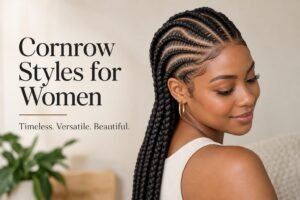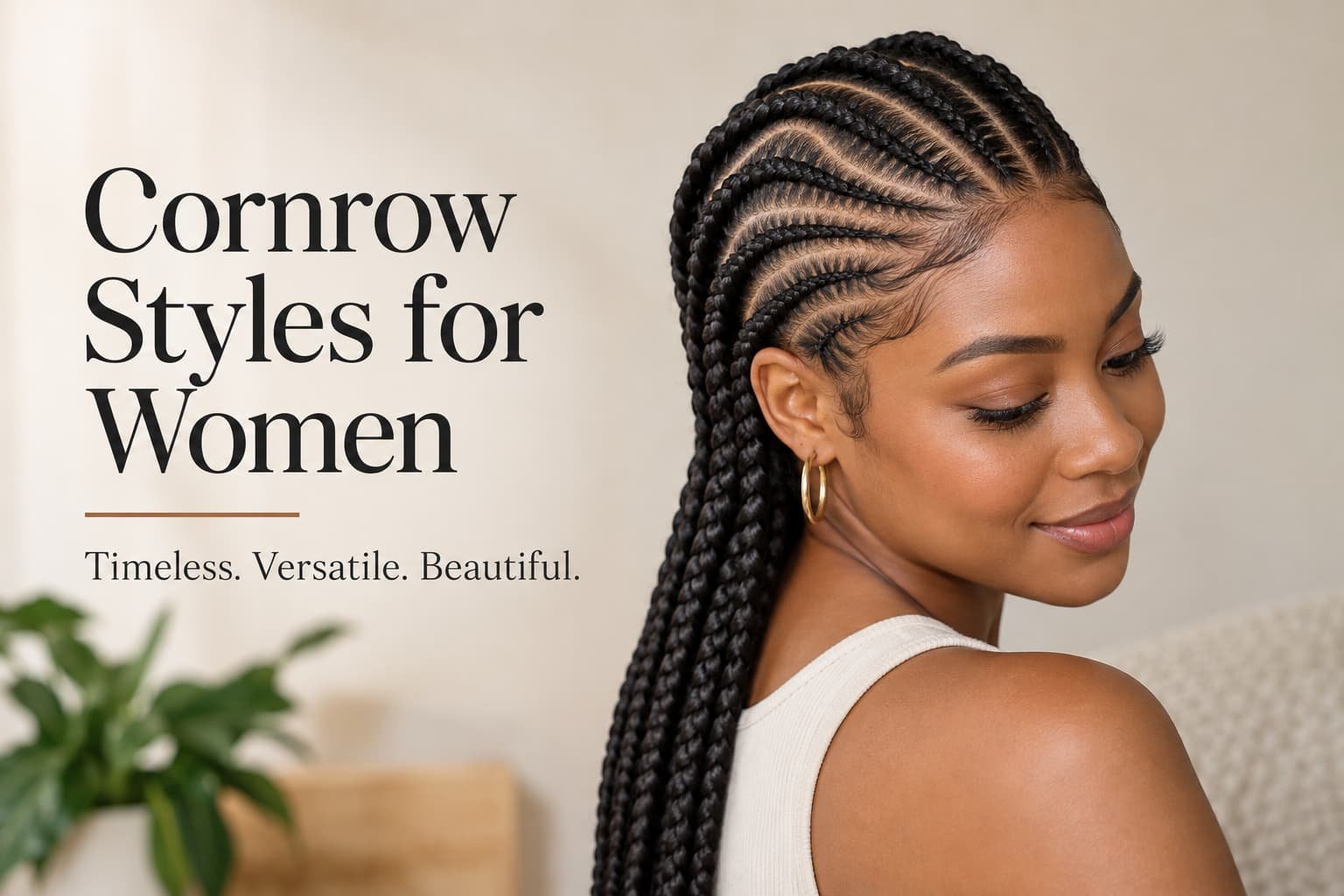
Cornrow hairstyles for women can range from simple straight-back braids to curved, side-swept, and geometric designs. Although the basic braiding structure is similar, changes in braid size, direction, parting, length, and added hair can give each style a noticeably different appearance.
Some designs place more visual emphasis on the pattern across the scalp, while others continue into longer hanging braids. Understanding these differences can make it easier to compare cornrow styles based on the pattern, length, and finish you prefer.
What Are Cornrow Hairstyles?
Cornrows are braids created close to the scalp in rows or shaped sections. As the braid follows its planned path, additional hair from the section is incorporated into it rather than forming a completely loose braid from the starting point.
Cornrows can follow straight, diagonal, curved, or more structured paths. The spaces and parting lines between the braids therefore become an important part of the overall design.
Braid direction can also change the finished appearance. Rows may travel toward the back, angle toward one side, curve around sections of the head, or follow a more decorative arrangement.
What Changes the Look of Cornrow Hairstyles?
Several design choices can make two cornrow hairstyles look noticeably different even when both use braids placed close to the scalp. Braid width, parting, direction, finished length, and the use of added braiding hair can all influence the overall shape and visual effect.
Braid Size
Small cornrows create narrower lines and allow more individual rows to fit within the hairstyle. This can make detailed parting or curved patterns more noticeable.
Medium cornrows create a visual balance between finer detail and more prominent braid definition. They can work with simple or more decorative layouts depending on how the sections are arranged.
Large cornrows use wider sections and generally result in fewer individual rows. This can create a bolder, simpler-looking pattern where each braid has a stronger visual presence.
Braid width does not have to remain the same throughout the hairstyle. Different sizes can be combined when a more varied pattern is preferred.
Parting and Braid Direction
Parting determines how the hair is divided before each row is braided. Straight sections can create a more regular appearance, while angled or curved parts can introduce more movement into the design.
Cornrows may follow several directions, including:
- straight from the front toward the back
- diagonally across the scalp
- toward one side
- along curved paths
- through structured geometric sections
Braid direction can also affect the visual balance of the hairstyle. A layout organized around the center may appear more symmetrical, while rows directed toward one side can create a more asymmetrical effect.
Geometric parting may use triangular, diamond-shaped, angled, or other clearly defined sections. The final appearance can vary according to braid width, placement, and the number of sections used.
Length and Added Braiding Hair
Cornrows can be created using natural hair alone or with additional braiding hair.
Without added length, the finished braid length depends largely on the available natural hair. In shorter styles, this can place more visual attention on the scalp pattern and direction of the rows.
Added braiding hair can change the visible length, fullness, or color of the finished hairstyle. The scalp-braided section may continue into longer braids that fall around the shoulders or farther down the back.Readers who want to explore added length or color can compare pre-stretched braiding hair in different lengths and shades on Amazon.
Length and pattern complexity are separate design choices. A shorter hairstyle can use detailed parting and curved rows, while a much longer style may use a relatively simple straight-back arrangement.
What Are the Main Cornrow Styles for Women?
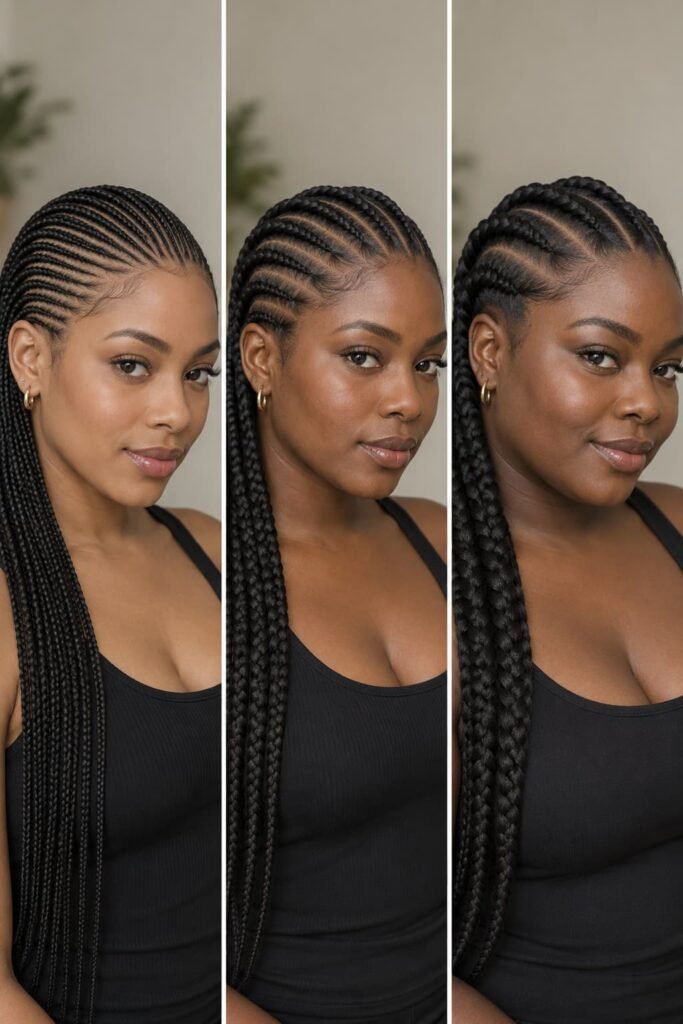
Cornrow styles can be distinguished by the path of the braids, the shape of the parting, and the way different rows are combined. Instead of treating every small variation as a separate hairstyle, it is more useful to compare the main design approaches.
Straight-Back Cornrows
Straight-back cornrows begin toward the front of the head and follow a generally backward direction.
This arrangement keeps the braid paths easy to see and places much of the visual emphasis on spacing, braid width, and the number of rows.
A smaller number of wider braids can create a bolder, more open-looking pattern. Using more narrow rows can produce a finer and more detailed appearance.
The braid widths do not need to be identical. Narrow accent braids can also be placed between wider rows while maintaining the same overall backward direction.
Side-Swept Cornrows
Side-swept cornrows direct the pattern toward one side rather than keeping every row centered or moving straight backward.
The braids may begin around the front hairline and travel diagonally across the scalp, or they may gradually curve toward one side.
This can create an asymmetrical arrangement in which more of the visual direction is concentrated on one side of the hairstyle.
The effect may be subtle with gently angled rows or more noticeable when most of the braids follow the same sideward direction.
Curved Cornrows
Curved cornrows follow rounded or flowing paths instead of remaining completely straight.
Some designs use gentle curves that follow the shape of the head, while others use more pronounced sweeping lines. Several curved rows can also be arranged beside one another to create a repeated pattern.
Because the braid direction changes along the scalp, the shape of the rows can become a major visual feature.
Curved and straight sections may also be combined within the same hairstyle. For example, a braid may begin along a curved path before continuing toward the back.
Geometric Cornrow Patterns
Geometric cornrow designs use structured parting to create angular or clearly defined sections.
Possible visual elements include:
- triangular sections
- diamond-shaped parts
- angled lines
- intersecting-looking layouts
- repeated structured shapes
In these styles, the visible parting can be as important to the overall appearance as the braids themselves. Clear separation between rows helps define the shapes.
A geometric pattern does not need to contain many different elements. Repeating one angled or structured section can create a distinctive design without making the layout overly complicated.
Center-Part Cornrows
Center-part cornrows use a visible middle division as the main organizing feature of the hairstyle.
Rows on either side may move straight back, angle outward, or curve away from the center. This can create a more symmetrical-looking arrangement when the two sides follow similar patterns.
A center part can be combined with small, medium, or larger cornrows. The width of the braids remains a separate design choice.
Some people may prefer this layout when they want the central division and balanced placement to be more noticeable.
Mixed-Size Cornrows
Mixed-size cornrows combine different braid widths within one hairstyle.
One possible approach is to place narrow accent braids between thicker main rows. Another is to use wider cornrows in one area and finer rows in another.
The contrast between braid widths can make individual sections stand out without requiring complicated parting or added accessories.
Different braid sizes can also change how much of the parting pattern remains visible. Narrow rows may add finer visual detail, while wider braids can create stronger, more prominent lines.
The finished effect depends on how the different widths are arranged within the overall pattern.
How Do Small, Medium, and Large Cornrows Differ?
Cornrow size changes how much detail is visible in the overall pattern. Smaller braids create finer lines and allow more rows within the hairstyle, while larger braids create broader, more noticeable sections.
These size descriptions are general rather than exact measurements. The finished look can vary depending on sectioning, braid placement, hair density, and whether additional braiding hair is used.
Small Cornrows
Small cornrows are created with narrower sections, which allows more individual rows to be included in the design.
This can make curved lines, detailed parting, and closely spaced patterns more noticeable. Narrow cornrows can also be used between wider braids as accent rows.
In a straight-back style, smaller braids usually create a finer-looking pattern than a design made with only a few wide rows.
Medium Cornrows
Medium cornrows fall between very narrow rows and larger, more prominent braids.
They can show the braid direction clearly while still leaving room for curved, diagonal, or structured parting. This makes them one possible option for both simple and more detailed layouts.
Medium cornrows can also continue into hanging braids or be directed into gathered styles such as ponytails.
Large Cornrows
Large cornrows use wider sections, so the hairstyle generally contains fewer individual rows.
The thicker braids create stronger visual lines and can make the direction of the pattern easier to notice. A few wide straight-back cornrows, for example, create a simpler-looking arrangement than many narrow rows.
Larger braids can also be combined with smaller accent cornrows when more contrast is preferred.
How Does Length Change the Appearance of Cornrows?
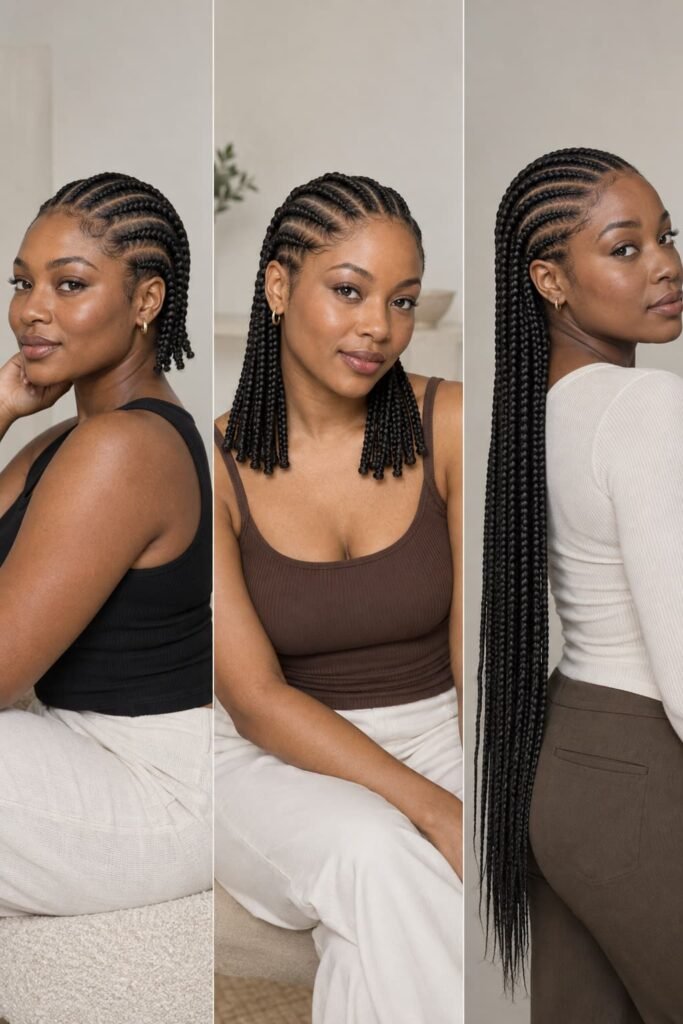
Length mainly changes the silhouette beyond the scalp-braided section. Cornrows can remain relatively short or continue into longer hanging braids.
The complexity of the scalp pattern does not depend on the finished length. Short cornrows can use detailed parting, while long styles can begin with simple straight rows.
Short Cornrows
Short cornrows keep much of the visual attention on the pattern across the scalp.
When the braided ends remain relatively short, details such as braid direction, spacing, curves, and parting may become more noticeable.
Straight, diagonal, curved, and mixed patterns can all be used with shorter lengths. The finished result can vary depending on the available natural hair and whether extra braiding hair is added.
Shoulder-Length Cornrows
Shoulder-length cornrows create a silhouette between compact styles and much longer braids.
The scalp pattern remains an important feature, but the hanging lengths also become a visible part of the overall design.
Depending on the braid placement, the ends may fall around the shoulders in a relatively even line or create a slightly varied shape. Additional braiding hair can be used when more length or visible fullness is wanted.
Long Cornrows
Long cornrows continue from the scalp into extended hanging braids.
This creates a more elongated silhouette and makes the lower braided lengths a stronger part of the overall look. The braids may fall down the back, over the shoulders, or be gathered into another style.
Additional braiding hair can be incorporated when a longer finished length is desired. The final appearance can vary with braid width, placement, and the amount of added hair.
What Are Feed-In Cornrows?
Feed-in cornrows use a braiding technique in which additional hair is incorporated gradually as the braid continues.
Rather than adding the full amount of extra hair at the beginning, smaller portions are introduced along the braid. This can create a gradual change from a narrower starting point to a fuller braid farther along the row.
Feed-in describes the technique rather than one specific design. It can be used with straight-back, curved, diagonal, and other cornrow patterns.
The finished thickness and length can vary depending on how much additional hair is incorporated and how the braid is arranged.
What Are Stitch Cornrows?
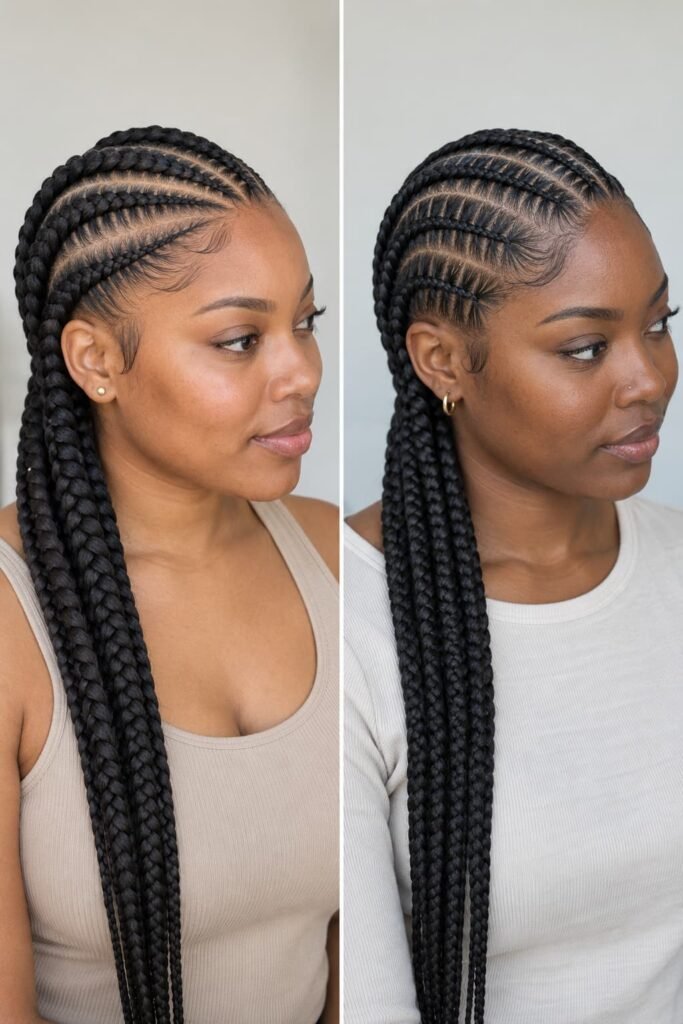
Stitch cornrows have a clearly divided, structured appearance created by separating small sections of hair along the braid path.
These divisions form repeated lines beside or within the cornrow, giving the hairstyle its distinctive segmented look.
Stitch cornrows can be arranged in different widths and directions. Straight-back designs emphasize repeated sections running toward the back, while curved or angled versions combine the stitch effect with a more shaped pattern.
Some stitch styles also use gradually added braiding hair, but the most noticeable visual feature is the repeated sectioning along the cornrow.
Can Cornrows Transition Into Other Styles?
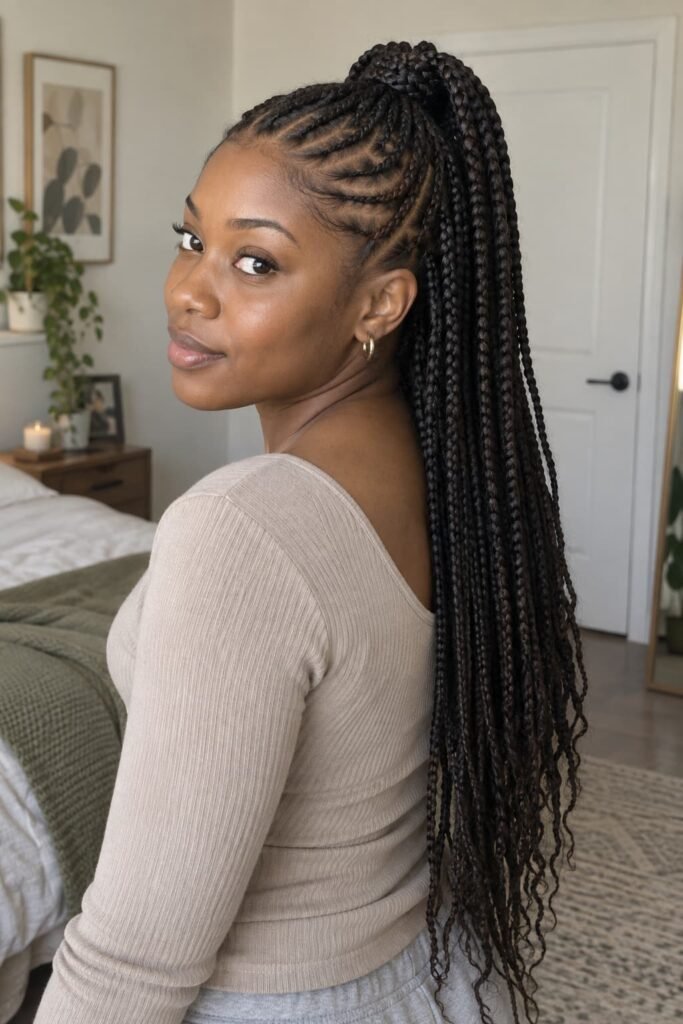
Cornrows do not have to remain attached to the scalp for the entire visible length. They can transition into hanging braids, curled ends, ponytails, or partially gathered arrangements.
These combinations keep the structured cornrow pattern near the scalp while changing the shape and movement of the lower lengths.
Cornrows With Loose Braids
Cornrows can continue into individual braids once the scalp-braided section ends.
This creates a visual contrast between the structured pattern near the scalp and the freely hanging lengths below.
The transition point can vary depending on the design. The hanging braids may remain similar in width to the cornrows or take on a slightly different proportion.
Cornrows With Curly Ends
Cornrows can transition into braided lengths that finish with curls.
The defined lines near the scalp contrast with the softer shape and movement of the curled ends. Some designs use curls only near the tips, while others leave a larger portion of the lower length curly.
The final effect can vary depending on the curl pattern, braid length, and amount of loose hair used.
Cornrow Ponytails
A cornrow ponytail directs several braids toward a shared gathering point.
The rows may travel upward toward the crown, straight toward the back, or toward a lower position before the remaining lengths form the ponytail.
Placement changes the overall silhouette. A higher gathering point can create more height, while a lower ponytail keeps the braided lengths closer to the back of the head.
Half-Up Cornrow Styles
Half-up cornrow styles combine gathered braids with sections that remain hanging.
Cornrows around the front or upper part of the head may lead into a ponytail or another gathered section, while the remaining braids fall freely below.
This creates a clear contrast between the more structured upper section and the hanging lengths.
Cornrows can also be arranged into buns. Because that topic overlaps with a separate updo category, readers looking specifically for those variations can see the guide to braided bun hairstyles for Black hair.
How Can Color and Accessories Change the Look?
Color and accessories can change which parts of a cornrow style attract the most attention. The underlying braid pattern can stay the same while color, beads, or cuffs add contrast and decorative detail.
Colored Braiding Hair
Added braiding hair can introduce color throughout the style or only in selected sections.
Using one shade creates a more consistent color effect. Contrasting shades can make individual braids or sections more noticeable, while blended colors can create a gradual transition through the hanging lengths.
Color can also be limited to a few accent braids. This is one possible option when the braid pattern is intended to remain the main visual feature.
The final effect depends on where the color is placed, how much is used, and the length of the braids.
Beads and Hair Cuffs
Beads and hair cuffs can add decorative detail without changing the basic cornrow structure.
Beads may be placed toward the ends of hanging braids or used on selected sections. A few beads create small points of detail, while using them across several braids makes them a more noticeable part of the style.Decorative hair beads for braids are available in different shapes, finishes, and colors for adding detail to selected braid ends.
Hair cuffs can be positioned along individual braids to highlight particular rows or sections. They may be used sparingly or repeated throughout the design.
Accessories do not need to appear on every braid. Leaving some rows undecorated can keep more attention on the underlying parting and braid pattern.
What Should You Consider Before Choosing a Cornrow Style?
The same general cornrow design can look different depending on braid size, direction, length, parting, and whether additional hair is used. It can help to decide which of these features matters most before choosing a specific look.
Consider:
- Braid size: Narrow cornrows create finer lines, while wider braids create broader, more prominent rows.
- Pattern: Straight, curved, diagonal, side-swept, and geometric layouts create different visual effects.
- Natural hair length: Without added hair, the available length influences how far the finished braids extend.
- Added braiding hair: Extra hair can change the visible length, fullness, and color.
- Finished length: Short, shoulder-length, and long braids create different silhouettes.
- Braid direction: Rows can move backward, toward one side, upward, or along curved paths.
- Visible parting: Some designs make the shapes between the braids a major part of the look.
- Comfort: A defined cornrow pattern does not require painful tightness.
- Accessories: Beads, cuffs, or color accents can add detail if they suit the intended look.
It may also help to decide whether the scalp pattern or the hanging lengths should be the stronger visual feature. Detailed parting and mixed braid sizes can place more attention on the upper design, while longer hanging braids can make the overall length more noticeable.
Reference photos are useful for inspiration, but the finished appearance can vary with hair length, density, sectioning, braid size, and added hair.
Cultural Context of Cornrow Hairstyles
Cornrows have longstanding roots in African hair traditions and have continued as an important part of Black hair culture across generations.
Historically, braided hairstyles could have social and cultural significance as well as a decorative purpose. In different African communities and historical settings, hairstyles could communicate information connected with background, community, status, or life events.
These meanings were not identical across all cultures, places, or periods. It would therefore be inaccurate to assign one universal historical meaning to every cornrow pattern seen today.
Modern cornrow styles can reflect cultural tradition, personal expression, or simply an individual’s preferred pattern, length, color, and finish.
Frequently Asked Questions
Can Cornrows Be Done Without Extensions?
Yes. Cornrows can be created using natural hair without adding extension hair.
Without added hair, the finished length depends more on the available natural hair and the way the sections are braided. Additional braiding hair is an option when more length, fullness, or color is wanted, but it is not required.
Can Cornrows Be Worn on Short Hair?
Cornrows can be created on shorter hair when there is enough length for the hair to be incorporated into the braid.
With less hanging length, the parting and scalp pattern may become a more noticeable part of the overall look. The result can vary depending on hair length, density, braid size, and pattern.
What Is the Difference Between Cornrows and Feed-In Braids?
Cornrows describe braids that follow the scalp in rows or planned paths.
Feed-in braiding describes a technique in which additional hair is introduced gradually as the braid progresses. A feed-in braid can therefore also be a cornrow.
Not every cornrow uses the feed-in technique, and cornrows can also be created without added hair.
What Is the Difference Between Cornrows and Box Braids?
Cornrows follow the scalp for part or all of their braided structure, creating rows or shaped paths.
Box braids are separate hanging braids that begin from individually divided sections rather than continuing along the scalp in rows.
Both can vary in size, length, color, and the amount of added hair, but their basic braid structures are different.
Can Different Cornrow Sizes Be Combined?
Yes. Different braid widths can be included within the same design.
For example, narrow accent cornrows can sit between wider main rows, or different areas of the hairstyle can use different braid sizes. This can add contrast without requiring a highly detailed parting pattern.
Can Cornrows Have Curly Ends?
Yes. Cornrows can continue into braided lengths that finish with curls or loose curly sections.
The curl may appear only near the ends or extend through a larger portion of the lower length. The final appearance can vary depending on the braid length, curl pattern, and amount of loose hair.
How Should You Choose Between Straight, Curved, and Geometric Cornrows?
Choose according to the type of pattern you want to emphasize.
Straight-back cornrows create clear directional lines. Curved designs create a more flowing pattern, while geometric cornrows place greater visual emphasis on angular parting and structured shapes.
None of these options is automatically better for everyone. Braid size, length, visible parting, and personal style preference can all affect which design you prefer.
Do Cornrows Need to Be Very Tight?
No. Cornrows do not need to feel painfully tight to have a defined appearance.
The braid needs enough control to hold its shape, but pain should not be treated as a necessary part of the style. If cornrows feel painful or excessively tight, the tension should be reduced.