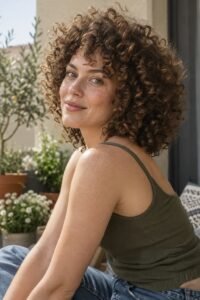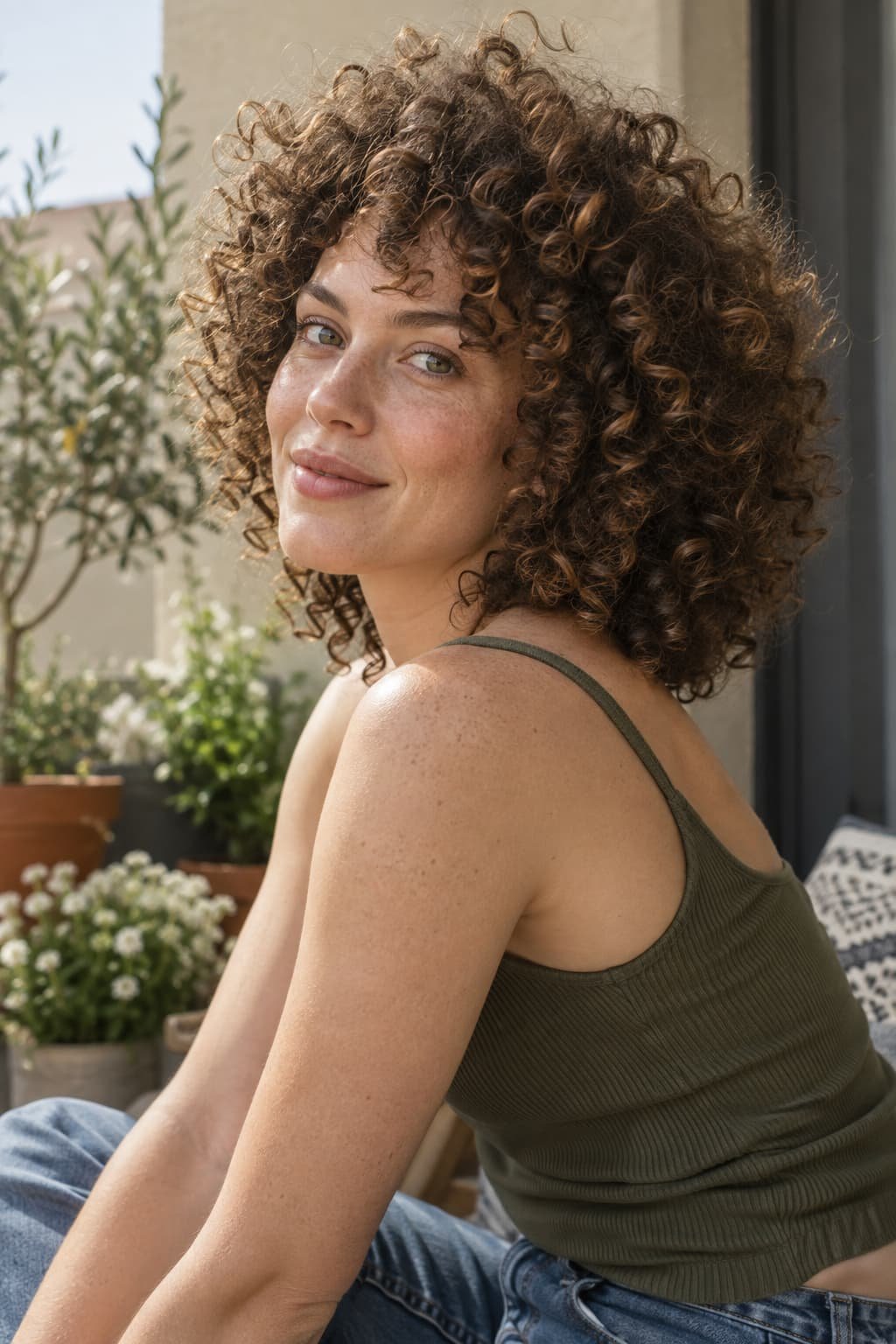
The phrase white person afro is often used online to describe a white person with naturally very curly, tightly curled, or highly voluminous hair that creates a rounded shape around the head. It is an informal description rather than an official hair category.
Hair texture can vary greatly from one person to another. Someone may have straight, wavy, curly, or tightly curled hair regardless of how they are commonly described by race. Genetics, curl pattern, hair density, length, and the way the hair is cut can all influence the final appearance.
Understanding these differences helps explain why some naturally curly hair may develop an Afro-like silhouette while other curly hair falls mainly downward.
What Does “White Person Afro” Mean?
The term white person afro generally refers to naturally curly hair on a white person when the hair has enough curl, volume, and outward shape to resemble an Afro hairstyle.
It does not describe one exact curl pattern. Two people may both have very curly hair while their hairstyles look noticeably different.
One person’s curls may form small, compact spirals that stay close together. Another person’s curls may be larger and create a softer, wider shape. Hair length and density can also change how much volume appears around the head.
For that reason, the term is mainly useful as a visual description. More specific language such as tight natural curls, voluminous curly hair, or an Afro-like rounded shape may give readers a clearer idea of what the hair actually looks like.
Why It Is a Descriptive Term, Not a Scientific Hair Type
“White person afro” is not a scientific hair classification.
Hair researchers can describe characteristics such as curliness, fiber shape, and hair morphology without placing every person’s hair into a racial category. Studies of human hair have also shown that curl patterns vary within populations as well as between them.
Genetics play an important role in natural hair shape. Research involving people of European ancestry has found strong genetic influence on whether hair appears straight, wavy, or curly.
This means a white person can naturally have pronounced curls without the hair representing a separate racial hair type.
Common curl charts may use labels such as wavy, curly, and coily, sometimes with numbered or lettered subcategories. These systems can be useful for describing appearance, but they should not be treated as a way to determine someone’s race or ancestry.
A clearer approach is to describe visible characteristics directly, such as:
- tight or loose curls
- small or large curl size
- low or high-looking volume
- rounded or downward-growing silhouette
- defined or fluffy curl appearance
These descriptions focus on the hair itself rather than making assumptions about the person.
Afro-Like Shape vs. General Curly Hair
Not all curly hair creates an Afro-like shape.
General curly hair may form spirals, ringlets, waves, or loose curls that mainly fall toward the shoulders. The overall shape may become longer as the hair grows.
An Afro-like hairstyle usually has more visible volume around the sides and crown. Instead of falling mostly downward, the hair may create a wider or more rounded outline around the head.
The difference is not simply whether the hair is curly. The overall silhouette matters.
For example, medium-length ringlets may hang downward and create a long curly shape. Tighter curls of a similar visible length may sit closer together and create more outward volume.
Haircut shape also changes the result. Even tightly curled hair can look more elongated when the length is concentrated toward the bottom. A more balanced cut around the sides and crown may create a rounder appearance.
The final look can therefore vary even between people with similar curl patterns.
Can White People Naturally Have Afro-Like Hair?
Yes. A white person can naturally have very curly or tightly curled hair that creates an Afro-like appearance.
There is no single curl pattern shared by every person within a racial group. Natural hair can vary considerably between individuals, including people with similar ancestry.
Some white people naturally have loose waves, while others have ringlets or much tighter curls. If the curls are dense and create enough outward volume, the overall hairstyle may develop a rounded silhouette.
This does not mean that all very curly hair should automatically be called an Afro. The word Afro also has an important cultural and historical connection with Black hair and identity.
When describing the appearance alone, Afro-like shape, rounded curly hair, or voluminous tight curls may sometimes be more precise.
Why Curl Pattern Can Vary Between Individuals
Natural curl pattern is influenced strongly by genetics.
Research on hair curliness has identified genetic differences associated with whether hair grows straight, wavy, or curly. Hair shape can therefore differ considerably even among people from the same broad population group.
Family members can also have visibly different textures. One person may have loose waves while another may have defined curls.
Several visible characteristics contribute to how a person’s curls look.
Curl size affects whether the hair forms broad waves, large spirals, small ringlets, or tighter curves.
Curl frequency affects how often the strand changes direction along its length.
Hair length influences whether the curls stay relatively compact or become more elongated.
Density affects how full the overall hairstyle may appear.
These characteristics can combine in many different ways. This is why describing someone’s actual curl pattern is more useful than assuming the texture from appearance, race, or ancestry alone.
Why Race Alone Does Not Define Hair Texture
Race is not a reliable system for identifying an individual’s exact hair texture.
Certain hair characteristics may occur more frequently in some populations, but that does not mean every person within that group has the same type of hair.
Research into worldwide hair variation has specifically demonstrated that human hair can be classified according to physical curl characteristics without using ethnicity as the basis of the classification.
This distinction is useful for beauty and hairstyle discussions.
Instead of saying that a particular racial group has one type of hair, it is more accurate to describe the visible features of the individual person’s hair.
A white person, for example, may have straight hair, loose waves, defined curls, or much tighter curls. The amount of volume may also vary independently from the curl pattern.
For an article about a white person afro, the most useful characteristics are therefore the curl pattern, density, length, volume, and overall silhouette rather than race alone.
What Creates an Afro-Like Shape?
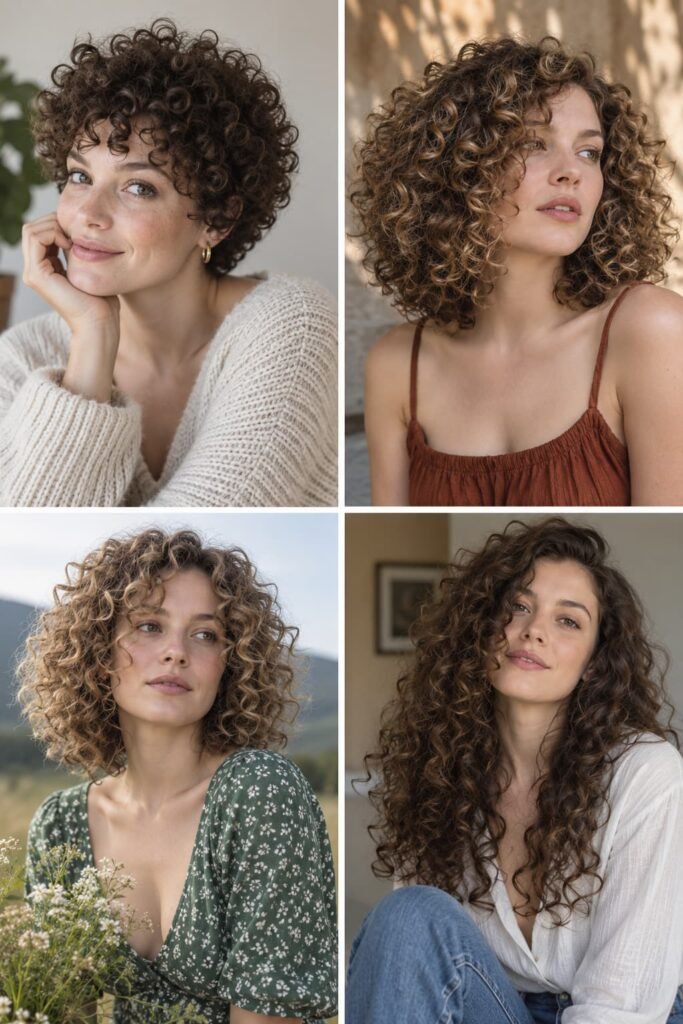
An Afro-like silhouette is usually created by several characteristics working together rather than by a single feature.
Curl tightness is important, but it does not fully determine the shape. Density, visible length, shrinkage, and haircut structure can all influence whether the hair looks rounded, elongated, compact, or wide.
Two people with similar curls may therefore have noticeably different overall hairstyles.
Curl Pattern and Curl Tightness
Curl pattern has a major effect on the way hair occupies space around the head.
Loose curls usually form larger curves or spirals. Depending on length and density, they may create noticeable volume while still falling mainly downward.
Tighter curls generally create smaller curves along each strand. Because the hair changes direction more frequently, its visible length may appear shorter than its full stretched length.
This can contribute to a more compact or outward-looking silhouette.
However, tight curls do not automatically create an Afro shape. A person’s haircut, length, density, and styling choices can still change the final appearance.
Curl definition matters as well.
Highly defined curls keep individual spirals more visible. Less separated or fluffier curls may blend together visually and create a softer, fuller outline.
Neither finish is automatically better. They simply produce different visual effects.
Hair Density and Overall Volume
Hair density refers to how much hair is growing across an area of the scalp. It is different from the thickness of an individual strand.
A person can have fine strands with relatively high density, or thicker strands with lower density.
Density can affect how full a curly hairstyle appears. When more curls are visible within the same area, the overall shape may look fuller or more compact.
Lower-density curly hair can still have significant volume, but the silhouette may appear more open or separated.
Volume also depends on factors beyond density. Curl pattern, length, haircut shape, and how closely the curls sit together can all influence the appearance.
For this reason, it is better to describe density as one part of the overall look rather than assuming it determines how large an Afro-like hairstyle will appear.
Length, Shrinkage, and the Final Silhouette
Curly hair may appear shorter in its natural state than when the strand is stretched. This visual difference is commonly referred to as shrinkage.
The amount can vary greatly depending on the curl pattern and individual hair characteristics.
Shrinkage can influence an Afro-like hairstyle because tighter curls may remain relatively compact instead of displaying their full stretched length.
Length also changes the overall silhouette.
Shorter curls may create a compact rounded shape close to the head.
Medium lengths can allow more width around the crown and sides, depending on curl pattern and density.
Longer curly hair may develop more downward movement. The hairstyle can still have considerable volume, but the overall shape may become more elongated rather than circular.
These are general appearance patterns rather than fixed rules. Two people with hair of a similar length can have very different silhouettes.
How Haircut Shape Can Change the Appearance
The way curly hair is cut can influence where volume appears.
A haircut with more balanced length around the head may create a rounded outline. A cut with longer sections toward the bottom may produce a more elongated shape.
Layers can also change the distribution of volume.
Shorter layers around the crown may allow some curls to sit higher, which can create the appearance of additional height or movement. Longer layers may preserve more length and create a different overall outline.
The effect depends on the natural curl pattern, density, length, and the placement of the layers.
A haircut does not change a person’s natural curl type, but it can change how those curls are arranged visually.
For someone considering an Afro-like curly hairstyle, the most useful starting point is the hair they naturally have. Looking at curl pattern, density, length, and preferred level of volume provides a clearer styling direction than trying to match a hairstyle based on race alone.
Common Afro-Like Styles for Naturally Curly Hair
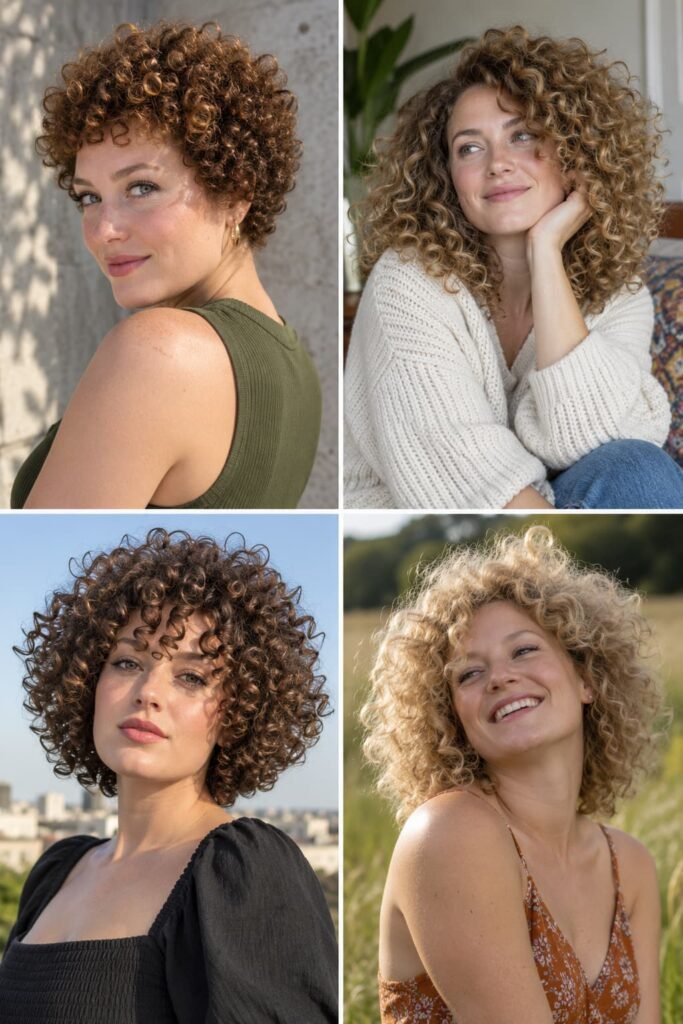
Naturally curly hair can create many different silhouettes. Some styles appear compact and rounded, while others show more length, visible curl definition, or a softer outline.
The final appearance can vary with curl pattern, hair density, length, haircut shape, and styling. The examples below describe visual possibilities rather than fixed hair categories.
Short Rounded Curls
Short curly hair may create a compact, rounded shape when the length is relatively balanced around the crown and sides.
Tighter curls can contribute to an outward-looking silhouette because the strands curve repeatedly instead of falling in a straight line. Looser curls may create a softer and less compact version of the same general shape.
The amount of visible volume varies from person to person. Hair density, curl size, and the way the haircut is shaped can all affect the result.
Medium-Length Voluminous Curls
Medium-length curls can combine visible length with volume around the sides and crown.
Depending on the natural curl pattern and density, the hairstyle may look broad and full while still showing some downward movement near the ends.
Some people may prefer a balanced rounded outline, while others may prefer more height at the crown or greater width through the sides.
The haircut can influence where that volume appears, so two people with similar hair lengths may still have very different silhouettes.
Defined Curly Afro-Like Shape
An Afro-like hairstyle does not have to look fluffy or undefined.
Individual spirals or curl groups can remain clearly visible while the overall hairstyle creates a rounded or outward-looking shape.
Greater curl definition puts more visual emphasis on the individual curls. Depending on density and curl pattern, the hairstyle can still appear full even when the curls remain well defined.
This means curl definition and overall volume can exist in the same hairstyle.
Soft Fluffy Curly Shape
A softer Afro-like style places more visual emphasis on the overall silhouette than on clearly separated curls.
Individual curls may still be visible, but the hair can appear more blended when viewed as a whole. This may create a softer and fuller-looking outer shape.
The effect varies with natural texture and styling. Some hair naturally forms clearly separated curl groups, while other curls may appear less defined.
A fluffy finish is not a separate hair type. It is mainly a difference in how much individual curl definition is visible within the overall shape.
Longer Curly Hair With a Rounded Silhouette
Long curly hair can still have an Afro-like sense of volume, although additional length may change the proportions of the hairstyle.
As curls become longer, the overall outline may appear wider or more elongated rather than compact and circular.
Some curl patterns may keep noticeable volume around the sides and crown, while others may show more downward movement.
Layers can also change how the length and volume are distributed through the hairstyle.
A longer curly style can therefore maintain a full, rounded appearance without looking the same as a short, compact Afro-like shape.
Curly Hair With Bangs
Bangs can change the front shape of naturally voluminous curly hair.
Curly bangs may sit across the forehead, separate into individual curls, or blend into the surrounding hair. Their appearance can vary with curl pattern, length, and haircut shape.
Shorter bangs may create a clearer break between the forehead and the main body of the hairstyle. Longer bangs may blend more gradually into the curls around the sides.
Curly hair can appear shorter in its natural curled state than when it is stretched. For that reason, the visible length of curly bangs can differ from their stretched length.
Defined Curls vs. Fluffy Volume
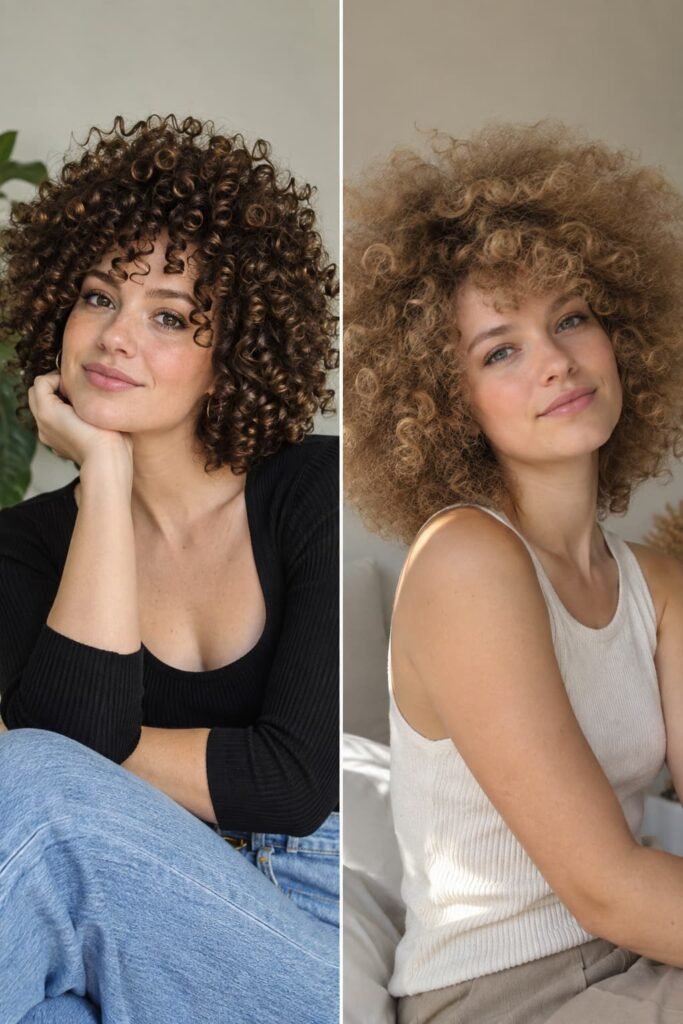
Curly hairstyles with a similar overall silhouette can look noticeably different depending on how clearly the individual curls are visible.
One hairstyle may show distinct spirals throughout the hair. Another may have a softer appearance because the curl groups are less visually separated.
Neither finish is automatically better. They simply create different visual effects.
How Curl Definition Changes the Look
Curl definition describes how clearly individual curls or curl groups can be seen.
More defined curls can give the hairstyle a more detailed and structured texture. Individual spirals may remain visible even when the overall shape is broad or rounded.
With less visible definition, the curls may blend together more when viewed from a distance. This can create a softer outer silhouette.
Definition can also vary across the same head of hair. Some sections may form clear curls while others appear looser or less separated.
The goal does not need to be identical curl definition throughout the hairstyle. The preferred finish is largely a matter of texture and styling preference.
How More Separation Can Create a Fuller Appearance
Separating larger curl groups into smaller sections may make the hair occupy more visible space, creating the appearance of a fuller or softer silhouette.
The effect is not identical for every curl pattern. Some hair may look noticeably fluffier with greater separation, while other textures may continue to show clear curl shapes.
A hair pick is another styling option that may be used to adjust the shape or create more visible lift around the roots without changing the natural curl type. Different sizes and designs are available among hair picks for curly hair on Amazon.
The main visual difference is simple:
Defined curls place more emphasis on the shape of individual curls.
Fluffier curls place more emphasis on the overall volume and outer silhouette.
Many naturally curly hairstyles combine elements of both.
How Layers and Length Can Change the Shape
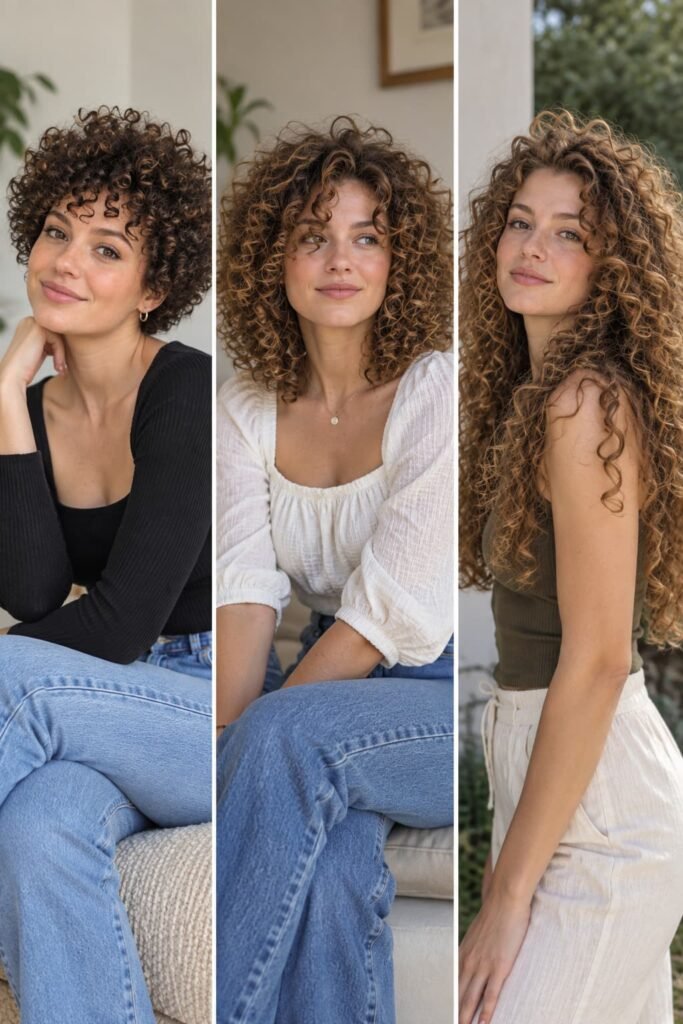
Length can change the overall proportions of naturally curly hair.
Shorter hair may create a more compact silhouette, while longer hair may show more downward extension. The exact effect depends on curl pattern, density, haircut shape, and individual hair characteristics.
Layers can also change where visible volume is concentrated by creating different lengths throughout the haircut.
They do not change a person’s natural curl pattern, but they may change how those curls sit within the overall hairstyle.
Shorter Lengths and Compact Volume
Short curly hair can create a compact silhouette because less visible length extends below the main body of the hairstyle.
When the length is relatively balanced around the crown and sides, the outline may appear rounded.
Tightly curled hair can appear particularly compact because the curved strand does not display its full length in a straight line.
The result is not always circular. Some short curly styles may have more height through the top, while others may appear wider around the sides.
Hair density and the haircut itself can also affect the final shape.
Medium Lengths and a More Rounded Outline
Medium-length curly hair may provide a balance between visible movement and volume around the head.
Depending on the curl pattern and haircut, the silhouette can appear broad, rounded, or slightly elongated.
Layers may change where that volume is most visible. Shorter sections around the crown can create the appearance of more movement higher in the hairstyle, while longer sections may add more visible length toward the lower areas.
A rounded hairstyle does not need to form a perfectly even circle. Natural curls can vary in direction and shape, so the outer silhouette may look soft and slightly irregular.
Some people may prefer this softer outline, while others may prefer a more deliberately shaped finish.
Longer Hair and More Downward Movement
Longer curly hair may develop a more elongated silhouette as more visible length extends below the sides and crown.
The hairstyle can still have substantial volume, but the overall proportions may differ from those of a shorter rounded style.
Looser curls may show more obvious downward movement, while tighter curl patterns may maintain more visible width around the head. Individual results can still vary considerably.
Longer layers may preserve more of the overall length while changing how the curls are distributed through the hairstyle.
Shorter layers in selected areas may create the appearance of more movement or volume higher in the shape.
Neither approach is universally better. Some people may prefer compact volume, while others may prefer a longer curly silhouette with a mixture of width and downward movement.
What to Consider Before Choosing an Afro-Like Hairstyle
An Afro-like hairstyle can look different from one person to another. Natural curl pattern, hair density, strand characteristics, length, haircut shape, and styling preference can all influence the final appearance.
Instead of expecting one exact result, it can be more useful to consider how the hairstyle may work with the hair’s existing texture and the type of silhouette someone prefers.
Natural Curl Pattern
Curl pattern affects the overall shape of curly hair.
Tighter curls may create a more compact or outward-looking silhouette, while looser curls may show more downward movement. The appearance can also change with hair length, density, and haircut shape.
This does not mean one curl pattern is better suited to the style than another. It simply means different textures may produce different versions of a rounded or voluminous look.
Looking at the natural curl pattern can help someone decide whether they prefer a compact shape, visible ringlets, softer volume, or a mixture of these features.
Hair Density and Strand Characteristics
Hair density refers to the number of hairs within an area of the scalp. It is different from the diameter, or thickness, of an individual hair strand.
These characteristics can affect how a hairstyle appears visually.
Hair with greater density may look fuller because more strands contribute to the overall silhouette. Hair with lower density can still have visible volume, although the curls may appear more separated.
Strand thickness can also change the visual character of the hairstyle. Fine and thicker strands may create different-looking shapes even when the curl pattern is similar.
These features should be considered individually rather than assuming one characteristic determines the final result.
Preferred Level of Volume and Definition
Afro-like hairstyles can range from clearly defined curls to softer, fluffier shapes.
More definition makes individual curls or curl groups easier to see. A less defined finish may place more visual emphasis on the overall volume and outer silhouette.
Some people may prefer strong curl definition throughout the hairstyle. Others may prefer a softer outline, while many styles combine both effects.
There is no required level of definition or volume. The preferred appearance is a personal styling choice.
Styling Effort and Personal Preference
The amount of styling involved can vary with the natural curl pattern, length, haircut, and desired finish.
A wide-tooth comb is one possible tool for gently arranging or separating curly hair, depending on the curl pattern and preferred finish. People looking for this type of styling tool can view wide-tooth combs for curly hair on Amazon.
Haircut shape can also affect how easily the hair forms the preferred outline. A compact rounded cut, for example, may behave differently from a longer layered style.
Personal preference matters as much as the visual characteristics of the hair. An inspiration image can be useful for identifying a preferred shape, but another person’s curls may not produce exactly the same appearance.
The Cultural Context of the Afro Hairstyle
The word Afro means more than simply large or curly hair.
The hairstyle has an important historical connection with Black identity, natural hair, cultural pride, and political expression, particularly in the United States during the twentieth century.
That context is worth understanding when using the term to describe hair on people from different backgrounds.
Why the Term “Afro” Has a Specific Historical Meaning
The Afro became especially prominent during the 1960s and 1970s and was closely associated with the Black Power and “Black is Beautiful” movements.
For many Black Americans, wearing natural hair in an Afro could express cultural pride and challenge beauty standards that favored straighter hairstyles.
Because of this history, an Afro is not simply another word for any large or tightly curled hairstyle.
At the same time, naturally tight curls are not limited to one racial group. People from different backgrounds can have curly or tightly curled hair.
When the goal is simply to describe appearance, terms such as Afro-like silhouette, rounded curly hair, or voluminous natural curls may sometimes provide a more precise description.
Using Clear Hair-Texture Terminology
Hair texture is usually easier to understand when it is described through visible characteristics instead of broad racial labels.
Useful terms can include:
- tightly curled hair
- loose curls
- defined curls
- coily hair
- voluminous curls
- compact curls
- rounded curly silhouette
- Afro-like shape
Other useful characteristics include curl size, density, strand thickness, length, and the overall haircut shape.
Research on human hair shows substantial variation in hair form within and between populations. This is one reason race should not be treated as a precise system for identifying an individual’s curl pattern.
Hair-typing systems may provide descriptive language for curl appearance, but they should not be used to determine a person’s race or ancestry.
Frequently Asked Questions
Can a White Person Naturally Have an Afro?
A white person can naturally have very curly or tightly curled hair that may create an Afro-like silhouette.
Human hair texture varies considerably between individuals. People who share a broad racial or geographic background do not necessarily share the same curl pattern.
Whether the final hairstyle appears rounded or Afro-like can also depend on density, length, haircut shape, and styling.
Is a White Person Afro an Official Hair Type?
No. White person afro is an informal descriptive phrase, not a scientific hair classification.
People generally use the phrase to describe a white person whose curly or tightly curled hair creates a rounded, voluminous shape.
When possible, describing the actual hair characteristics, such as tight curls, coily texture, high volume, or a rounded silhouette, can provide more useful information.
What Hair Texture Can Form an Afro-Like Shape?
Tightly curled or coily hair can create a compact, rounded silhouette, but there is no single curl type required for an Afro-like appearance.
Looser curls can also create considerable volume in some cases.
Curl pattern works together with density, length, haircut shape, and styling to influence the overall silhouette.
What Is the Difference Between an Afro and Curly Hair?
Curly hair is a broad description covering many curl sizes, patterns, lengths, and shapes.
An Afro refers to a recognizable hairstyle with volume around the head and also carries an important historical and cultural association with Black identity.
This means curly hair is not automatically an Afro. Curly hairstyles can be long, short, rounded, narrow, layered, defined, fluffy, or shaped in many other ways.
Can Loose Curls Create an Afro-Like Appearance?
Loose curls can create a rounded or voluminous appearance, depending on the hair’s density, length, haircut, and styling.
However, looser curls may show more downward movement than tighter curls, so the silhouette may appear softer or more elongated.
There is no fixed boundary separating an Afro-like shape from other voluminous curly hairstyles.
Does Race Determine Whether Hair Is Curly or Coily?
No. A racial label does not determine an individual’s exact hair texture.
Hair shape varies widely within human populations as well as between them. Research on worldwide hair diversity has shown that hair can be described according to physical curl characteristics without relying on ethnicity as the classification system.
Genetics and ancestry can influence hair characteristics, but they do not mean every person within a broad racial group has the same texture.
For hairstyle discussions, describing the actual curl pattern, density, strand characteristics, length, and silhouette is generally more informative than assuming hair type from race alone.