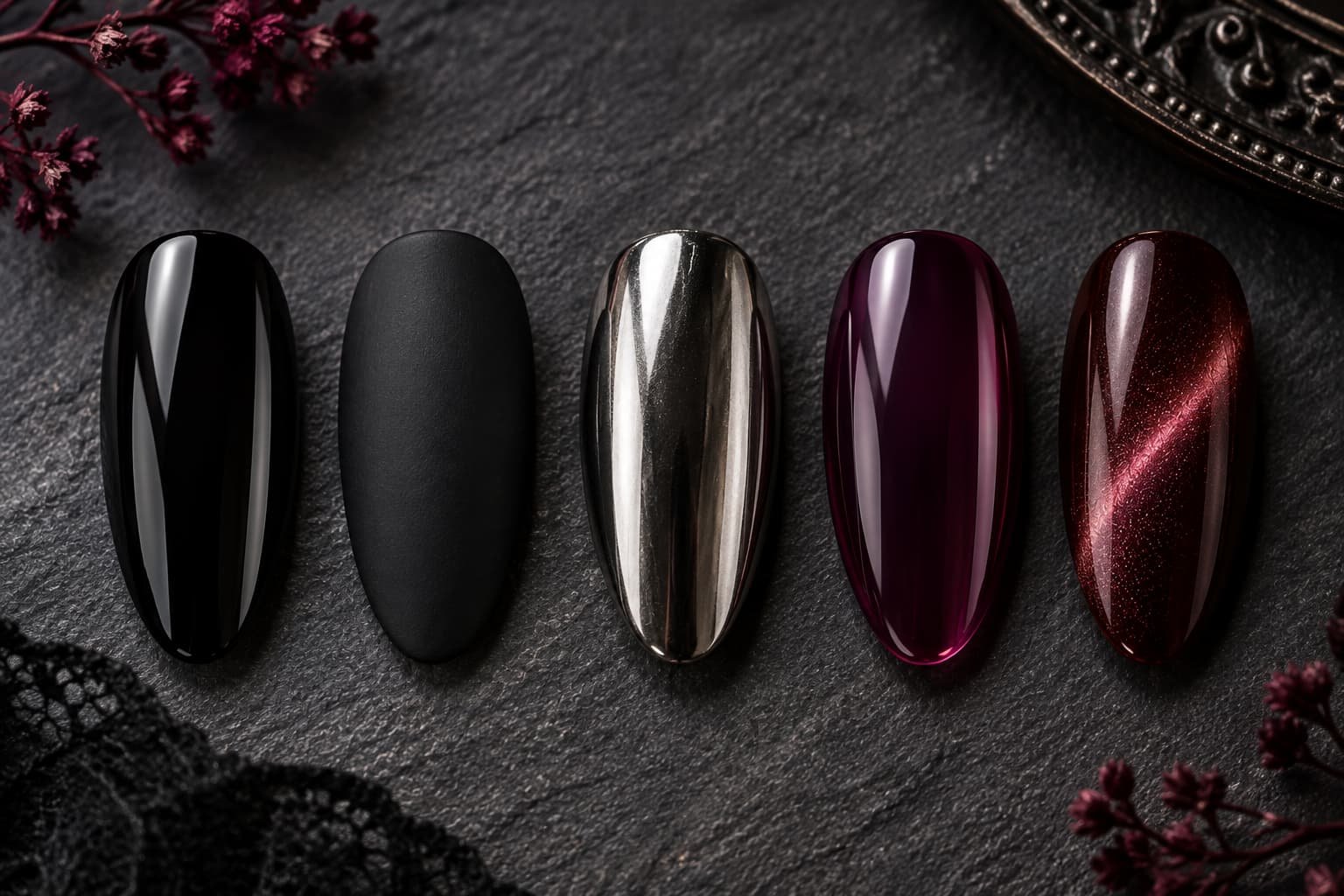
Elegant gothic nails combine dark colors and gothic-inspired details with a more controlled, refined visual style. The look can include black, burgundy, deep plum, smoky gray, metallic accents, sheer bases, ornamental patterns, florals, and celestial motifs.
The gothic element does not have to come from an all-black manicure. Fine lace-inspired lines, dark roses, crescent moons, architectural shapes, or small metallic details can establish the aesthetic while leaving parts of the manicure simple.
This means the style can range from minimal black French tips with one small silver accent to detailed nail art inspired by filigree, stained glass, dark florals, and gothic architecture.
What Defines Elegant Gothic Nails?
Elegant gothic nails combine gothic-inspired colors and motifs with deliberate placement and visual balance.
Dark shades are common, but color alone does not define the style. A plain black manicure may look dark without having a clear gothic theme. Lace-inspired lines, filigree, roses, celestial symbols, pointed arches, stained-glass-style patterns, and metallic ornament can make the gothic influence more noticeable.
The more refined side of the look often comes from controlling how much detail appears across the manicure. Fine lines, related colors, selective accent nails, and visible negative space can keep decorative artwork easy to read.
For example, a sheer base with thin black ornamental lines creates a different effect from covering every nail with dense patterns. Both approaches can fit a gothic direction, but the amount and placement of detail change the overall appearance.
Gothic nail art also does not need to use Halloween-specific imagery. Dark florals, lace, celestial details, burgundy, silver, and architectural motifs can create a gothic look without pumpkins, ghosts, or other clearly seasonal symbols.
What Makes Gothic Nails Look Elegant Rather Than Overly Dramatic?
Visual balance can help a detailed gothic manicure remain clear rather than crowded.
One approach is to use a limited color palette. Black and silver, black and burgundy, plum and gunmetal, or black over a sheer base are possible combinations that keep the different elements visually connected.
Detailed art can also be used selectively. One or two accent nails may contain lace, florals, or architectural patterns while the remaining nails use solid colors, simple tips, or smaller details.
Negative space is another option. Leaving parts of a sheer or nude-looking base visible can separate dark linework and make individual motifs easier to distinguish.
Scale also matters. Tiny stars, fine vines, narrow metallic lines, and small ornamental patterns can create a restrained result, while larger gemstones, layered designs, or multiple motifs create a more decorative appearance.
Neither direction is automatically better. The final look can vary with nail length, shape, color contrast, finish, placement, and personal preference.
Elegant Gothic Nail Design Styles
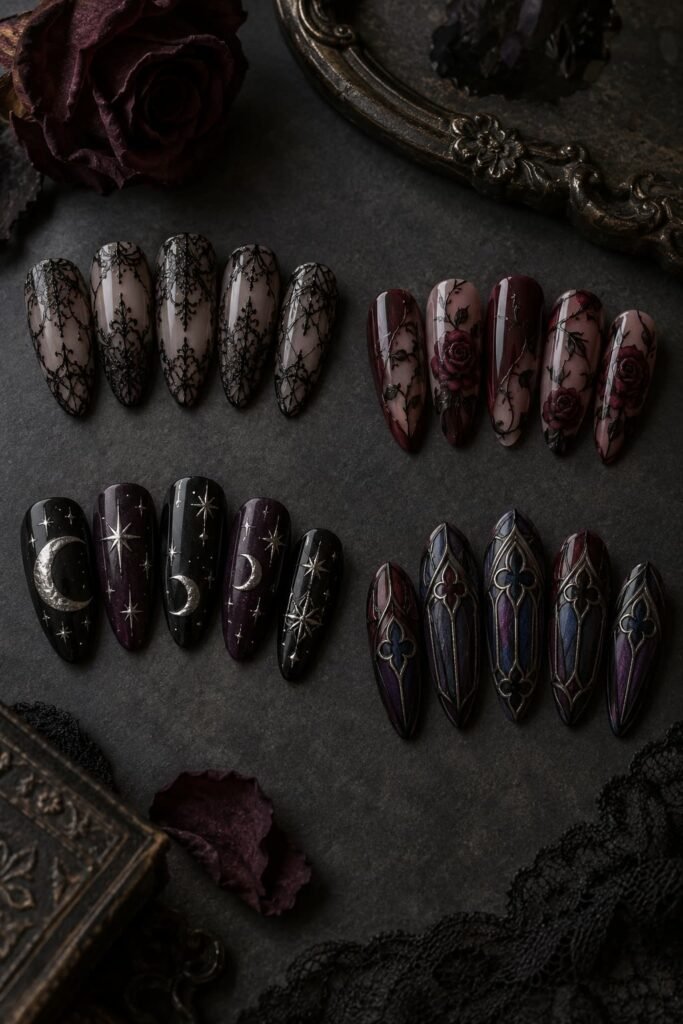
Gothic nail designs can move in several different visual directions. Some focus on romantic details, while others use celestial, architectural, or metallic elements.
Victorian Lace and Filigree Nails
Lace and filigree designs use fine lines, curved shapes, and ornamental details.
Black linework is one possible option because it can create clear contrast against sheer, nude-looking, smoky gray, or muted bases. Burgundy can also be paired with darker details for a deeper color combination.
A lace-inspired design may cover only part of the nail. Fine lines around the tip, base, or side of the nail can suggest lace while leaving some of the background visible.
Filigree-style designs can include curved scrolls, loops, and symmetrical ornamental shapes. For readers interested in creating fine ornamental linework, a nail art liner brush set is one practical tool option.These details may be placed on one or two accent nails when a more selective design is preferred.
For a simpler variation, some nails can carry ornamental artwork while others remain black, burgundy, sheer, or another coordinated shade.
Dark Floral and Rose Designs
Dark floral nail art can use black, burgundy, wine red, plum, or muted metallic details.
A black rose over a sheer base can create clear contrast, while burgundy floral details over a dark background may produce a more tonal appearance.
Thorn and vine motifs are another option. They can appear as narrow lines along one side of the nail or surround a floral accent without covering the entire surface.
The flowers also do not need to be repeated on every nail. One detailed rose, a smaller vine motif, and several simpler nails can create variation within the same theme.
The base color can change the overall effect. A sheer background leaves more open space around the artwork, while black or burgundy creates a darker visual result.
Celestial Gothic Nails
Celestial gothic nail art can include crescent moons, stars, constellation-inspired dots, and other night-sky motifs.Moon and star nail decals are another option for adding small celestial motifs without making every nail highly detailed.
Black with silver details creates a noticeable dark-and-light contrast. Navy, plum, charcoal, and burgundy are other possible base colors.
Crescent moons can appear as small accents or as the main motif on one nail. Fine metallic lines or dots may be added without turning every nail into a detailed celestial scene.
Constellation-inspired designs can also use small dots connected with thin lines. Keeping these elements small can allow the base color to remain an important part of the design.
Cathedral and Stained-Glass-Inspired Nails
Cathedral-inspired nail art uses architectural shapes rather than floral or celestial motifs.
Pointed arches, narrow window-like outlines, and symmetrical linework can suggest gothic architecture without reproducing a specific building or decorative pattern.
Stained-glass-inspired designs can use dark outlines to divide the nail into smaller sections. Burgundy, plum, dark blue, smoky red, or other muted jewel tones may appear between the lines.
Because this type of artwork can contain several details, it can be used selectively. One or two architectural accent nails can be paired with simpler black, burgundy, or metallic nails.
Antique Metallic Gothic Details
Metallic accents can introduce reflective contrast to a darker manicure.
Silver may be used for thin outlines, stars, ornamental borders, French-tip details, or small motifs. Gunmetal creates a darker metallic effect, while pewter offers another muted option.
Muted or antique-looking gold can create a warmer direction when paired with black, burgundy, or deep red-brown shades.
Metallic details do not need to cover the whole nail. Small framing lines, filigree details, or one metallic accent can be enough to change the overall appearance.
Which Colors Work With Elegant Gothic Nails?
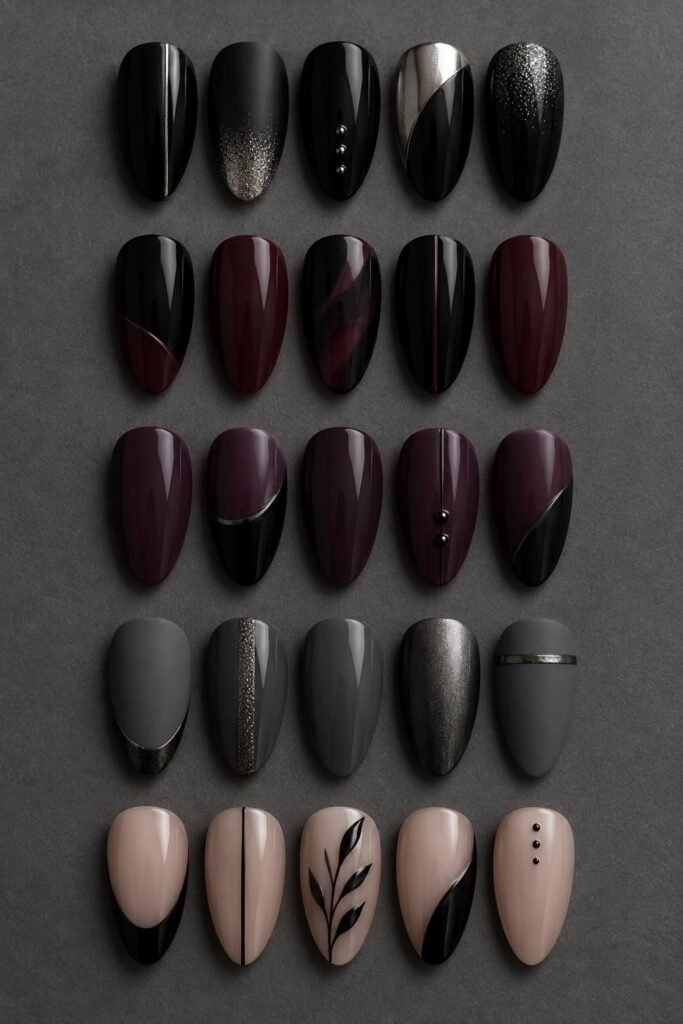
The gothic palette does not have to rely on black alone. Burgundy, deep plum, smoky gray, silver, gunmetal, navy, and sheer bases can all be incorporated in different ways.
The final appearance can vary depending on contrast, finish, placement, and the amount of decoration.
Black and Silver
Black and silver can create a noticeable light-and-dark contrast.
Silver details may appear as filigree lines, celestial motifs, borders, French tips, or small metallic accents. Glossy and matte black bases can also create different visual effects when paired with reflective silver.silver nail-art liner is one option for adding narrow metallic lines, borders, or small decorative details.
This combination can be adapted to both simple and more detailed designs.
Black and Burgundy
Black and burgundy create a deep, warm-toned palette.
Burgundy can appear as a full base, French tip, floral detail, or ornamental section. Black can then be used for outlines, vines, lace-inspired artwork, or accent nails.
This is one possible direction for dark floral or romantic gothic styling without making every nail completely black.
Deep Plum and Black
Deep plum provides a dark base while keeping a visible purple tone.
Black can be introduced through linework, French tips, ornamental shapes, or small motifs.
Depending on the exact shades, plum and black may create less contrast than a combination that uses bright silver or a pale background.
Smoky Gray and Gunmetal
Smoky gray and gunmetal can create a more muted palette.
Gray may serve as a base for black details, while gunmetal can appear in borders, narrow lines, or small reflective accents.
This combination is one option for someone who prefers dark colors with less contrast than black paired with bright silver.
Black With Sheer or Nude Bases
Sheer or nude-looking bases leave visible space around darker artwork.
Black French tips, roses, celestial motifs, lace-inspired lines, or ornamental details can be placed over the lighter base without covering the full nail.
This approach also works with negative-space designs, where part of the base remains visible as an intentional part of the manicure.
Minimal vs Ornate Elegant Gothic Nails
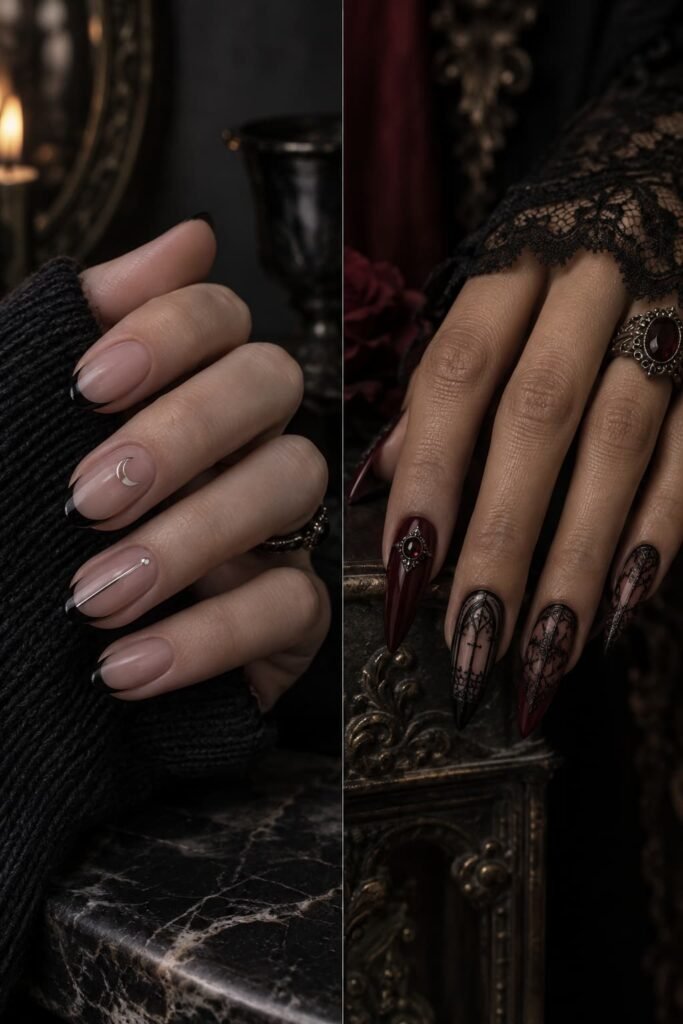
Gothic nail art can range from restrained to highly decorative. The main difference is how much artwork, layering, and embellishment is used.
Both approaches can fit the same aesthetic.
Minimal Gothic Nails
Minimal gothic nails use fewer decorative elements and leave more visual space around them.
One possible option is a sheer base with thin black French tips. Tiny crescent moons, narrow metallic lines, small stars, or one dark floral accent can also establish a gothic direction.
Another approach is to keep most nails in one dark shade and reserve one or two nails for simple ornamental details.
Finish contrast can also be used without introducing extra colors. A matte base with a small glossy detail in the same shade is one example.
The focus remains on a small number of carefully placed elements rather than layered decoration across every nail.
Ornate Gothic Nails
Ornate gothic nails use more detailed or layered decoration.
Lace-inspired art, filigree, stained-glass-style patterns, metallic borders, gemstones, and other 3D accents can be incorporated in different combinations.
Some designs may repeat decorative elements across several nails, while others place the most detailed artwork on one or two focal nails.
Using related colors can help several decorative elements feel visually connected. Black, burgundy, plum, metallic silver, and muted gold are possible choices rather than fixed rules.
An ornate manicure also does not need to combine every gothic motif. Focusing mainly on lace, architecture, florals, or another clear theme can keep the design easier to read.
Which Nail Shapes Work With Gothic Designs?
Gothic nail art can be adapted to different nail shapes. Shape changes the overall silhouette, while length affects how much surface is available for artwork.
There is no single required shape for this style.
Almond Nails
Almond nails taper toward a softly rounded point.
The curved, tapered outline can create a softer visual effect than a sharply pointed shape. Dark French tips, florals, metallic accents, and small ornamental motifs can all be adapted to almond nails.
Longer almond nails provide more surface for detailed artwork, while shorter versions can use smaller motifs.
Coffin and Stiletto Nails
Coffin and stiletto nails create more angular or pointed silhouettes.
Coffin nails taper toward a flatter tip, while stiletto nails narrow toward a sharper point. These shapes can give dark colors and gothic artwork a more dramatic outline.
Longer versions provide more room for filigree, metallic accents, or architectural patterns, although simple artwork can also be used.
The final appearance can vary depending on length, finish, color, and amount of decoration.
Oval, Square, and Squoval Nails
Oval, square, and squoval nails can also support gothic nail art without relying on a pointed silhouette.
A short square nail might use black French tips or small metallic details. Oval nails can be paired with dark florals or sheer bases, while squoval shapes can support simple ornamental designs.
With these shapes, the gothic character can come mainly from the colors and artwork rather than the nail silhouette.
Can Short Nails Have an Elegant Gothic Look?
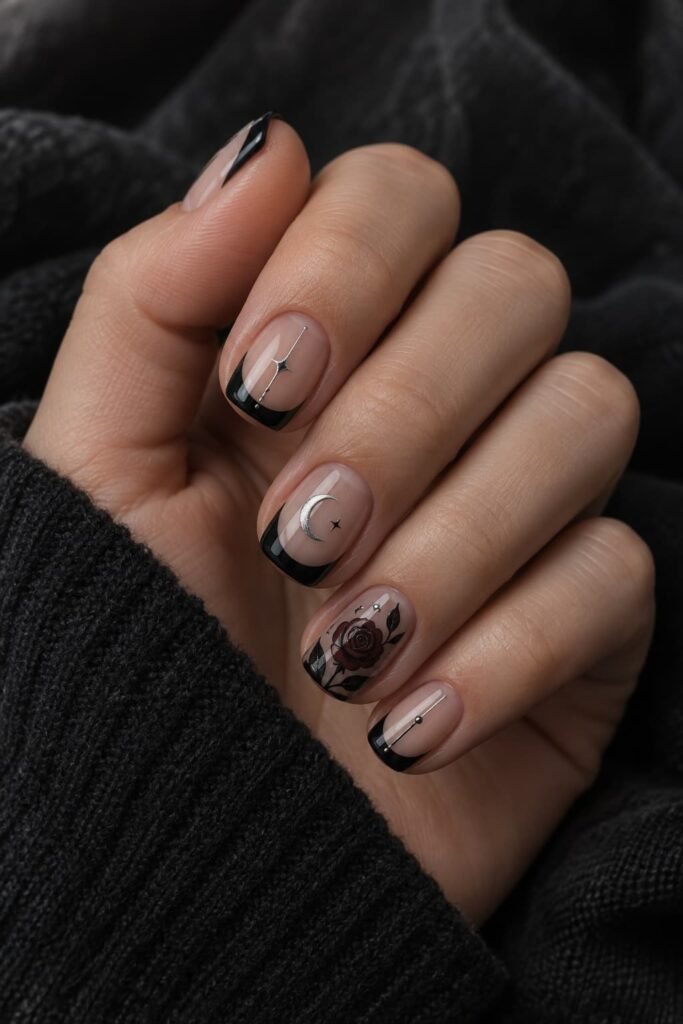
Short nails can be styled with gothic colors and details without needing a long or sharply pointed shape.
When the available surface is smaller, simpler motifs can keep the design clear. Thin black French tips, tiny moons, fine metallic lines, small rose details, or one accent nail are possible options.
A sheer base with one dark motif can create a more open design. Another approach is to use a solid dark shade on most nails and reserve one or two for more detailed artwork.
The gothic character can come from the palette, contrast, finish, and decorative motifs rather than nail length alone.
How Do Finishes Change the Gothic Look?
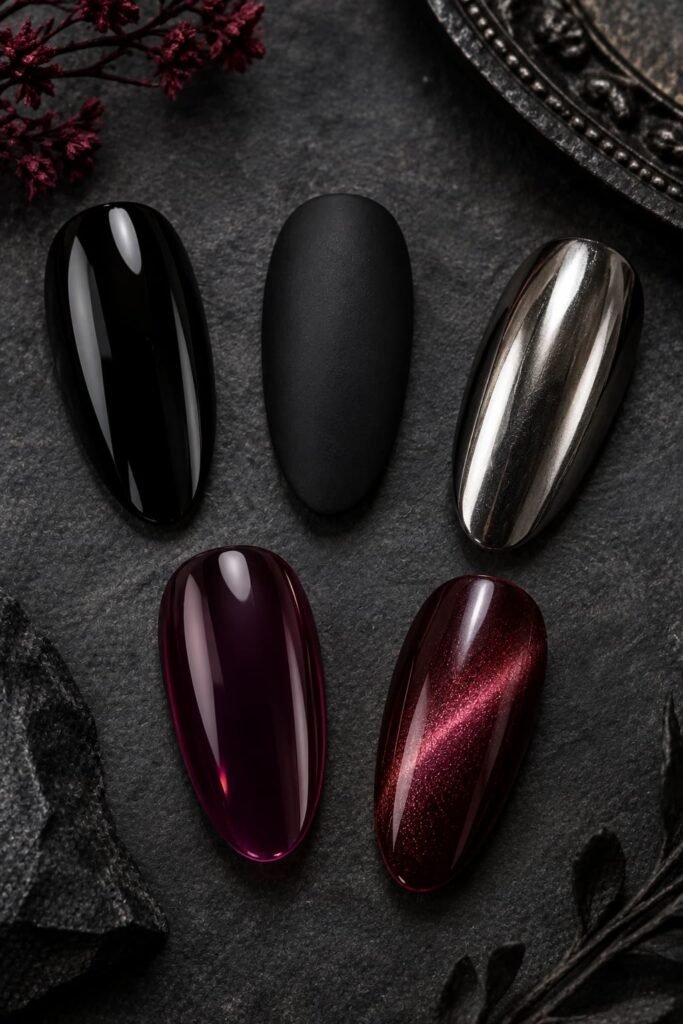
Finish changes how the surface of a manicure interacts with light and can alter its overall visual effect.
The same colors and patterns can appear more reflective, muted, translucent, or dimensional depending on the finish.
Glossy and Matte Finishes
Glossy finishes have a more reflective surface, while matte finishes have less visible shine.
Both can be used with black, burgundy, plum, navy, and other dark colors.
A matte black base, for example, can be paired with a small glossy detail in the same shade. Glossy burgundy may also be combined with matte black artwork.
Neither finish is inherently better for gothic styling. The choice depends on the amount of shine and contrast preferred.
Chrome and Metallic Details
Chrome and metallic finishes introduce reflective elements.
Silver can create clear contrast against black or deep plum. Gunmetal offers a darker reflective option, while muted gold can introduce a warmer accent.
Metallic details may cover a full nail or appear only in French tips, borders, stars, ornamental lines, or small accent motifs.
The appearance can vary depending on how much reflective surface is included.
Sheer, Jelly, and Magnetic Effects
Sheer and jelly finishes create a more translucent appearance than fully opaque color.
A smoky sheer base can be paired with black lace-inspired lines, dark French tips, or celestial motifs. Deep red or plum jelly shades are another possible option for adding translucent color.
Magnetic-effect polish can create a shifting reflective pattern within a darker manicure. Black, burgundy, plum, or navy can all be used as possible color directions.
These finishes can add visual interest without requiring detailed artwork on every nail.
Elegant Gothic Nails vs Halloween Nails
Elegant gothic nails and Halloween nails can share dark colors and some motifs, but they do not have to represent the same visual style.
Gothic nail art may use black, burgundy, plum, lace-inspired patterns, dark florals, celestial motifs, metallic details, or architectural shapes. These elements do not require a seasonal theme.
Halloween nail art can include clearly holiday-related imagery such as pumpkins, ghosts, bats, candy, or similar symbols.
Some designs can sit between the two directions. Fine silver web details over black may have a darker gothic appearance, while adding pumpkins or cartoon ghosts makes the seasonal theme more explicit.
The distinction comes mainly from the chosen imagery and overall design direction rather than the use of dark colors alone.
How to Keep Gothic Nail Art Visually Balanced
Detailed nail art can remain visually clear when individual elements are given enough space.
Choosing one main design direction can help. A manicure might focus on dark florals, celestial motifs, cathedral-inspired patterns, or lace instead of combining several unrelated themes.
A limited color palette can also make individual motifs easier to distinguish. Black and silver, burgundy and black, or plum and gunmetal are possible combinations.
Detailed artwork does not need to appear on every nail. One or two focal nails can carry complex patterns while the others use solid shades, French tips, or smaller accents.
Artwork can also be scaled to nail length. Shorter nails have less room for complex patterns, while longer nails provide a larger area for layered details.
Leaving some nails simpler can keep different elements from competing for attention.
The aim is not necessarily to remove decoration, but to arrange it so each detail remains easy to see.
What to Consider Before Choosing an Elegant Gothic Nail Design
Several practical and visual factors can help narrow the choices.
Nail length affects the amount of surface available for artwork. Smaller motifs may be easier to fit on shorter nails, while longer nails offer more room for layered patterns.
Natural nail shape can influence how lines, tips, and decorative patterns sit across the surface. The artwork can be adapted instead of tying the style to one specific shape.
Desired level of detail also matters. Some people may prefer one dark shade with a small accent, while others may prefer lace, metallic borders, gemstones, or architectural patterns.
Personal preference can guide whether the final design feels romantic, minimal, dramatic, or highly ornamental.
Everyday activities may also be worth considering when choosing raised decoration. Flat painted details and larger 3D accents can feel different during normal hand use.
It can also help to decide whether the design should use strong contrast or a more muted palette before choosing individual motifs.
Frequently Asked Questions
Do elegant gothic nails have to be black?
No. Black is one possible base color, but burgundy, deep plum, navy, smoky gray, gunmetal, silver, muted gold, and sheer shades can also be incorporated.
The overall gothic effect can come from the combination of colors, motifs, contrast, finish, and placement rather than one specific shade.
Can gothic nails be short?
Yes. Gothic details can be adapted to shorter nails.
Dark French tips, small moons, fine metallic lines, simple floral motifs, and individual accent nails are possible options when less surface is available for artwork.
What colors can be used instead of black?
Possible alternatives include burgundy, wine red, deep plum, charcoal, smoky gray, midnight blue, and darker metallic shades.
They may be used alone or combined with black depending on the desired design.
What is the difference between gothic nails and ordinary dark nails?
Dark color alone does not automatically create a clearly gothic design.
Gothic-inspired nail art can use lace-like lines, filigree, dark florals, celestial motifs, cathedral-inspired shapes, stained-glass-style patterns, and antique-looking metallic details.
The stronger gothic reference comes from the overall combination of color, artwork, finish, and decorative direction.
Can gothic nails look minimal and refined?
Yes. Gothic styling does not require heavy decoration.
Thin black French tips, a small celestial motif, narrow metallic lines, dark floral accents, or one detailed nail can create a more restrained version of the aesthetic.
Are gothic nails only suitable for Halloween?
No. Gothic nail designs can use dark colors, florals, lace, celestial details, metallic accents, and architectural motifs without Halloween-specific imagery.
The design becomes more clearly seasonal when it uses recognizable holiday symbols such as pumpkins or ghosts.
Which nail shapes can work with gothic designs?
Almond, coffin, stiletto, oval, square, and squoval shapes can all be used with gothic-inspired nail art.
The final appearance can vary depending on nail length, silhouette, color palette, finish, and amount of decoration.