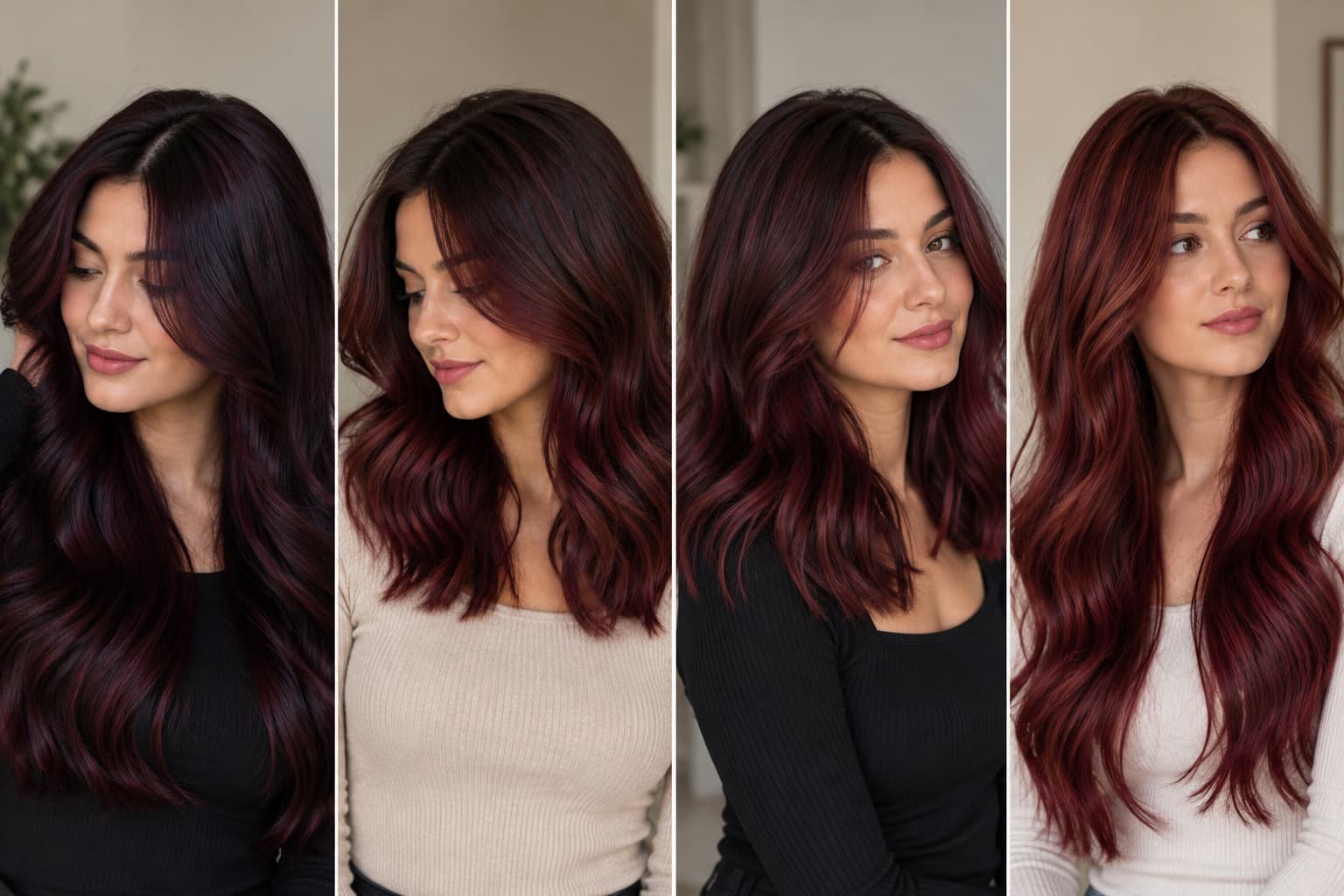
Burgundy hair color combines deep red with violet or purple tones. Within that general color family, some shades lean toward wine red, while others show stronger plum, violet, or brown influences.
This range is why burgundy hair color ideas can look quite different from one another. Some are dark and subtle, while others make the red or purple tones more noticeable. Looking at the balance of these tones can help distinguish one burgundy variation from another.
What Is Burgundy Hair Color?
Burgundy is generally a deep red hair color with a violet or purple influence. It is often described through wine-inspired shades because of its combination of rich red and cooler violet tones.
Burgundy is not one fixed hair color. The balance of red and violet can vary, and some versions also include noticeable brown tones. A red-leaning burgundy may look closer to a deep wine red, while a violet-heavy shade can appear more purple.
Brunette-based burgundy keeps more brown visible within the overall color. This can give the shade a darker and more subdued appearance compared with a brighter red-violet version.
Starting hair color also matters. The same color may not appear identical on black, brown, or lighter hair. Existing artificial color and the type of hair color used can also affect the final appearance.
Is Burgundy Hair More Red or Purple?
Burgundy contains both red and violet or purple influences, but their balance can vary from shade to shade.
Red-leaning burgundy makes deep red the stronger visual feature. Violet may still be present, but it plays a supporting role rather than becoming the dominant tone.
Violet-leaning burgundy moves further toward purple while keeping a red foundation. These shades can appear cooler than burgundy colors in which red is more prominent.
Brown-based versions provide another variation. They combine brunette depth with burgundy tones, which can make the red and violet less vivid.
Because of this range, burgundy is more accurately understood as a red-violet color family rather than one exact shade.
Why Burgundy Can Look Different in Different Lighting
Lighting can affect which tones in a dark hair color are easiest to see.
A deep burgundy shade may look more subdued in low or indirect light. In stronger or more direct light, red, violet, or wine-colored tones can become more noticeable.
The hair color itself is not changing from one setting to another. Instead, different lighting conditions affect how the color is perceived.
The depth of the shade also matters. A dark brown-burgundy may remain relatively subtle, while a more vivid red-violet burgundy can create stronger visible color contrast.
Color placement can change the effect as well. For example, burgundy highlights against a dark base can show separate areas of contrast, while an all-over burgundy shade creates a more continuous color effect.
Burgundy Hair Color Ideas by Shade
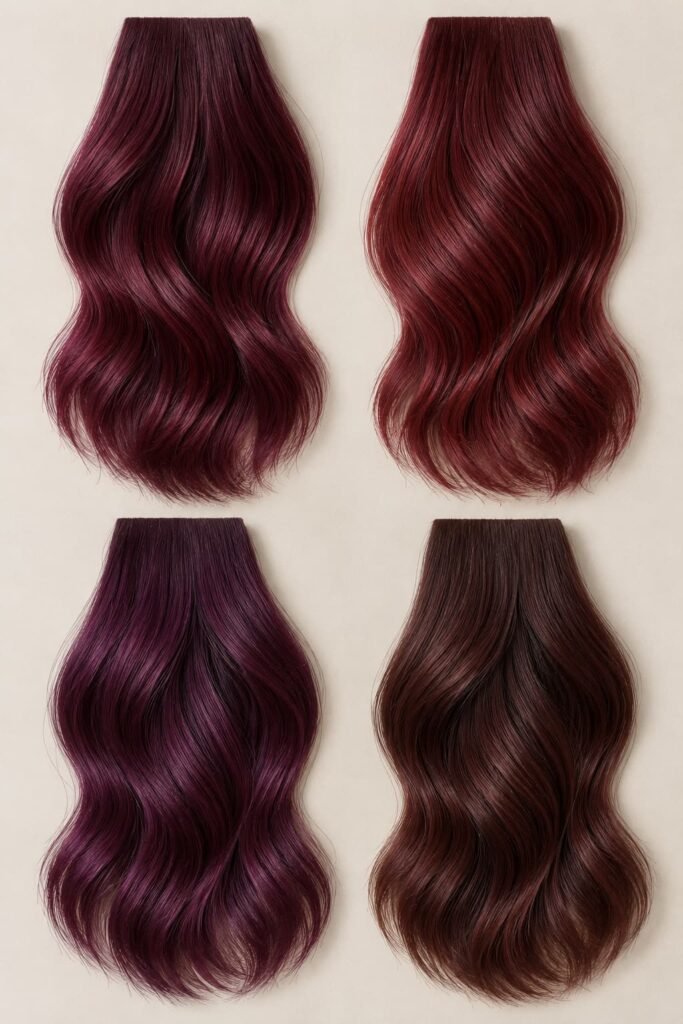
Burgundy shades can be grouped by which part of the red-violet spectrum is most noticeable. Some emphasize deep red, while others move toward wine, plum, violet, or brunette tones.
These burgundy hair color ideas show several meaningfully different ways the color can be interpreted.
Classic Deep Burgundy Hair
Classic deep burgundy balances dark red with violet without pushing strongly toward either bright red or purple.
It has a rich red-violet appearance and usually stays on the deeper side of the color spectrum. In softer lighting, the overall shade may appear quite dark, while stronger light can make the underlying red and violet tones easier to notice.
This may be an option for someone who wants a recognizable burgundy shade without making either red or purple the dominant feature.
The exact appearance can vary with the starting hair color and the color used, so the same general burgundy shade will not necessarily look identical on every base.
Wine Burgundy Hair
Wine burgundy places more emphasis on deep wine-red tones.
Compared with a bright red hair color, it generally has a darker and more muted appearance. Violet, purple, or brown influences may also be present, depending on the particular shade.
Wine burgundy can be used as an all-over color or introduced through selected sections of the hair. Against a darker base, wine-colored pieces can provide visible red-toned contrast without creating the effect of a bright primary red.
For readers comparing similar colors, wine burgundy usually sits closer to deep red than strongly purple burgundy variations.
Plum Burgundy Hair
Plum burgundy moves further toward purple and violet.
It still contains red, but its stronger purple influence gives it a different visual character from red-focused burgundy. Depending on the particular shade, the result can sit between deep burgundy and dark plum.
A deeper plum-burgundy color may appear quite dark in softer lighting, while its violet tones can become easier to see under brighter light.
This variation may suit someone who wants burgundy to have a noticeable purple direction without choosing a distinctly bright purple hair color.
Red Burgundy Hair
Red burgundy keeps deep red as the most noticeable part of the color.
Violet may still contribute to the overall shade, but it is less prominent than it would be in plum or violet burgundy. Some versions can resemble deep wine red, while others may appear somewhat brighter.
“Red burgundy” is therefore better understood as a general color direction rather than one exact shade.
It can be used as a full hair color or paired with a darker base when more contrast between the burgundy and the surrounding hair is preferred.
Brown Burgundy Hair
Brown burgundy combines brunette depth with red or red-violet tones.
The brown base remains an important part of the appearance, so this variation often looks more restrained than a vivid burgundy. Depending on the lighting and the balance of the color, the burgundy influence may appear as a deep red or wine-colored cast within the brown.
There is no single fixed balance between brown and burgundy. Some versions stay close to dark brunette, while others make the red-violet tones more noticeable.
Brown burgundy is also different from a straightforward warm brown. Burgundy introduces a deeper red or red-violet direction, while warm browns may instead lean toward golden, copper, or red-brown tones.
Violet Burgundy Hair
Violet burgundy places stronger emphasis on violet or purple within a deep red base.
Compared with classic burgundy, its purple influence is more noticeable. The effect may appear subtle on a very dark base or more distinct when the burgundy tones create greater contrast with the starting color.
There is not always a strict boundary between violet burgundy and plum burgundy. Hair-color names can overlap, and different brands or publications may use these labels in slightly different ways.
As a useful visual distinction, plum burgundy can describe a deep red-purple shade with a plum-like character, while violet burgundy can describe a version in which violet is particularly noticeable.
For someone comparing the main burgundy shade families, red burgundy sits toward the redder end of the range, violet burgundy moves toward purple, and brown burgundy keeps more brunette depth visible.
Burgundy Hair Color Ideas for Different Starting Hair Colors
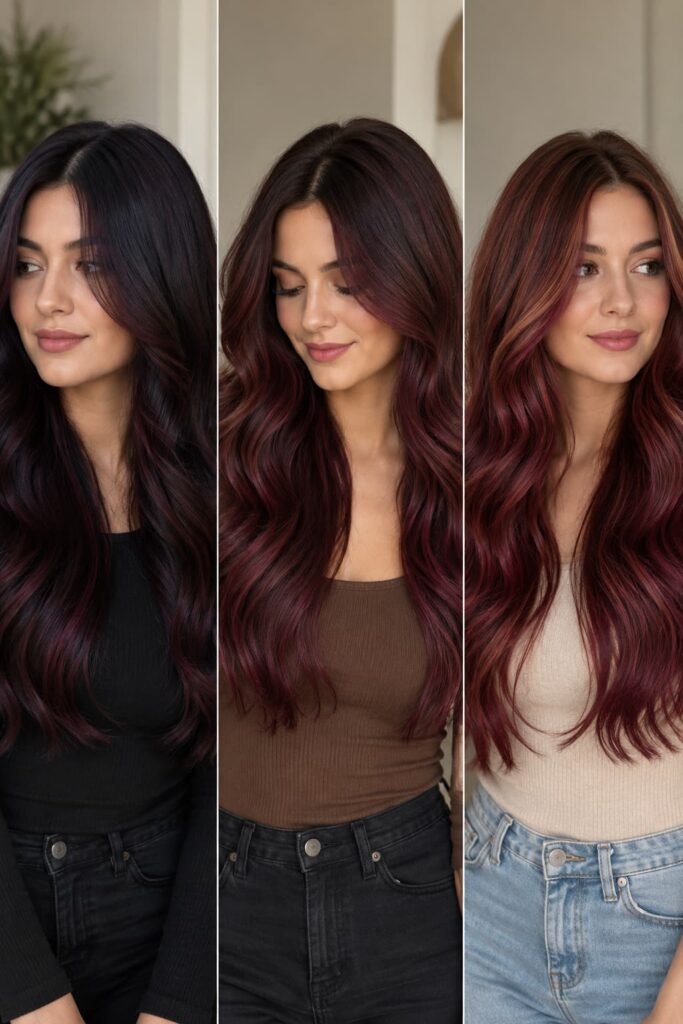
Starting hair color can influence how noticeable burgundy appears and how much contrast it creates. A deep burgundy on a very dark base may appear more subtle than a similar shade on a lighter brunette base.
The final appearance can also depend on factors such as previous color, hair porosity, the color formulation, and the balance of red and violet in the chosen shade. Starting color is therefore an important consideration when comparing burgundy hair color ideas.
Burgundy on Black Hair
Burgundy on black hair can create a deep, low-contrast effect when the burgundy shade is also dark.
In lower light, the overall color may appear predominantly black or very dark. In brighter light, red, wine, or violet tones may become easier to notice. The amount of visible contrast can vary with the starting color and the burgundy shade used.
A red-leaning burgundy can give the look a stronger red direction, while plum or violet burgundy moves it further toward red-purple.
Burgundy can also be added without covering all of the hair. Highlights, face-framing sections, balayage, or color through the lengths are possible options for keeping some of the dark base visible.
Previously colored black hair should not be assumed to behave the same way as uncolored black hair. Previous artificial color can affect the result, so the starting appearance alone cannot predict the finished shade.
Burgundy on Dark Brown Hair
Dark brown and burgundy can be combined to create a deeper brunette-red appearance.
Brown burgundy, wine burgundy, and deep red-violet shades can visually connect with a dark brunette base because the colors share a relatively deep overall value.
For a more restrained effect, burgundy can appear only in selected sections while dark brown remains the dominant color. For greater contrast, a more noticeable red or violet shade can be used as the accent.
Another possible approach is to keep darker roots visible while introducing burgundy through the mid-lengths and ends. This preserves some brunette depth while making the burgundy more noticeable through other parts of the hair.
Dark brown covers a range of depths and undertones, so one burgundy shade may not look identical on every dark brown base.
Burgundy on Medium Brown Hair
Medium brown is lighter than dark brown or black, which can change the amount of contrast created by burgundy.
Depending on the shade and color used, red, wine, or violet tones may be easier to distinguish against a medium brown base. Brown burgundy can keep more of a brunette character, while a stronger red-violet shade may create clearer color contrast.
For someone who does not want one solid color, medium brown can also be combined with burgundy highlights, balayage, an ombré effect, or darker roots.
Starting depth is only part of the picture. Previous artificial color, porosity, formulation, and the desired intensity can all affect the finished appearance, so an exact result cannot be predicted from the description “medium brown” alone.
Ways to Add Burgundy Without Using One Solid Color
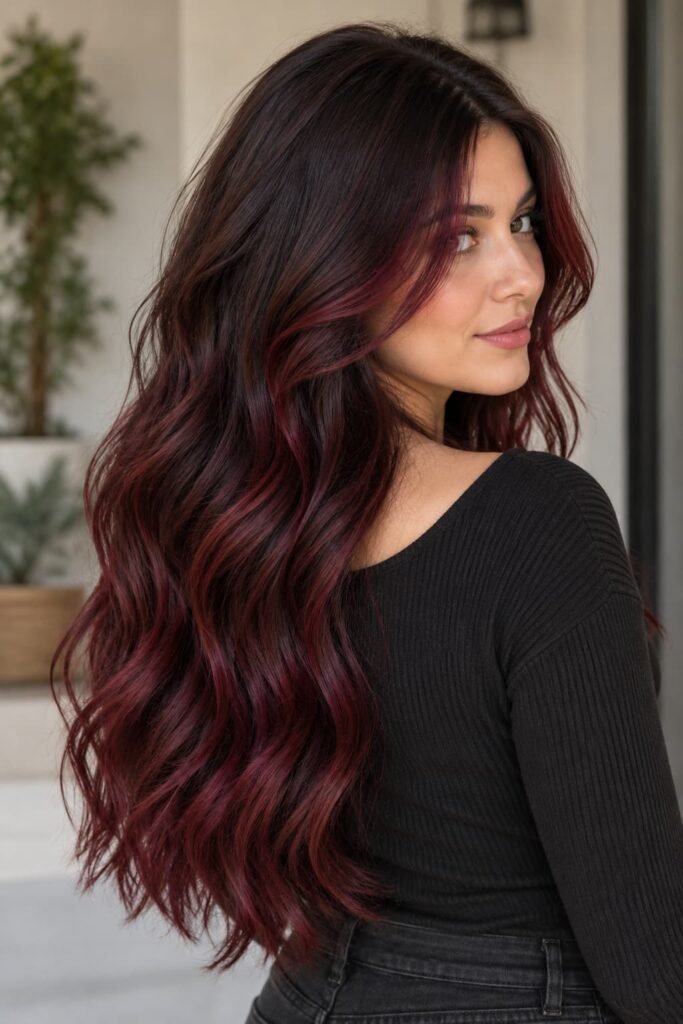
Burgundy does not need to cover the hair in one uniform shade from roots to ends. Different placement approaches can change where the color appears and how much of the darker or brunette base remains visible.
This allows burgundy to work as an accent, a gradual color transition, or part of a multi-tonal look.
Burgundy Highlights
Burgundy highlights introduce selected red-violet sections within another base color.
Against black or brown hair, the darker base remains visible between the colored pieces. The amount of contrast can vary according to the burgundy shade, base color, placement, and size of the highlighted sections.
Narrower pieces may create a more blended pattern, while wider or more concentrated sections can make the burgundy more visually prominent.
Highlights can also be placed more heavily in certain areas. Burgundy around the front or through selected upper sections is one possible way to emphasize the color without applying it throughout the entire head.
Burgundy Balayage
Burgundy balayage uses selective painted sections of color rather than applying one uniform burgundy shade throughout the hair.
The burgundy may appear in ribbons through selected mid-lengths and ends, allowing darker areas to remain between the colored sections. This creates a different visual pattern from solid all-over color.
On a brunette base, wine, red, plum, or violet-burgundy tones can be used as the contrasting color. How noticeable the effect appears depends on the difference between the base and the chosen burgundy shade, as well as the placement.
Balayage and ombré are related color concepts but are not the same. Balayage refers to a painted highlighting technique and selective placement. Ombré describes a broader color transition, commonly moving from darker roots toward a different or lighter color through the lengths and ends.
Burgundy Ombré
Burgundy ombré creates a gradual transition from a darker root area toward more noticeable burgundy through the lower lengths or ends.
Instead of distributing separate highlighted pieces throughout the hair, an ombré look generally gives a larger portion of the lower hair a different color from the roots.
Black or brown roots can transition toward wine burgundy, red burgundy, plum, or violet-toned burgundy. The contrast can be subtle or more defined depending on the colors chosen.
This may appeal to someone who wants to keep a darker root area while making burgundy increasingly noticeable through the length.
A blended transition can also avoid a sharp visual line between the darker base and burgundy sections.
Burgundy Hair With Dark Roots
Dark roots paired with burgundy lengths create a visible difference in color or depth between the root area and the rest of the hair.
Black or brunette roots can provide a dark background for red-violet lengths. A deep burgundy may keep that contrast relatively restrained, while a more vivid burgundy can make the difference more apparent.
Dark roots can be combined with different placement styles. They may lead into mostly burgundy lengths, a gradual ombré transition, or selected balayage pieces.
This is a placement choice rather than a separate burgundy shade. The burgundy itself may still lean toward wine, red, plum, violet, or brown.
Burgundy Face-Framing Pieces
Face-framing burgundy concentrates the color in sections around the front of the hair.
This can create a visible accent while leaving much of the original base color unchanged. Against black or brunette hair, the burgundy front sections may provide more noticeable contrast than scattered subtle pieces.
The colored sections can be narrow and blended or wider and more defined. A deep wine shade may create less contrast with a dark base, while a brighter red or violet burgundy may stand out more clearly.
Face-framing color can also be combined with smaller burgundy sections elsewhere in the hair. This is one way to make the front color a stronger visual feature without using all-over burgundy.
As with other color-placement options, the finished appearance can vary with the starting hair color, chosen burgundy shade, and amount of hair included in the colored sections.
How Undertones Change the Look of Burgundy Hair
Burgundy is not one fixed red-purple shade. Some versions emphasize red, others lean more toward violet, and some keep more brown visible. These differences can change whether the overall color looks warmer, cooler, brighter, or closer to brunette.
Understanding the dominant tone can make it easier to compare burgundy shades without treating every version as the same color.
Red-Leaning Burgundy
Red-leaning burgundy makes deep red more noticeable than violet or purple.
It can look warmer than a strongly violet-based burgundy, although the exact appearance depends on the shade. Some versions move toward wine red, while darker variations may include enough brown or violet to keep the color deep and muted.
This may be an option for someone who wants burgundy to appear more red than purple.
Lighting and the starting hair color can affect how noticeable that red tone appears, so the color may not look identical in every setting.
Violet-Leaning Burgundy
Violet-leaning burgundy gives purple or violet a stronger role within the red base.
This creates a cooler-looking direction than a burgundy shade dominated by red. Some versions remain clearly burgundy, while others move closer to deep plum as the violet influence becomes stronger.
On darker hair, a deep violet-burgundy may look relatively subtle in softer lighting. Brighter light can make the red-purple character easier to see.
This may appeal to someone who prefers the purple side of burgundy without moving into a distinctly bright purple hair color.
Brown-Leaning Burgundy
Brown-leaning burgundy combines brunette depth with deep red or red-violet tones.
Brown remains an important part of the overall color, which can make this variation appear more subdued than a vivid red or violet burgundy. Depending on the balance of tones, it may look close to dark brunette in some lighting while showing a burgundy cast in others.
Some versions stay predominantly brown with subtle red-violet influence. Others make burgundy more visible while keeping enough brown to maintain a brunette character.
This is one possible direction for someone who prefers a deeper, brown-based interpretation of burgundy.
Burgundy Hair on Different Lengths and Textures
Hair length and texture can change how burgundy color placement is displayed, even when the shade itself stays the same.
Short hair shows the color within a smaller overall shape, while longer hair provides more length for gradients and multiple color areas. Straight, wavy, and curly hair can also display highlights and tonal changes in different visual patterns.
Short Burgundy Hair
Short hair can make the overall relationship between the base color and burgundy easy to see within a compact shape.
An all-over burgundy shade creates a more continuous color effect, while highlights or contrasting sections can break up the base color.
On a pixie, bob, or other short cut, burgundy could also be concentrated around selected sections while darker hair remains visible elsewhere.
Deep wine, brown burgundy, red-violet, and more purple-leaning shades are all possible directions. The choice mainly changes the color balance and level of contrast rather than determining whether burgundy works with the haircut.
Medium-Length Burgundy Hair
Medium-length hair can display both solid burgundy color and more varied placement.
Highlights may appear through selected sections, while layers can expose different areas of color as the hair falls and moves. A brown or black base may also remain visible between burgundy pieces.
Balayage, darker roots, or a gradual transition through the lengths are other possible approaches.
Keeping the burgundy close in depth to the base can create a more restrained contrast. Choosing a noticeably different red or violet shade can make the color placement easier to distinguish.
Long Burgundy Hair
Long hair provides more visible length for gradients, balayage, ombré, and combinations of related tones.
For example, a burgundy ombré can move from darker roots toward more noticeable red-violet color through the lower lengths. Balayage can place burgundy through selected sections while allowing darker hair to remain visible between them.
Different burgundy tones can also be combined across the length. A deeper shade near the upper sections could transition toward a more noticeable wine or violet tone farther down.
These are style options rather than rules. Long hair can also be colored in one consistent burgundy shade when a more uniform appearance is preferred.
Burgundy on Straight, Wavy, and Curly Hair
Hair texture can affect how different areas of color are visually displayed.
On straight hair, highlights and gradients may follow clearer continuous sections. The transition between a darker base and burgundy lengths can therefore be easier to trace from root to end.
On wavy hair, bends can interrupt those continuous lines. Burgundy highlights or balayage pieces may appear at different angles as the waves move through the length.
On curly hair, color can appear across individual curls and sections as they turn and overlap. Burgundy pieces may therefore appear in separate visible areas rather than as one continuous strip of color.
No texture is inherently better for burgundy. The main difference is how the chosen shade and placement appear across straight sections, waves, or curls.
Burgundy vs Similar Red and Purple Hair Colors
Burgundy sits close to several deep red, brown, and purple hair colors. Terms such as cherry cola, auburn, plum, and burgundy can sometimes overlap, but the dominant tones provide a useful way to tell them apart.
Burgundy vs Cherry Cola Hair
Burgundy and cherry cola can both combine deep red with darker tones, so the two colors may sometimes look similar.
Burgundy usually places more emphasis on deep red with violet, purple, or wine-colored influence. Cherry cola commonly keeps a stronger brunette base, with cherry-red or burgundy tones adding color to the brown.
This means cherry cola may read more clearly as a red-toned brunette, while burgundy can move further toward red-violet or wine.
The names are descriptive rather than exact formulas, so individual shades can overlap. For a closer look at the brunette-red combination, see the Cherry Cola Hair Color guide.
Burgundy vs Auburn Hair
Auburn and burgundy both belong to the broader red hair color range, but they usually move in different tonal directions.
Auburn is generally a blend of red and brown with a warmer appearance. Some versions can include noticeable copper tones, while deeper auburn shades keep more brown.
Burgundy usually has a deeper wine-red character with violet or purple influence. This often gives it a cooler-looking direction than copper or warm red-brown auburn.
There can still be variation within both color families, so the distinction is not always a sharp boundary.
Readers interested in warmer red-brown and copper variations can also explore the Copper Auburn Hair guide.
Burgundy vs Plum Hair
Burgundy and plum both contain red and purple influences, which can make closely related shades difficult to separate.
As a general visual distinction, burgundy usually keeps deep red as an important part of the color. Plum tends to place greater emphasis on purple or violet.
A red-heavy burgundy may look closer to wine, while a strongly purple burgundy can move toward plum. Because hair-color names are not always used in exactly the same way, some shades described as plum burgundy may sit between the two.
For someone comparing the colors visually, the main question is whether deep red or purple is the stronger feature.
What to Consider Before Choosing a Burgundy Shade
Choosing between burgundy shades is easier when the color is considered in terms of tone, depth, starting hair color, and placement.
There is no single burgundy variation that will suit every preference or produce the same result on every base.
Decide How Red or Purple You Want the Color to Look
Start by considering which side of burgundy you want to emphasize.
Red-leaning burgundy can create a wine-red or deep red appearance. Violet-leaning burgundy moves closer to purple or plum, while a more balanced shade keeps both red and violet visible.
Brown can also be part of the mix. A brown-based burgundy may appeal to someone who wants to keep more brunette depth rather than choosing a strongly red or purple result.
Looking at the dominant tone is usually more useful than relying only on a shade name, since terms such as wine, plum, and burgundy can overlap.
Consider How Deep or Noticeable You Want the Color
Burgundy can range from very dark and restrained to considerably more visible.
A deep brown-burgundy may appear close to brunette in lower light, with the red-violet tones becoming more apparent under brighter conditions. A more vivid red or violet burgundy can create stronger contrast.
The starting base also affects how noticeable that contrast may be. For this reason, choosing between subtle and more visible burgundy involves both the shade itself and the hair color underneath it.
Neither approach is automatically better. The choice depends on whether the goal is a small tonal change or a more obvious red-violet effect.
Consider Your Starting Hair Color
Starting hair color can influence how a burgundy shade appears.
On very dark hair, a deep burgundy may create a relatively subtle shift. Against a lighter brunette base, the difference between the base and the red-violet color may be easier to see.
Previous artificial color can also affect the finished result. Hair that has already been colored should not be assumed to respond in the same way as uncolored hair of a similar visible shade.
Porosity, the type of color used, and the chosen burgundy tone can also influence the outcome. An exact finished shade should therefore not be predicted from the starting color alone.
Choose Between All-Over Color and Dimensional Placement
Burgundy can cover most or all of the hair, or it can be introduced through selected sections.
All-over burgundy creates a more continuous color effect from one area of the hair to another.
Highlights keep more of the original base visible between burgundy sections. Balayage uses selective placement to introduce the color through chosen areas, often across the mid-lengths and ends.
Ombré creates a broader transition from a darker root area toward more noticeable burgundy farther down the hair.
Face-framing pieces are another option when the goal is to concentrate burgundy around the front while keeping most of the base color visible.
The choice mainly affects where the color appears and how much contrast is visible, rather than changing what burgundy itself means.
Basic Maintenance Considerations for Burgundy Hair
Burgundy color can gradually lose intensity over time, as can other red and violet hair colors.
Frequent washing can contribute to color fading. Products intended for color-treated hair, such as a color-care shampoo and conditioner, are one possible option for routine care, although individual product instructions should still be followed.
Frequent washing can contribute to color fading. Products intended for color-treated hair are one possible option for routine care, although individual product instructions should still be followed.
High heat can also affect color longevity. When heat styling is used, the temperature, frequency of use, and products involved can all be part of the overall color-care routine.
Different burgundy shades may also change in appearance as they fade. A red-heavy shade may become less intense, while a violet or brown-based burgundy may shift differently depending on the formulation and starting color.
There is no single maintenance schedule that applies to every burgundy color. Permanent, demi-permanent, semi-permanent, and other color systems can behave differently, and individual washing and styling habits also vary.
For that reason, burgundy maintenance is better understood as ongoing color care rather than a fixed timetable with a guaranteed period of intensity.
Common Questions About Burgundy Hair Color
What color is burgundy hair?
Burgundy hair is generally a deep red color with violet or purple influence. Some burgundy shades lean more toward wine red, while others show stronger violet, plum, or brown tones.
There is no single fixed version of burgundy, so the exact balance of red, purple, and brown can vary from one shade to another.
Is burgundy hair more red or purple?
Burgundy contains both red and violet or purple tones, but one can be more noticeable than the other.
Red-leaning burgundy may appear closer to deep wine red. Violet-leaning burgundy moves further toward purple or plum. Brown-based burgundy keeps more brunette depth visible.
For this reason, burgundy is better understood as a range of related red-violet shades rather than one exact color.
Does burgundy show on dark hair?
Burgundy can be visible on dark hair, but how noticeable it appears depends on the starting color and the result being created.
On black or very dark brown hair, a deep burgundy may produce relatively subtle contrast. Red or violet tones can sometimes become easier to see under brighter lighting.
A lighter or more vivid burgundy result may require a different coloring process than a very dark burgundy effect. Previous artificial color can also affect the outcome, so two similarly dark starting colors may not produce identical results.
What is the difference between wine and plum burgundy?
Wine burgundy generally emphasizes deep red, while plum burgundy places more emphasis on violet or purple.
Wine-inspired shades may look like rich, muted reds with some violet influence. Plum burgundy usually moves further toward the purple side of the red-violet range.
These terms can overlap and are often used descriptively, so there is no universal boundary separating every wine burgundy from every plum burgundy.
Can burgundy be used only as highlights?
No. Highlights are only one way to incorporate burgundy.
Burgundy can also be used as an all-over color, balayage, ombré, face-framing sections, or through the lengths while darker roots remain visible.
The placement changes where the burgundy appears and how much of the original base color remains visible.
Why does burgundy hair look different indoors and in sunlight?
Lighting affects how hair color is perceived.
A deep burgundy may appear darker or more subdued in softer indoor lighting. Under brighter or more direct light, its red or violet tones may become easier to see.
The shade itself has not suddenly changed. Different lighting conditions simply make certain parts of the color more or less visually noticeable.
What is the difference between burgundy and cherry cola hair?
Burgundy generally emphasizes deep red with violet, purple, or wine-toned influence.
Cherry cola usually combines a darker brunette base with cherry-red or burgundy tones. This can make it read more clearly as a red-toned brunette, while burgundy may place greater emphasis on the red-violet color itself.
The two can overlap, particularly in deeper shades. For a closer look at the brunette-red combination, see the Cherry Cola Hair Color guide.
What is the difference between burgundy and auburn hair?
Auburn generally combines red and brown and usually has a warmer red-brown appearance. Some auburn shades also show noticeable copper tones.
Burgundy typically moves toward deeper wine red with violet or purple influence, giving many burgundy shades a cooler-looking direction than warm auburn.
Both color families contain variations, so some deeper red-brown shades may sit visually close to one another. For more on warmer red-brown and copper variations, see the Copper Auburn Hair guide.