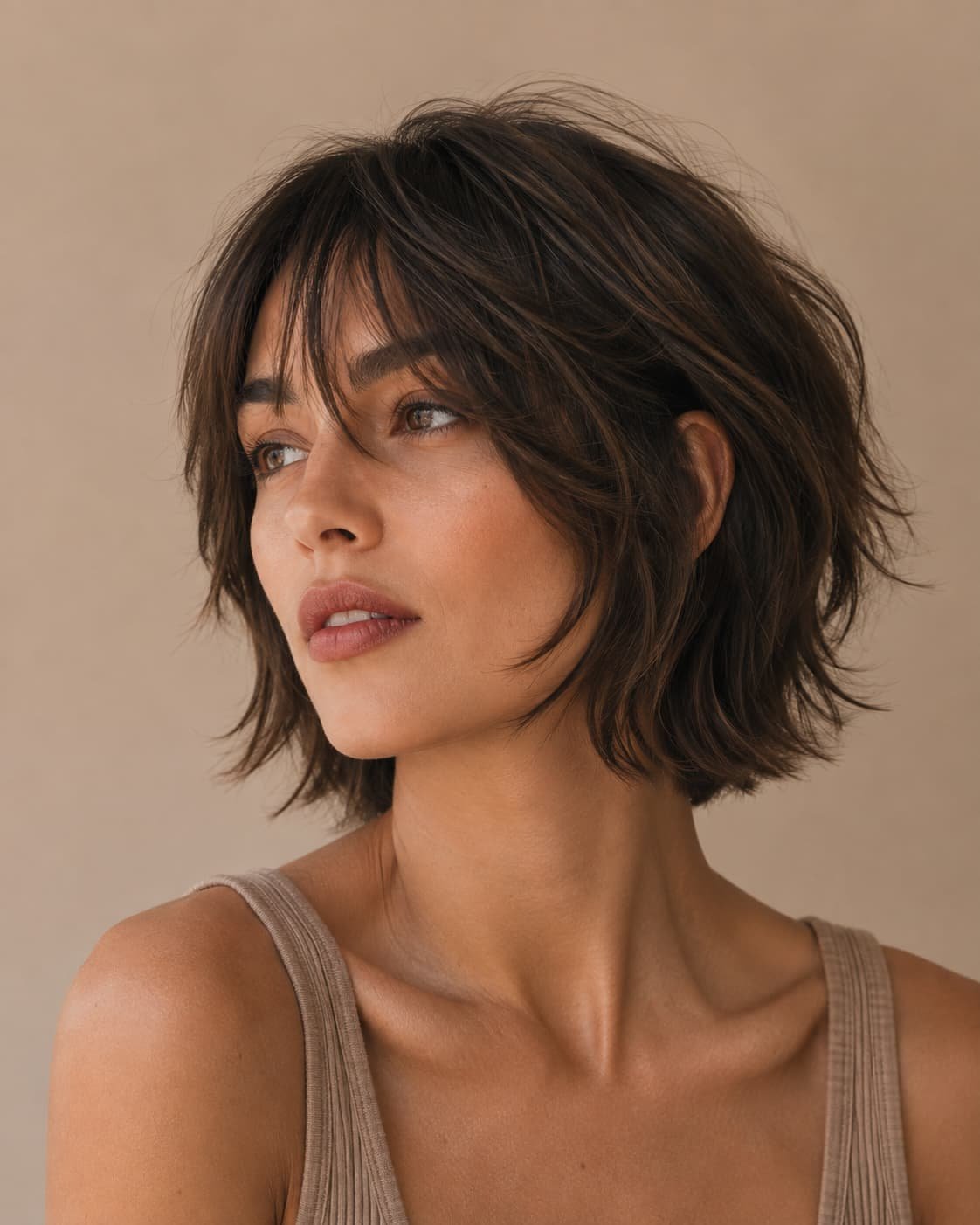
A layered shaggy bob combines the shorter outline of a bob with varied layers, textured ends, and a relaxed finish. Depending on how the haircut is shaped, the layers can look soft and blended or more separated and choppy.
Length, layer placement, bangs, natural texture, and styling can all change the final appearance. Some versions keep a clearly defined bob shape, while others show a stronger shag influence through shorter layers and more visible separation.
What Is a Layered Shaggy Bob?
A layered shaggy bob is a bob-length haircut that uses layers to create more variation within the overall shape. Shorter sections may be placed through the crown, sides, interior, or around the front of the hair.
The bob provides the main length and outline, while shag-inspired layering introduces more separation and texture. The result can range from a softly layered bob with subtle movement to a more heavily layered cut with distinctly piecey sections.
Compared with a traditional blunt bob, which usually has a stronger and more consistent perimeter, a shaggy bob tends to show greater variation between the lengths. A lightly layered bob may still look smooth and controlled, while a shag-inspired version often places more emphasis on visible layers and textured ends.
Main Characteristics of a Layered Shaggy Bob
Several features commonly help create the shaggy appearance, although they do not need to be equally pronounced in every version.
Layered Interior Structure
Interior layers are shorter sections cut within the main body of the haircut rather than only around the outer edge.
They can break up a uniform shape and make individual sections more visible. Shorter layers around the upper part of the haircut may create a stronger shag-inspired effect, while longer layers can keep the silhouette softer.
The appearance can vary depending on how many layers are used and where they are placed. A few longer sections may preserve more of the classic bob shape, while more varied layering through the crown and sides can create greater separation.
Textured or Choppy Ends
The way the ends are shaped also affects the overall look.
Softly textured ends can blend more gradually into one another, creating a less defined transition between layers. Choppier ends make the separation between sections more noticeable and can produce a piecey finish.
Neither approach defines the haircut on its own. A shaggy bob can have subtle texture or a much stronger choppy effect depending on the preferred style.
Face-Framing Sections
Face-framing layers are shorter pieces positioned around the front of the haircut. They may begin around the cheek, jaw, or another chosen point before blending into the rest of the length.
Longer front layers can create a gradual transition into the bob, while shorter pieces can make the layering around the front more noticeable.
These sections may be combined with curtain bangs, wispy bangs, or other fringe styles, but bangs are not required. The final appearance can vary with the length of the front pieces, hair texture, parting, and styling.
Relaxed Overall Finish
A layered shaggy bob often appears less rigid than a classic blunt bob because the outline is broken up by layers, texture, or separated ends.
The haircut may be worn with a tousled finish that makes the movement more noticeable, but it does not have to look intentionally messy. A smoother styling approach can still show the underlying layered structure.
How soft, piecey, polished, or tousled the haircut appears depends on the cut itself as well as natural texture and styling choices.
Layered Shaggy Bob Style Ideas
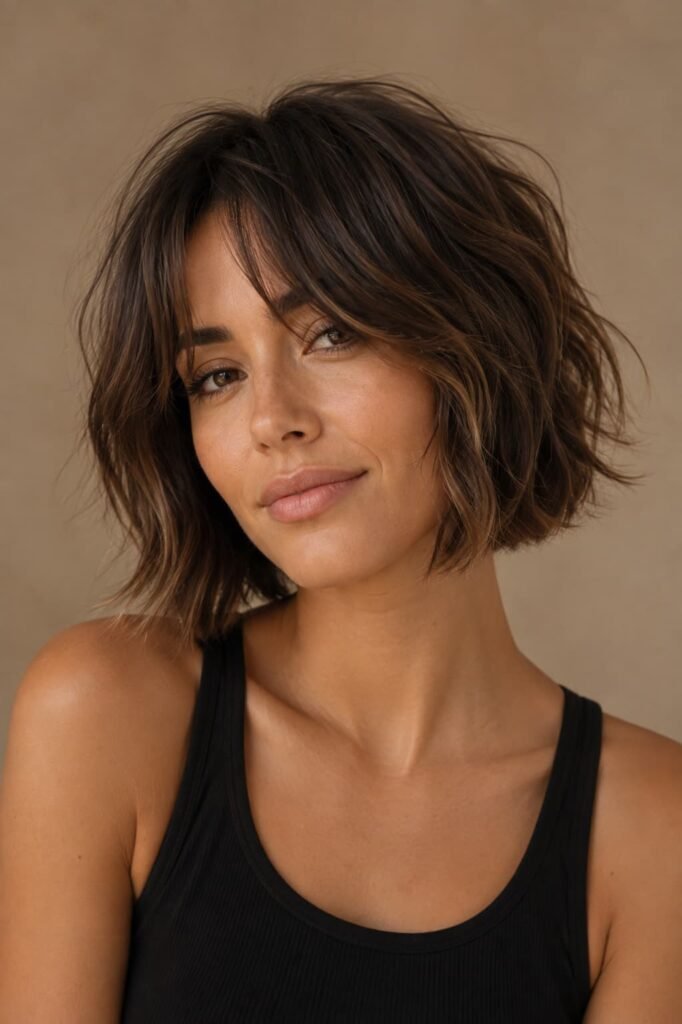
1. Classic Layered Shaggy Bob
A classic layered shaggy bob keeps a recognizable bob outline while adding varied layers through the interior and ends. The layers break up the solid shape and can create more visible movement.
This version sits between a structured bob and a more heavily layered shag. It can be worn with a smoother finish or styled to show more separation between the layers.
2. Soft Layered Shaggy Bob
A soft layered shaggy bob uses longer, more blended layers instead of sharply defined sections.
The gradual transitions can give the haircut a smoother appearance while still adding texture through the lengths and ends. This may appeal to someone who wants a subtle shag influence rather than a strongly choppy finish.
3. Choppy Layered Shaggy Bob
A choppy version uses more noticeable differences between the layers and ends.
The individual sections may appear more separated, giving the haircut a piecey or deliberately textured look. How pronounced the effect appears depends on the layer placement, overall length, and styling.
4. Short Jaw-Length Shaggy Bob
A jaw-length shaggy bob creates a compact silhouette with the ends sitting around the jaw area.
Because the overall length is shorter, layered sections can become an important part of the visible shape. Softer layers may keep the cut relatively rounded, while stronger separation can create a more pronounced shag-inspired appearance.
5. Chin-Length Shaggy Bob
A chin-length version keeps the haircut within a classic bob range while providing room for visible layering through the sides and ends.
The cut can include subtle interior layers or more noticeable sections around the crown and front. The final result can look smooth, tousled, or more piecey depending on the way the layers are shaped and styled.
6. Longer Shaggy Bob
A longer shaggy bob extends below the chin and may approach long-bob or lob length.
The additional length allows for longer layered sections and a less compact silhouette. Face-framing pieces can also be extended farther into the main length for a more gradual transition.
7. Layered Shaggy Bob With Curtain Bangs
Curtain bangs can be paired with a shaggy bob to create a layered front section that opens around the center or slightly off-center.
Shorter curtain bangs create a more noticeable fringe, while longer versions can blend into the surrounding face-framing pieces. For a shorter bob variation that combines waves, texture, and a parted fringe, explore this textured wavy French bob with curtain bangs. The final shape can vary depending on the length and density of the bangs.
8. Layered Shaggy Bob With Wispy Bangs
Wispy bangs use lighter, more separated sections across the forehead.
They can complement the soft texture of a layered bob without creating a heavy fringe. Paired with longer layers, the result may appear more delicate, while stronger layering can create a more visibly textured combination.
9. Layered Shaggy Bob With Choppy Bangs
Choppy bangs introduce more visible separation across the fringe.
This can echo the broken-up texture of a heavily layered bob and create a stronger shag-inspired appearance at the front. The effect can range from subtle to more defined depending on the bang length and amount of separation.
10. Layered Shaggy Bob Without Bangs
Bangs are not necessary for creating a shaggy bob.
Without fringe, longer front pieces can frame the haircut while a center or side part shapes the front section. This version keeps more length around the forehead and allows the layers to remain the main visual feature.
11. Shaggy Bob With Strong Face-Framing Layers
This variation uses more noticeable shorter pieces around the front of the haircut.
The face-framing sections may begin around the cheek, jaw, or another chosen point before connecting with the longer lengths. Changing where these layers begin can noticeably alter the front silhouette.
12. Wavy Layered Shaggy Bob
On wavy hair, bends in the texture can make individual layered sections appear more separated.
Some versions may look softly tousled, while others can show stronger definition between the layers. The finished appearance can vary with wave pattern, hair density, haircut length, and styling.
13. Straight Layered Shaggy Bob
On straighter hair, the differences between lengths and textured ends may appear relatively clear.
Longer blended layers can create a smoother outline, while shorter or choppier sections may produce a more defined piecey effect. The amount of visible texture depends largely on the cut and styling.
14. Curly Layered Shaggy Bob
A layered shaggy bob can also be adapted to curly hair.
Curl pattern, density, shrinkage, overall length, and layer placement can all influence the finished silhouette. Because curls can sit at different lengths when dry, the appearance of the layers may vary considerably from one person to another.
15. Tousled Shaggy Bob
A tousled shaggy bob emphasizes a relaxed styling finish rather than a different haircut structure.
Loose bends, natural texture, or gently separated sections can make the layering more noticeable. The effect can remain subtle or become more textured depending on how much separation is created.
16. Piecey Textured Shaggy Bob
A piecey textured shaggy bob emphasizes selected strands or sections instead of allowing the ends to blend into one continuous outline.
This can make choppy layers and textured ends easier to see. Some people may prefer only a few separated pieces, while others may choose a more defined textured finish throughout the haircut.
How Layer Placement Changes the Look
Layer placement can change the overall shape, separation, and movement of a shaggy bob. Two cuts with a similar length may look quite different depending on whether the layers are long and blended, shorter around the crown, heavily choppy, or concentrated around the front.
Soft, Longer Layers
Longer layers create a more gradual transition between different sections of the haircut.
Because the changes in length are less pronounced, the silhouette may appear smoother and more connected. This approach can also keep more visual weight toward the lower part of the bob while adding subtle movement through the interior.
Someone who prefers a softer interpretation of the shaggy bob may choose longer, more blended layers instead of strongly separated sections.
Shorter Crown Layers
Shorter crown layers introduce more variation through the upper part of the haircut.
When these sections are noticeably shorter than the lengths below, the layered structure can become more visible and create a stronger shag-inspired shape. Depending on natural texture and styling, the crown may also show more separation and movement.
The effect can range from subtle to pronounced depending on the difference between the crown layers and the rest of the haircut.
Heavier Choppy Layers
Heavier choppy layering creates clearer differences between individual sections.
Instead of transitioning smoothly from one length to another, the layers may appear more separated through the crown, sides, and ends. This can give the haircut a more fragmented or piecey appearance.
Compared with softly blended layers, this approach creates a more noticeable textured effect. The final look can vary with hair texture, length, and styling.
Face-Framing Layers
Face-framing layers are shorter sections placed around the front of the haircut.
The point where these layers begin can change the front silhouette. Layers starting around the cheek create a different visual proportion from pieces beginning closer to the jaw or chin.
Shorter front sections may make the layering more noticeable, while longer pieces can blend more gradually into the main bob length. Bangs, parting, natural texture, and styling can also influence how these front layers appear.
How Bangs Change a Layered Shaggy Bob
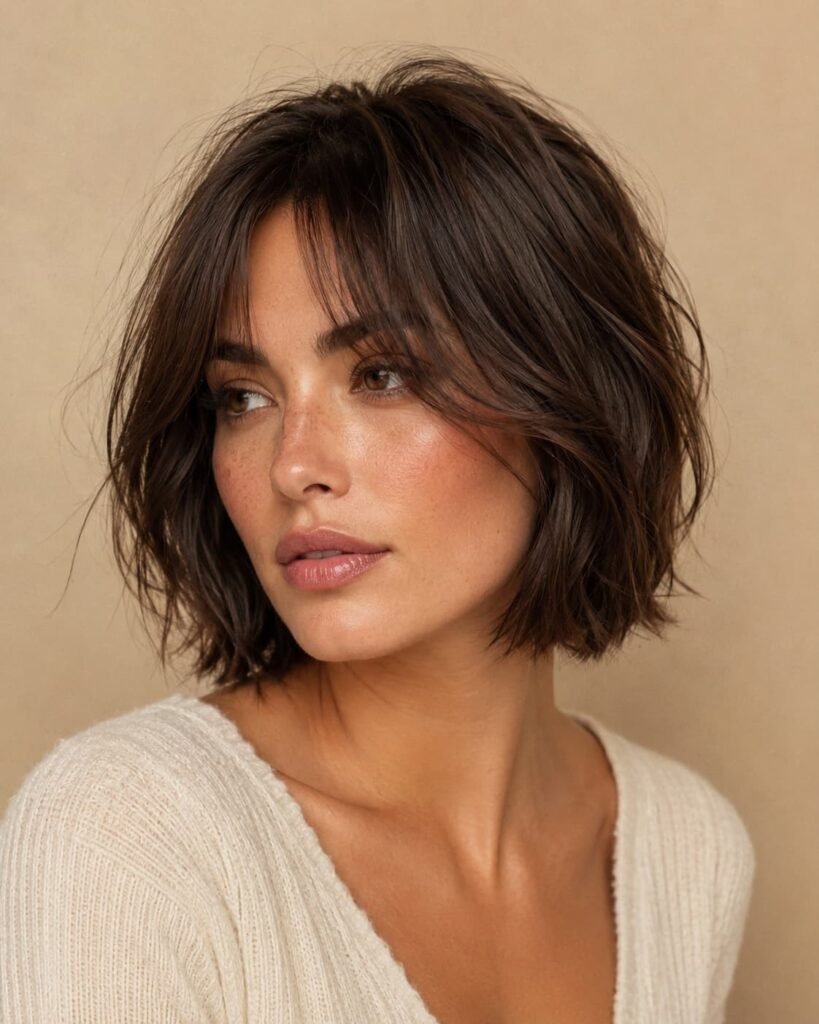
Bangs can change the front shape of a layered shaggy bob while leaving the main length largely unchanged. Different fringe styles can make the front appear softer, more textured, or more asymmetrical.
Curtain Bangs
Curtain bangs usually part near the center and become longer toward the sides.
They can blend into face-framing layers and create a gradual transition into the rest of the haircut. Shorter curtain bangs make the fringe more noticeable, while longer versions can merge more subtly with the side sections.
Wispy Bangs
Wispy bangs use lighter, more separated sections across the forehead.
They can create a softer front shape without forming a dense fringe. The effect may look subtle with longer layers or more textured when paired with stronger separation through the rest of the cut.
Choppy Bangs
Choppy bangs have more visible variation between individual sections.
They can echo the texture of a heavily layered shaggy bob and make the shag-inspired character more noticeable around the front. The final appearance can vary depending on the fringe length, density, and amount of separation.
Side-Swept Bangs
Side-swept bangs are directed toward one side and are often longer than a straight-across fringe.
They can connect with face-framing layers and create an asymmetrical front shape. Longer versions may blend closely into the side sections, while shorter versions create a more distinct fringe.
No Bangs
A layered shaggy bob can also be worn without bangs.
A center part can create a more even front shape, while a side part can shift more visual weight to one side. Longer face-framing pieces can still add movement around the front without forming a separate fringe.
How Length Changes the Silhouette
The overall length can change how compact or elongated a shaggy bob appears and how much space there is for layered sections.
Jaw-Length
A jaw-length shaggy bob creates a short, compact outline.
With less overall length, the layers and textured ends may appear more noticeable. Softer layering can keep the shape relatively controlled, while stronger separation can create a more pronounced shag-inspired effect.
Chin-Length
A chin-length version stays within a classic bob range while allowing room for interior and face-framing layers.
The perimeter can remain clearly visible, while shorter sections add variation through the shape. Depending on the layering and styling, the result may appear smoother, more tousled, or more piecey.
Neck-Length
A neck-length shaggy bob extends below the chin and creates a slightly longer silhouette.
The additional length allows more space between shorter and longer sections. Crown layers, front pieces, and textured ends can still keep the shag-inspired structure visible.
Long Bob or Lob Length
A long bob, often called a lob, extends farther toward the shoulders.
This length allows for longer layers and more gradual transitions between sections. When the layering is soft and blended, the overall shape may appear less compact than a shorter shaggy bob.
The final look can vary with natural hair texture, layer placement, bangs, parting, and styling.
How Hair Texture Can Affect the Appearance
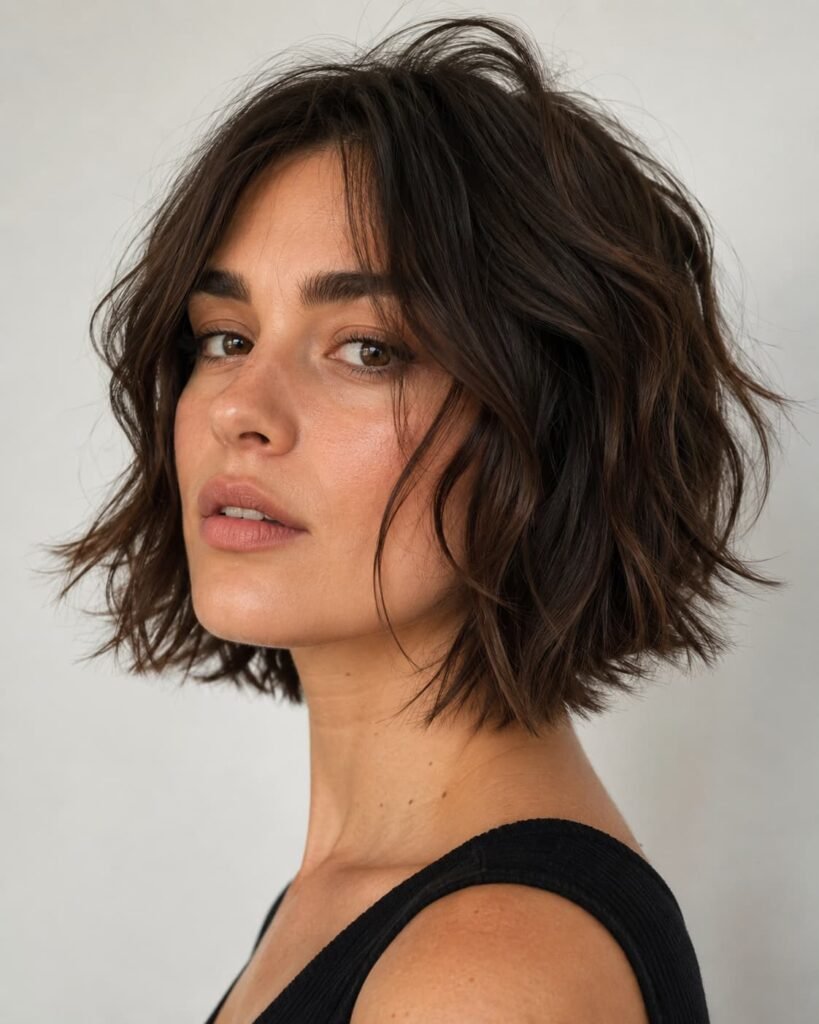
Hair texture can influence how clearly the layers, ends, and overall outline of a shaggy bob are seen. The same general haircut can look quite different on straight, wavy, and curly hair.
Straight Hair
On straight hair, differences between the layers and textured ends may appear more defined.
Longer, blended layers can create a smoother outline, while shorter or choppier sections may show more visible separation. The final look also depends on the overall length and styling.
Wavy Hair
Waves can create natural bends between different sections of the haircut.
This may make the layers appear softer or more tousled and can emphasize movement through the sides and ends. The result can vary depending on the wave pattern, density, layer placement, and length.
Curly Hair
On curly hair, the layered shape can vary with curl pattern, density, shrinkage, and the placement of the layers.
Shorter and longer sections may sit at noticeably different levels once the hair is dry. Because curl patterns differ from person to person, the final silhouette can vary even when the overall haircut concept is similar.
Layered Shaggy Bob vs. Similar Haircuts
Layered bobs, choppy bobs, and shag haircuts can share some visual features. The clearest differences usually involve the perimeter, the amount of layering, and how much separation is visible between sections.
Layered Shaggy Bob vs. Traditional Layered Bob
Both styles use layers, but the finished structure can look different.
A traditional layered bob often keeps a more connected bob outline while using layers to introduce movement within the shape. A layered shaggy bob generally places more emphasis on visible separation, textured ends, and varied lengths through the crown, sides, or front.
When the layers are soft, the distinction can be subtle. With shorter crown layers or more choppy texture, the shag influence becomes easier to see.
Layered Shaggy Bob vs. Choppy Bob
Choppy bob hairstyles and shaggy bobs can overlap because both may include piecey ends and uneven-looking texture.
A choppy bob usually emphasizes visible separation within the bob shape. A shaggy bob often combines that texture with more variation between layers at different levels of the haircut, including the crown and face-framing sections.
Because haircut terminology is not always used consistently, two similarly shaped cuts may be described by different names.
Layered Shaggy Bob vs. Shag Haircut
A shag haircut uses varied layers and textured sections but is not limited to bob length.
A layered shaggy bob keeps the overall length within a bob or longer-bob range while borrowing shag-inspired features such as crown layering, textured ends, and visible separation.
A shag haircut can extend well beyond bob length and may have a more pronounced layered shape through the crown and lengths. The main distinction is that a shaggy bob retains a recognizable bob-length foundation. For another haircut built around noticeable layering and a textured shape, see our wolf cut hairstyle guide.
Styling Considerations
Styling can change how clearly the layers and textured ends of a shaggy bob are seen. The haircut may be worn close to its natural texture or styled for a smoother, wavier, or more separated finish.
Natural Texture
Wearing the hair close to its natural texture can show how the layers fall without heavily reshaping them.
Straight hair may show the differences between lengths more clearly, while waves and curls can create more variation between sections. The final appearance can vary with texture, density, length, and layer placement.
Loose Waves or Bends
Loose waves or gentle bends can make individual sections of the haircut more visible.
The bends may create separation through the lengths and give the layers a softer, more relaxed appearance. If heated styling tools are used to create these bends, a heat-protectant spray such as CHI 44 Iron Guard Thermal Protection Spray can be applied according to its directions before styling.
Smoother Styling
A shaggy bob does not need to be styled with a tousled finish.
Smoother styling can make the main bob outline more noticeable while leaving the layered structure visible. Longer, blended layers may appear more connected, while choppier ends can still show separation.
Piecey or Tousled Finish
A piecey finish separates selected ends or small sections instead of allowing them to blend into one continuous outline.
This can emphasize textured ends and more noticeable layering. A texturizing product such as Not Your Mother’s Beach Babe Texturizing Sea Salt Spray is one option for adding separation and a more tousled finish when used according to the product directions. A subtle finish may use only a few separated pieces, while a more defined approach can make the shag-inspired texture more prominent.
What to Consider Before Choosing a Layered Shaggy Bob
Before choosing a specific version, consider the details that will shape its overall appearance.
Overall length: A jaw- or chin-length bob creates a more compact silhouette, while neck-length and lob versions leave more length for layered sections.
Layer intensity: Longer, blended layers can create a softer transition between sections. Shorter or more heavily separated layers produce a more noticeable textured effect.
Bangs or no bangs: Curtain, wispy, choppy, and side-swept bangs each change the front shape differently. Without bangs, the haircut can rely on the parting and longer face-framing pieces.
Crown layering: Shorter crown layers can make the shag-inspired structure more visible, while longer upper layers may create a smoother transition into the rest of the haircut.
Natural hair texture: Straight, wavy, and curly hair can show the same haircut differently. Density, curl pattern, shrinkage, and layer placement can also influence the final silhouette.
Amount of visible texture: Some people may prefer subtle movement and blended ends, while others may choose stronger separation and a more choppy appearance.
Face-framing length: Shorter front pieces make the layering around the face more noticeable. Longer sections can blend more gradually into the main length.
Preferred finish: The haircut can be worn smooth, softly waved, piecey, or tousled. The styling approach can change how strongly the layers and texture stand out.
FAQs About Layered Shaggy Bobs
What is the difference between a shaggy bob and a layered bob?
Both haircuts use layers, but the overall finish can look different.
A traditional layered bob often keeps a more connected outline, while a shaggy bob usually places more emphasis on visible separation, textured ends, and varied layer lengths. The distinction can be subtle when the layers are soft and more noticeable when the cut includes shorter crown layers or choppier sections.
Can a layered shaggy bob be worn without bangs?
Yes. Bangs are not required.
Without fringe, a center part, side part, or longer face-framing pieces can shape the front of the haircut. The shag-inspired effect can still come from the layers, textured ends, and variation through the crown and sides.
What bangs can be paired with a shaggy bob?
Curtain bangs, wispy bangs, choppy bangs, and side-swept bangs are all possible options.
Curtain bangs can blend gradually into longer front layers, while wispy or choppy fringe can create more visible separation. The final appearance can vary with the length, density, texture, and placement of the bangs.
Can straight hair have a layered shaggy bob?
Yes. The cut can be adapted to straight hair.
On straighter textures, differences between the layer lengths and textured ends may appear more defined. Longer, blended layers can create a smoother result, while shorter or choppier sections can make the texture more noticeable.
How does a shaggy bob look on wavy hair?
Natural waves can create bends and separation between different sections of the haircut.
This may give the layers a softer or more tousled appearance. The final silhouette can vary with the wave pattern, density, overall length, and placement of the layers.
Can curly hair be cut into a shaggy bob?
Yes. A shaggy bob can be adapted to curly hair.
Curl pattern, density, shrinkage, overall length, and layer placement can all influence the finished shape. Because curls can sit differently once dry, the same general haircut may look different from one person to another.
What is the difference between a shaggy bob and a choppy bob?
The two styles can overlap because both may include separated ends and visible texture.
A choppy bob generally emphasizes uneven or piecey sections within the bob shape. A shaggy bob often combines that texture with more variation between layers through the crown, sides, and front.
Haircut terminology is not always used in exactly the same way, so the actual layer placement and silhouette are more useful than the name alone when comparing the two.
Is a layered shaggy bob the same as a shag haircut?
Not exactly.
A layered shaggy bob keeps a recognizable bob or lob-length foundation while using shag-inspired features such as varied layers, textured ends, and visible separation.
A shag haircut is not limited to bob length and can extend farther through the hair. The shaggy bob is therefore better understood as a bob-length interpretation of shag-style layering rather than a completely separate version of the same cut.