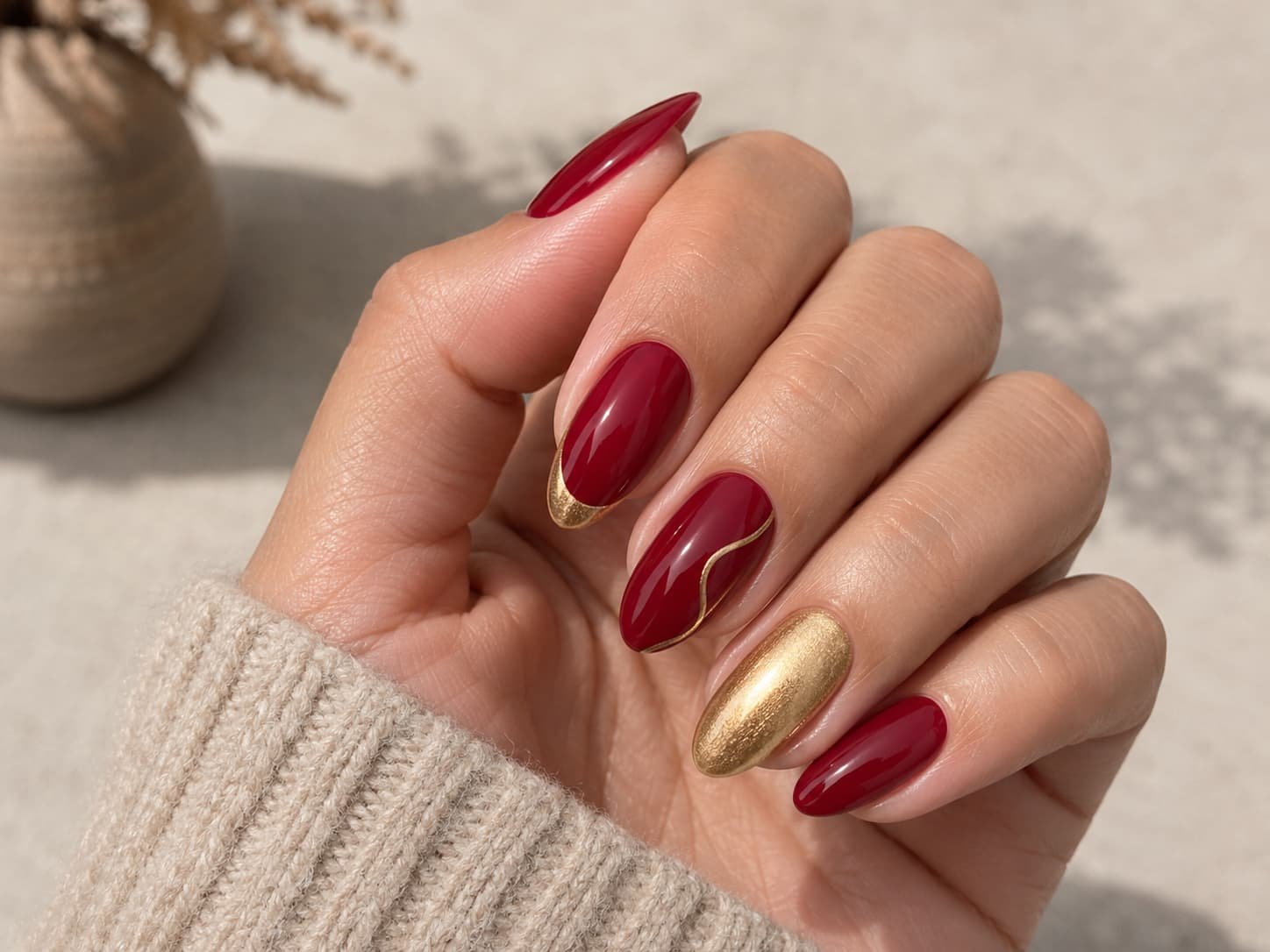
Red and gold nails can range from simple and understated to highly decorative, depending on how the two colours are combined. Red usually provides the main colour, while gold can appear as a thin outline, metallic accent, foil detail, or part of a more artistic design.
The look can also change significantly with the shade of red and the chosen finish. Bright cherry red creates a more vivid appearance, while burgundy and wine tones give the palette a deeper feel. Matte, glossy, metallic, and sheer finishes offer additional ways to change the overall style without moving away from the same red-and-gold colour combination.
What Defines a Red and Gold Nail Design?
A red and gold nail design uses some form of red as the main or supporting colour and introduces gold through polish, metallic detailing, foil-inspired accents, glitter, chrome-style effects, or fine nail art.
The two colours do not need to appear in equal amounts. Some designs use red across nearly the entire manicure and add only a small gold line. Others give gold a much stronger role through full accent nails or larger metallic sections.
The red-and-gold combination can be adapted to different nail shapes and lengths by changing the size and placement of the metallic details. A short nail may use a small metallic detail, while a longer nail can provide more space for swirls, larger French tips, or abstract artwork.
How Red Shade, Gold Placement, and Finish Change the Overall Look
Changing the shade of red can alter the overall colour contrast and visual depth of the manicure. Cherry and classic red create a brighter contrast against gold, while burgundy, wine, and dark red produce a deeper colour combination.
Gold placement also changes which part of the nail receives the most visual emphasis. A thin gold French tip keeps the metallic detail limited to the edge of the nail. Gold near the cuticle creates a different focal point, while foil-inspired pieces or large metallic sections make gold more noticeable.
Finish can further change the appearance. Matte red reduces surface shine and creates stronger textural contrast with reflective gold. Glossy red produces a shinier overall look, while a sheer base can make red-and-gold artwork appear lighter and more open.
The final appearance can vary depending on nail length, shape, the amount of metallic detail, and how many nails include decorative elements.
Red and Gold Nail Ideas to Explore
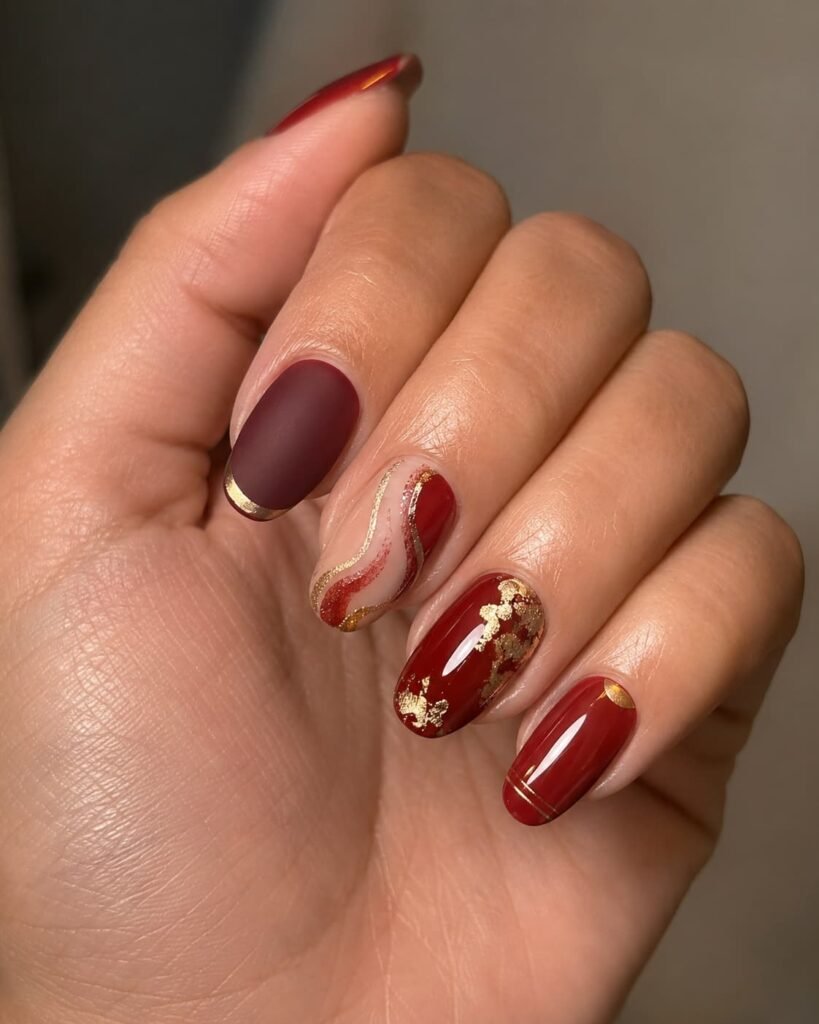
The following ideas use noticeably different combinations of colour placement, finish, and nail art rather than repeating the same design with minor changes.
1. Matte Red Nails With Thin Gold French Tips
Matte red nails with narrow gold French tips create contrast through both colour and finish. Most of the nail remains smooth-looking and non-reflective, while the metallic line at the tip adds a small amount of shine.
The gold edge can be kept very fine for a minimal design or made slightly wider for stronger definition. On almond and oval nails, the metallic line can follow the curved tip. Square or squoval nails can use a straighter gold edge.
Deep red, burgundy, and classic red can all work with this approach. The exact effect will depend on how dark the red is and how reflective the gold finish appears.
This option keeps most of the nail red while limiting the metallic detail to the tip.
2. Glossy Red Nails With a Single Metallic Gold Accent Nail
A glossy red manicure with one metallic gold accent nail keeps the overall design simple while introducing a clear point of contrast.
Most nails can remain one consistent red shade, such as cherry, crimson, or dark red. One product example for a glossy classic-red base is OPI Big Apple Red Nail Lacquer. One nail can then use a more reflective gold finish instead of additional patterns or line work.
The accent nail may be placed on the ring finger, but there is no requirement for a specific placement. It can appear wherever the design feels visually balanced.
Because the design relies mainly on colour and finish rather than detailed artwork, it can be adapted to short, medium, or longer nails. The contrast comes mainly from the difference between glossy red and reflective metallic gold.
For a more restrained version, only one nail can feature gold. Adding several metallic nails would shift the manicure toward a bolder two-colour look.
3. Burgundy Nails With Irregular Gold Foil Accents
Against a burgundy base, reflective gold details create a noticeable contrast in both colour and finish.
Instead of using straight lines or symmetrical French tips, foil-inspired gold pieces can appear in uneven sections across one or more nails. The metallic areas may sit near the tip, along one side, around the cuticle area, or in scattered sections.
The irregular placement gives the design a less structured appearance than geometric nail art.
Gold does not need to cover every nail. One possible option is to keep several nails solid burgundy and add foil-style details only to selected accent nails. Repeating the same burgundy-and-gold palette across the set can create visual consistency even when only selected nails include foil-inspired details.
The effect can also change with finish. A matte burgundy base creates stronger textural contrast with metallic gold, while a glossy base produces a more reflective overall look.
4. Cherry Red French Tips With Fine Gold Outlines
Cherry red French tips can be given extra definition with a narrow gold line placed along the edge of the red section.
A sheer or neutral-looking base leaves more of the nail visually open, which can give greater emphasis to the red tip and gold outline. Rather than using a full gold tip, the metallic detail acts as a border between the red French section and the rest of the nail.
The shape of the outline can follow the nail. Almond and oval nails may use a curved tip, while square nails can create a straighter design.
The gold line can remain very thin for a lighter appearance. A wider outline would make the metallic element more noticeable and change the balance between the two colours.
Unlike a solid red manicure, this variation concentrates most of the colour near the tip while leaving the rest of the nail more visually open.
5. Red and Gold Swirl Nails Over a Sheer Base
Red and gold swirl nails use flowing lines rather than straight edges or solid colour blocks.
A sheer or neutral-looking base can leave visible space between the red and metallic details. Curved red lines may move across the nail alongside finer gold accents, creating an abstract design without requiring every nail to match exactly.
The amount of artwork can be adjusted according to the preferred level of detail. A few narrow curves can create a simpler look, while wider red sections and multiple metallic lines produce a more decorative result.
Swirl placement can vary from nail to nail, while repeating the same red-and-gold palette can visually connect the designs.
For a mixed manicure, some nails can feature swirls while others remain solid red, sheer, or use a small metallic accent. This approach creates variation through placement and finish while keeping the colour palette consistent.
6. Dark Red Nails With Gold Cuticle Accents
Dark red nails can be paired with gold details placed close to the cuticle rather than at the tip. This shifts the visual emphasis toward the base of the nail while leaving most of the surface red.
The gold accent may follow the curve near the base of the nail or appear as a small metallic section in the center. A narrow line keeps the metallic detail limited, while a wider curved section makes the gold more noticeable.
Deep crimson, wine, and burgundy tones can all be used with this placement. The final appearance can vary with the red shade, nail shape, and amount of metallic detail.
7. Red Nails With Geometric Gold Lines
Geometric gold lines can add a more structured element to a solid red manicure. Straight, diagonal, or intersecting metallic lines can divide the nail into distinct sections without requiring large areas of gold.
A single diagonal stripe creates a simpler layout, while several lines or small geometric shapes add more visual detail.
Straight-line designs can be adapted to square, squoval, almond, or oval nails by adjusting the angle and placement of the metallic details. Some nails can also remain solid red to keep the overall design less detailed.
8. Red and Gold Negative-Space Nails
Negative-space designs leave part of the nail visually open or use a sheer or neutral-looking base around the coloured details.
One nail might feature a red curve with a fine gold border, while another can use a diagonal red section separated from the rest of the nail by a metallic line.
Leaving visible space between the decorative elements creates a different visual balance from a fully covered red manicure.
For a simpler variation, negative space can be limited to one or two accent nails while the remaining nails stay solid red.
9. Red Nails With Gold Glitter Gradient Details
Gold glitter-style details can be concentrated in one area of the nail and become more scattered across the remaining surface.
The gold may appear more densely near the tip and gradually reduce toward the center. The placement can also be reversed, with more glitter near the base and fewer reflective details toward the tip.
Deep red creates a darker background for reflective gold, while brighter red shades produce a lighter and more vivid colour contrast.
The gradient-style detail can appear across the full manicure or only on selected accent nails. Solid red nails can be included between the glitter designs for additional variation.
10. Red Nails With Full Gold Chrome Accent Nails
A full gold chrome-style accent nail places more metallic detail into the manicure than a thin line, small foil section, or narrow French tip.
Most nails can remain solid red while one or more nails use a highly reflective gold finish. This creates contrast through both colour and surface reflection.
Using one gold accent nail keeps red as the dominant colour. Adding several metallic nails gives gold a larger role in the overall design.
Because this idea relies mainly on colour and finish rather than small artwork, it can be adapted to different nail lengths and shapes.
11. Red and Gold Half-Moon Nails
Half-moon designs place a curved section of contrasting colour near the base of the nail.
For a red-and-gold version, most of the nail can remain red while a small metallic gold section follows the curve near the cuticle area. The placement can also be reversed, with gold covering more of the nail and red appearing near the base.
A narrow half-moon keeps the gold detail small, while a wider curved section gives the metallic colour more visual emphasis.
The curved shape can follow the rounded outline of almond or oval nails, while the same idea can be adapted to square and squoval shapes with a different curve or proportion.
12. Red Nails With Diagonal Gold Colour Blocking
Diagonal colour blocking uses larger sections of colour rather than thin decorative lines.
A red nail can include a defined diagonal gold section, creating a clear division between the two colours. A sheer or neutral-looking area can also be placed between them to create a three-part design.
The metallic section may cover one corner of the nail or extend across a larger area.
Changing the size and angle of the gold section can make the design appear more minimal or more graphic without adding additional patterns.
13. Red and Gold Abstract Mixed Nails
An abstract mixed manicure can combine several red-and-gold elements within the same set.
One nail may remain solid red, another may feature a curved metallic section, and another can combine a fine gold line with visible negative space.
The individual nails do not need to use identical patterns. Repeating the same red shade and a similar gold finish can help visually connect the different designs.
Using a limited number of patterns can also keep the set from appearing overly crowded.
14. Wine Red Nails With Minimal Gold Stripes
Wine red provides a deep background for narrow metallic details.
A vertical, horizontal, or diagonal gold stripe can divide the solid colour without covering a large part of the nail. The stripe may appear across the full set or only on selected accent nails.
Very fine lines keep the gold detail limited, while wider metallic bands make it more prominent.
The design can be paired with either matte or glossy wine red, depending on the preferred finish.
15. Red and Gold Ombré-Inspired Nails
A red-and-gold ombré-inspired design uses a gradual-looking transition rather than a sharply defined division between the two colours.
When the gold element has a metallic or glitter-style finish, the transition can be created by gradually increasing or decreasing the amount of reflective detail across the nail. For a softer version focused on neutral color blending rather than metallic gold, see these natural ombre nails.
Gold may become more concentrated toward the tip while red remains more visible near the base, or the placement can be reversed.
The effect can appear across the full manicure or only on selected accent nails within a mostly red set.
16. Red Nails With Gold Micro French Tips
Micro French tips use a very narrow line along the outer edge of the nail.
With a red base, a thin gold line can add metallic detail while leaving most of the visible nail surface red. The design uses less gold than a wider metallic French tip.
On almond and oval nails, the line can follow a curved edge. Square and squoval nails can use a straighter version.
The width and placement of the tip can be adjusted according to nail length and the amount of gold desired.
17. Red and Gold Marble-Inspired Accent Nails
Marble-inspired accent nails use irregular lines, curved sections, or veining rather than repeated geometric patterns.
A neutral or pale base can feature flowing red areas with fine gold details placed between or alongside them. The remaining nails may stay solid red or use simpler metallic accents.
Keeping the marble-inspired pattern to selected nails is one way to combine detailed artwork with simpler elements across the same manicure.
The final appearance can vary depending on the width of the red sections, the placement of the veining, and the amount of gold included.
18. Alternating Solid Red and Metallic Gold Nails
Alternating red and gold nails use both colours without requiring additional line work, patterns, or detailed artwork.
Some nails can remain solid red while others use metallic gold. The colours may alternate evenly or appear in a less regular sequence.
Glossy red creates reflection across both colours, while matte red introduces a clearer difference in finish next to metallic gold.
This approach keeps the main focus on colour placement and finish, making it visually different from foil, French-tip, swirl, and geometric designs.
Choosing a Red Shade for Gold Accents
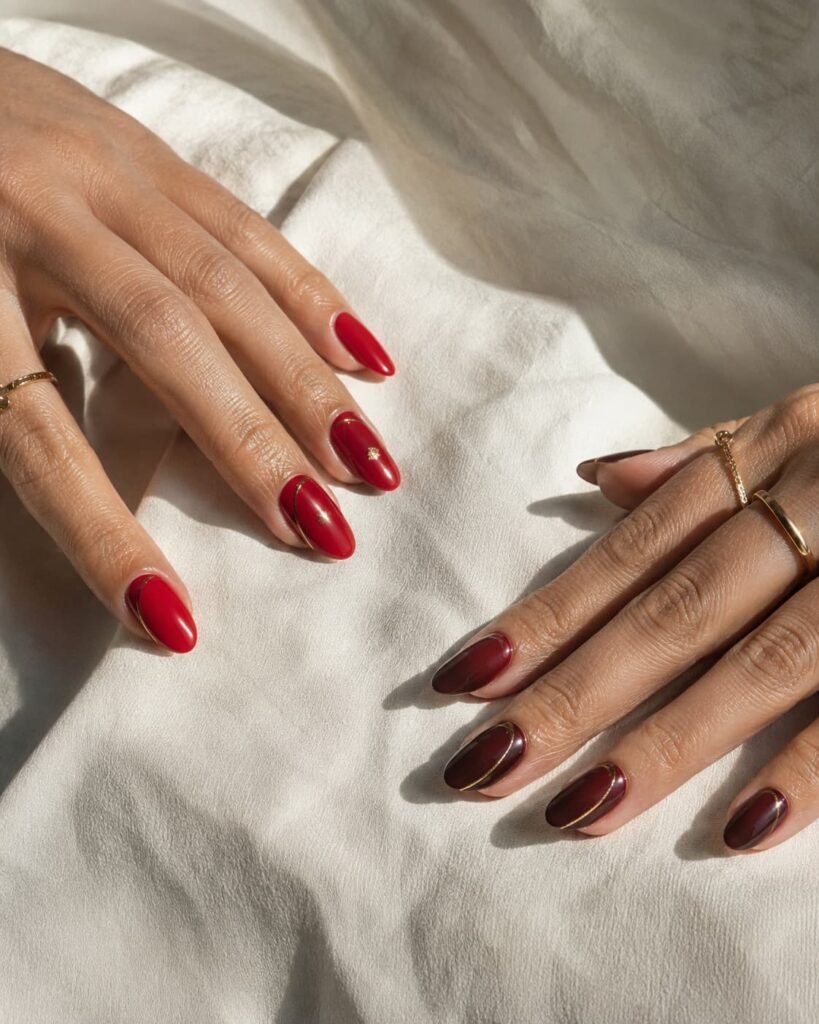
The shade of red changes the overall colour balance of the manicure. Brighter reds create a more vivid contrast with gold, while burgundy, wine, and other deeper reds create a darker palette.
The choice can depend on how much gold is included, whether the finish is matte or glossy, and how detailed the design is.
Cherry and Classic Red for a Brighter Look
Cherry and classic red create a brighter colour contrast when paired with metallic gold.
These shades can be combined with fine gold outlines, French tips, cuticle accents, or a single metallic accent nail. Readers looking for a more illustrative red manicure can also explore red fruit nail art with cherry, strawberry, and accent-detail ideas. A small amount of gold can remain visible without covering a large part of the red design.
Glossy red reflects more light from the surface, while matte red creates a clearer visual difference next to reflective metallic details.
For a more open-looking design, cherry red can also be limited to the French tip over a sheer or neutral-looking base.
Burgundy, Wine, and Dark Red for a Deeper Look
Burgundy, wine, and dark red provide a deeper-coloured background for gold details.
These shades can be paired with narrow metallic lines, foil-inspired accents, half-moon designs, or full gold accent nails. The difference between dark red and reflective gold creates contrast in both colour and finish.
Matte dark red can be paired with metallic details for a stronger difference in surface appearance, while glossy burgundy creates a more reflective overall finish.
Smaller gold details leave red as the dominant colour, while larger metallic sections give gold a more noticeable role in the design.
Choosing the Gold Finish
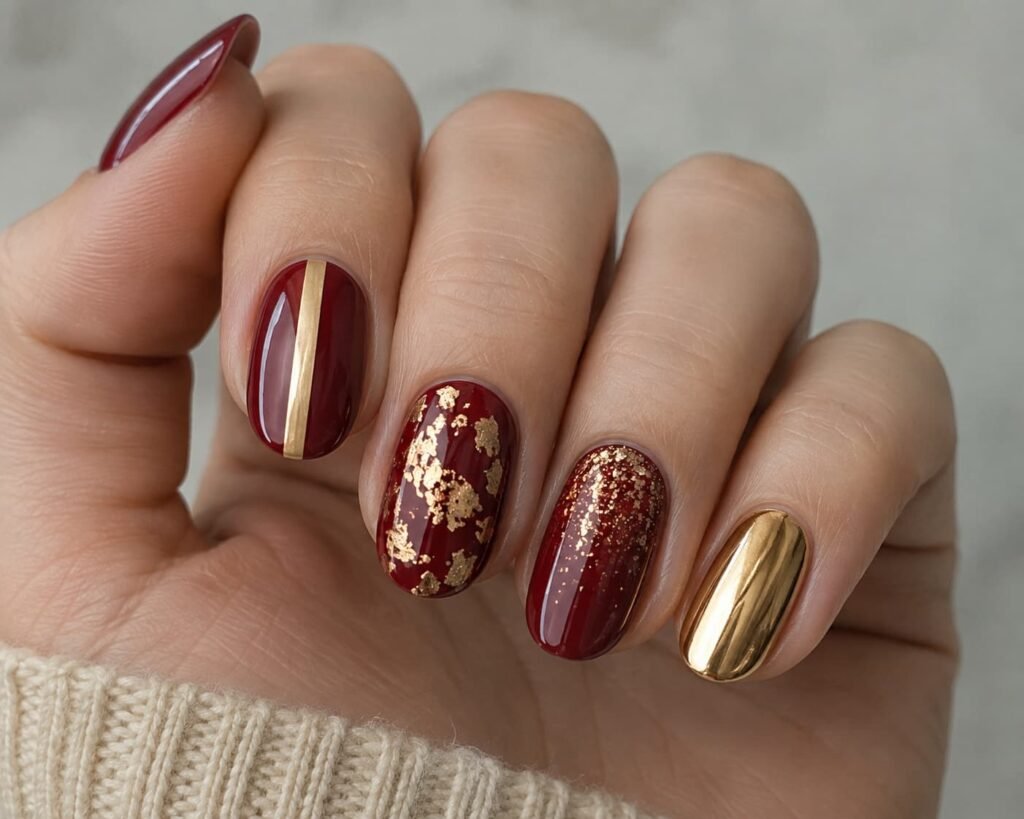
Gold can appear in several visual forms, including metallic polish, foil-inspired details, glitter, and chrome-style finishes.
Each creates a different type of surface effect. Defined metallic finishes can be used for lines and tips, while foil and glitter create more irregular or scattered details.
Metallic Gold for Defined Lines and Tips
Metallic gold can be used when the design calls for clear edges or controlled placement. One product example is Essie Good As Gold Nail Polish, a metallic gold shade that can be used according to its application directions.
Possible uses include French tips, micro French lines, geometric stripes, cuticle accents, and narrow outlines around red sections.
A solid metallic line creates a more defined separation between the two colours than scattered glitter or irregular foil-inspired details.
Thin lines keep the gold detail limited, while wider metallic sections make it more noticeable.
Gold Foil for Irregular Decorative Details
Gold foil-inspired accents create uneven metallic shapes rather than straight lines or symmetrical sections.
The gold can appear near the tip, along one side, close to the base, or scattered across the nail. For another color palette using the same type of metallic detail, explore these brown and cream nails with gold foil accents.
This placement can be combined with burgundy, classic red, dark red, or a sheer base. The irregular shapes become part of the artwork rather than forming a simple border.
For a less detailed variation, foil-inspired accents can be limited to selected nails while the remaining nails stay solid red.
Gold Glitter for a Textured Reflective Effect
Gold glitter creates scattered reflective details rather than one continuous metallic area.
It can be concentrated near the tip or base, used in a gradient-style design, or placed on selected accent nails.
The amount of glitter changes how much red remains visible. Lighter placement keeps more of the red surface exposed, while denser coverage gives gold a larger role.
Gold glitter accent nails can also be paired with solid red nails to create variation in finish without adding another pattern.
Gold Chrome for a Mirror-Like Metallic Look
Gold chrome-style finishes create a smooth-looking and highly reflective metallic appearance.
One gold chrome accent nail can leave red as the dominant colour, while several metallic nails give gold a larger role across the manicure.
Chrome-style gold can also be limited to French tips or selected sections instead of covering the full nail.
Using the finish across a larger area makes the reflective gold more visually noticeable.
Red and Gold Ideas for Different Nail Lengths
Nail length affects how much visible surface is available for lines, patterns, negative space, and larger colour sections.
Many red-and-gold designs can be adapted to different lengths by changing the size and placement of the decorative details.
Short Nails: Smaller Accents and Simple Placement
Short nails can use smaller areas of metallic detail while leaving much of the red surface visible.
Micro French tips, fine gold lines, small cuticle accents, and a single metallic accent nail are possible options.
Negative-space designs can also be adapted by using fewer or smaller decorative sections.
When several patterns are placed within a smaller area, the design can appear more detailed. Some people may prefer simpler placement for a less crowded look.
Medium-Length Nails: More Space for Mixed Details
Medium-length nails provide additional visible space for combining different design elements.
Swirls, foil-inspired accents, geometric sections, French tips, and negative-space details can all be adapted to this length.
Another option is to keep most nails solid red and use one or two nails for more detailed artwork.
The extra surface area does not require a highly decorative design. Fine lines and small metallic accents can still keep the manicure visually simple.
Longer Nails: More Space for Larger Patterns
Longer nails provide more visible space for larger colour sections, curved artwork, and wider areas of negative space.
Diagonal colour blocking, marble-inspired accents, extended French tips, and abstract red-and-gold designs can be arranged with more space between individual elements.
Larger metallic sections are another option when gold is intended to play a more noticeable role.
Long nails can also use minimal details, such as a narrow gold line, micro French tip, or small cuticle accent. The final appearance can vary with placement, finish, and the amount of detail used.
Red and Gold Designs by Nail Shape
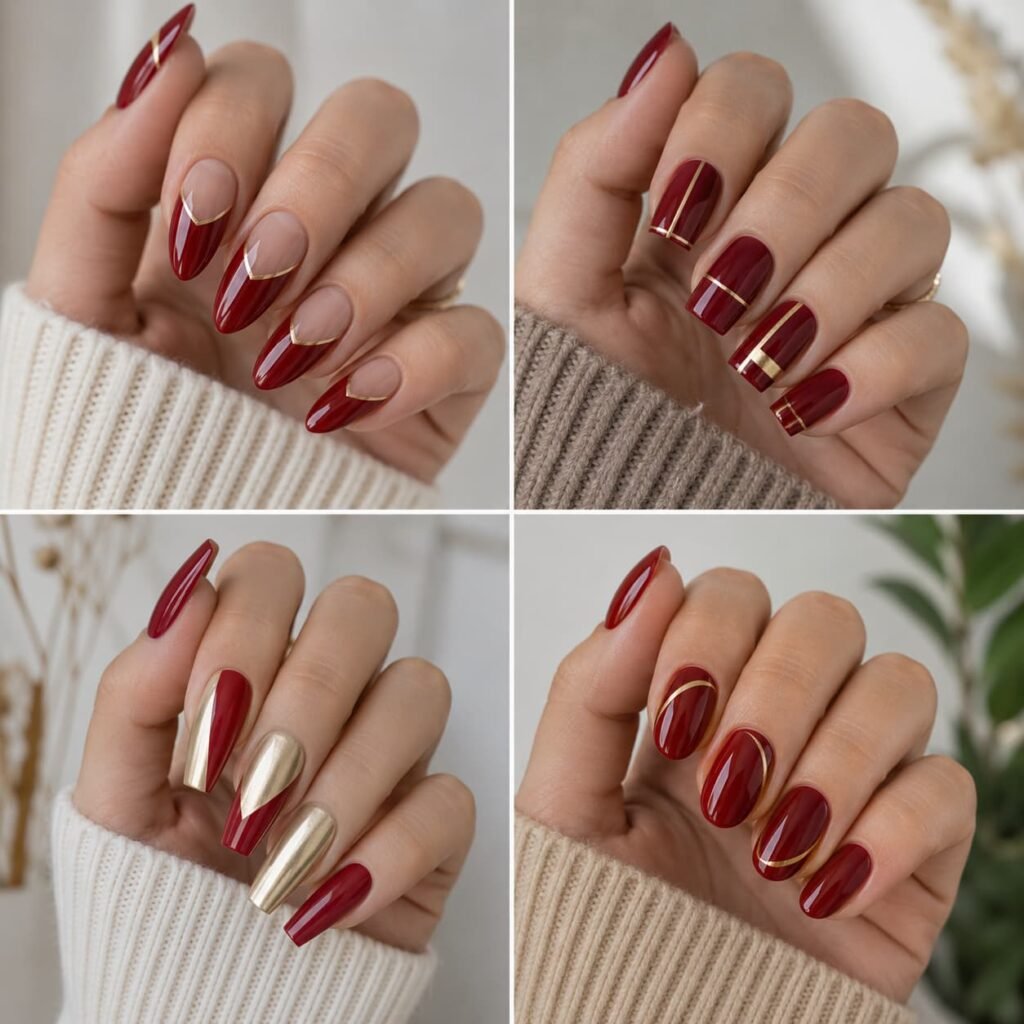
Nail shape changes the outline of the manicure, which can influence how French tips, lines, curves, and larger metallic sections are arranged.
Many red-and-gold designs can be adapted to different shapes by changing the direction, width, or placement of the details.
Almond Nails
Almond nails have tapered sides and a rounded tip, creating a curved outline for the design.
Red French tips with fine gold edging, flowing swirls, narrow metallic lines, and small cuticle accents are possible options.
Longer almond nails provide more visible space for abstract sections or negative space, while shorter almond nails may work better with smaller or fewer decorative details.
Square and Squoval Nails
Square nails have a flatter tip, while squoval nails combine a straighter edge with softer corners.
Straight French tips, geometric gold lines, diagonal colour blocking, and structured metallic sections can be adapted to these shapes.
A narrow gold line across the tip can follow the straight edge, while angled metallic details create a more graphic appearance.
Coffin Nails
Coffin nails have tapered sides and a flatter tip, and longer versions provide more visible surface for larger design elements.
Red-and-gold colour blocking, chrome sections, marble-inspired accents, negative space, and wider French tips are possible options.
More surface area can also provide additional room between separate elements in a detailed design.
Oval Nails
Oval nails have a rounded outline that can be paired with curved design elements.
Half-moon accents, curved French tips, fine gold outlines, and flowing swirl patterns can follow the shape of the nail.
For a simpler variation, most of the nail can remain solid red with one small curved metallic detail.
Minimal vs More Detailed Red and Gold Nails
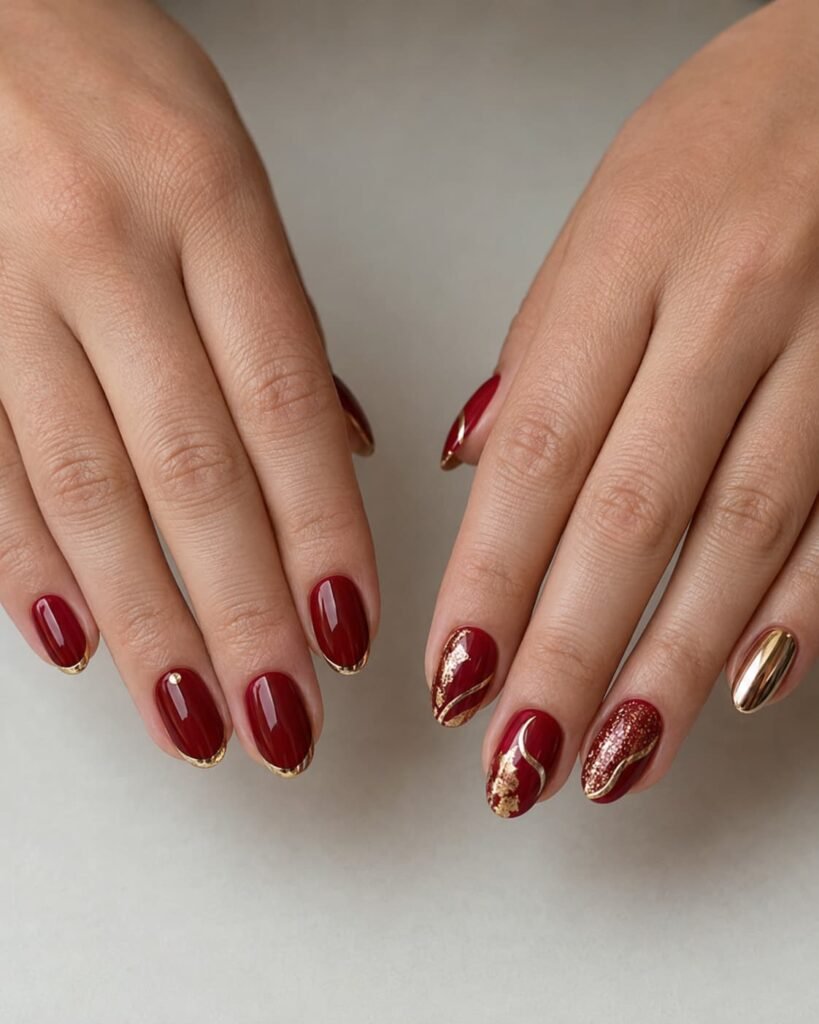
The amount of decoration changes how much visual detail appears across the manicure.
Some designs use gold only as a small accent, while others combine several patterns, finishes, or metallic sections.
Minimal Red and Gold Designs
Minimal designs use fewer or smaller decorative elements.
Thin gold French tips, one metallic accent nail, small cuticle details, or a single narrow stripe can add contrast while leaving most of the red surface visible.
Another option is a sheer or neutral-looking base with one red section and a fine gold outline.
Repeating one type of metallic detail across several nails can keep the design visually consistent without introducing several different patterns.
More Detailed Red and Gold Designs
More detailed manicures can combine elements such as foil-inspired accents, swirls, glitter gradients, chrome sections, marble-inspired patterns, and geometric lines.
Each nail does not need to use the same pattern. One may feature foil-inspired detail, another may use a swirl, while another can remain solid red.
Repeating the same red shade and a similar gold finish can visually connect the different designs.
Limiting the number of patterns is one option for keeping a mixed manicure from appearing overly crowded.
How to Choose a Red and Gold Nail Look
Choosing a red-and-gold design starts with deciding how much of each colour you want to include and how detailed you want the manicure to appear.
The same palette can look minimal, graphic, reflective, or more decorative depending on the placement, finish, and amount of gold used.
Decide Which Colour Should Dominate
If red is the main colour, gold can be limited to smaller details such as French tips, fine lines, cuticle accents, or one metallic accent nail.
If you want gold to have a stronger presence, wider metallic sections, chrome-style accents, glitter details, or several gold nails are possible options.
The shade of red also changes the colour balance. Cherry or classic red creates a brighter contrast with gold, while burgundy and wine tones create a deeper combination.
Choose Between Matte, Glossy, Glitter, and Metallic Finishes
Different finishes change the amount and type of visible reflection across the manicure.
Matte red has a less reflective appearance, while glossy red has more surface shine. Metallic gold creates a more continuous reflective effect, glitter produces scattered points of reflection, and chrome-style finishes create a smoother, highly reflective appearance.
These finishes can be mixed within the same set or kept consistent. The choice depends on whether you prefer a more restrained look or stronger reflective details.
Match the Amount of Detail to Nail Length and Personal Preference
Nail length affects how much visible surface is available for decorative elements.
Short nails can use fine lines, micro French tips, small cuticle accents, or limited negative space. Medium and longer nails provide more room for swirls, geometric sections, wider tips, and larger metallic areas.
More surface area does not require more decoration. Longer nails can still use very simple details, while shorter nails can include several elements if the placement remains visually clear.
Keep Mixed Designs Connected Through a Consistent Colour Palette
A mixed manicure can include several patterns without making every nail identical.
One nail may use a French tip, another may feature foil-inspired detail, and another may remain solid red. Repeating the same red shade and a similar gold finish can visually connect the different designs.
Limiting the number of unrelated patterns is another way to keep the overall set from appearing overly crowded.
Frequently Asked Questions About Red and Gold Nails
Can red and gold nails look simple rather than heavily decorated?
Yes. The amount of gold can be kept small for a more minimal appearance.
Thin gold French tips, one metallic accent nail, a narrow stripe, or a small cuticle detail are possible options that leave most of the red surface visible.
Do red and gold designs work on short nails?
Yes. Many red-and-gold designs can be adapted to shorter nails by reducing the size or number of decorative elements.
Micro French tips, fine metallic lines, small glitter accents, and a single gold accent nail are possible options.
What shades of red can be paired with gold?
Cherry red, classic red, crimson, burgundy, wine, and other deep red shades can all be used with gold accents.
Brighter reds create a more vivid colour contrast, while deeper reds create a darker-looking palette.
What is the visual difference between gold foil, glitter, and chrome?
Foil-inspired details usually appear as irregular metallic patches or fragments rather than one continuous section.
Gold glitter creates many smaller reflective points that can be scattered or concentrated in one area.
Gold chrome-style finishes create a smoother and more continuous reflective appearance.
Each option produces a different type of metallic detail within the manicure.
Can matte red and metallic gold be used together?
Yes. Matte red and metallic gold can be combined within the same manicure.
The less reflective red surface creates a visible finish difference next to metallic gold. The gold can be limited to tips, lines, accent nails, or other selected sections.
Which nail shapes can work with red and gold French tips?
Red-and-gold French tips can be adapted to almond, oval, square, squoval, and coffin shapes.
Curved tip placement can follow almond and oval outlines, while straighter placement can be used on square and squoval nails. Coffin nails can use narrow or wider tip sections depending on the preferred design.
Do red and gold nails have to look festive?
No. Red and gold can be styled in ways that are not tied to a particular season or occasion.
Thin metallic lines, micro French tips, small cuticle accents, or one gold accent nail can create a simpler look. Glitter, chrome, foil-inspired details, and mixed artwork can create a more decorative version.